by James Clive-Matthews | 14 May, 2020 | Marginalia
As an ex-journo I’ve always put more emphasis on substance than style in marketing, but that’s not to deny style’s essential role in making the substance shine. The very best content (and advertising) has always had a perfect balance between both. The best copy in the world won’t do anything for you if it doesn’t stand out and get noticed by the right audiences.
Now, however: “Chrome is setting the thresholds to 4MB of network data or 15 seconds of CPU usage in any 30 second span”.
I get the thinking behind this – both for consumers (to save their data/battery) and for Google (to re-emphasise the importance and value of data-light search marketing) – but it feels a decade late. Modern phones, and most data packages, surely won’t even blink at a meagre 4 megs – and 5G will make it a nothing.
A good digital ad is a rare thing (most are, let’s face it, either annoying or ignored), but many of the best are creative, interactive experiences that maximise the potential of the medium. This means they need more bandwidth to make better user experiences.
So while I may focus on organic distribution and the message before the medium, I do worry this restriction of ad options will create a blander, less creative digital future. At least give users the choice to turn this on or off.
by James Clive-Matthews | 7 May, 2020 | Systems & Technology
“I haven’t witnessed an update as widespread as this one since 2003,” says the author of this piece. Some sites are reporting 90% traffic drops, with even the likes of Spotify and LinkedIn apparently impacted. This is big.
What exactly has changed is still unclear – a few days on results are still fluctuating too much for detailed analysis – but one thing does seem certain: “there are multiple reports of thin content losing positions”.
This has been the trend with Google for a while now, with the firm recommending “focusing on ensuring you’re offering the best content you can. That’s what our algorithms seek to reward.”
What *is* good content in this context? After all, “quality” is quite a subjective concept.
Well, algorithms aren’t people, but Google’s long been aiming to make their code more intelligent, and better able to understand context and likely relevance. Keyword stuffing has been penalised for years, as have dodgy link-building efforts. Instead, Google is aiming for near-human levels of appreciation of nuance.
Helpfully, though, Google has also put out a list of questions to help you understand if the content of your site is likely to be seen as quality in the eyes of the all-powerful algorithm:
- Does the content provide original information, reporting, research or analysis?
- Does the content provide a substantial, complete or comprehensive description of the topic?
- Does the content provide insightful analysis or interesting information that is beyond obvious?
- If the content draws on other sources, does it avoid simply copying or rewriting those sources and instead provide substantial additional value and originality?
- Does the headline and/or page title provide a descriptive, helpful summary of the content?
- Does the headline and/or page title avoid being exaggerating or shocking in nature?
All good questions, and all from Google’s own blog.
by James Clive-Matthews | 26 Apr, 2020 | Narratives & Meanings
 2/5 stars
Very readably written (hence the extra star and bothering to finish it), but for a 700-page character study it’s impressive just how shallow all the characters are.
Every single one – from the principles to the supporting cast – has one defining characteristic, and one only. There’s so little complexity or depth they may as well all be described as deeply as the two characters known throughout only as “black Henry Young” and “Asian Henry Young”.
There’s Withdrawn Trauma, our hero – the life of the title – defined purely by his childhood abuse, and still acting like a child decades later. Selfish, closed-minded, suspicious. Worthy of pity, certainly – but it’s hard to see why so many other characters deem him worthy of so much loyalty for so long, in the face of so much predictable nonsense. Normally after spending 700 pages with a character you empathise with them. Not this guy, despite having winced through scene upon scene of abuse and suffering.
There’s the three friends, Compassion (who, at least, briefly shows signs of developing some complexity where Compassion briefly turns to Conflicted), Obvious Unrequited Secret Admirer, and Architect (supposedly one of the core group of four friends at the heart of the story, but with no personality beyond his career).
There’s also Ineffective Father-figure, always wanting to help but never quite knowing how. There’s Doctor, who inexplicably keeps staying on call 24/7 – unpaid too, in America! – for one of the most difficult, selfish patients anyone could ever hope not to encounter. And then there’s Violent Rapist, Manipulative Rapist, Psycho Rapist, and a succession of other anonymous rapists undeserving of description.
And it’s still astonishing, 700 pages later, that a woman was able to write such a long novel without a single substantive female character.
Plus, it’s incredibly predictable. In the final quarter I found myself actively laughing as it unfolded, because everything was so obvious. No surprises at all.
But worst of all, this is a novel that exists to smother the concept of hope for change and redemption. To confirm the worst suspicions of the traumatised and suicidal. To encourage the suicidal to go through with it. It’s repeated message is that things don’t get better – at least, not for long. It’s Keynes’ “In the long run we’re all dead” in brutal, unforgiving, waffling novel form.
It contains nothing positive, says nothing new or substantive, is packed with stereotypes, and, considering the subject matter, is deeply irresponsible.
Tempted to take that second star off now, TBH.
by James Clive-Matthews | 25 Apr, 2020 | Marginalia
Finally, some good news!
Word is going to start showing double spaces after a full-stop/period as a mistake, preventing the daily howls of frustration from copy-editors worldwide who are continually having to find/replace the damned things.
(And yes, I know lots of people were taught to type with a double space after a full-stop. I was too – because I learned on a typewriter, which is where this came from: to improve the kerning and create more readable text. Computers / word processors are rather more sophisticated than typewriters – they sort the spacing out for you. This means using a double space on a computer actually *increases* layout issues – especially when justifying text – so achieves the precise opposite of what people who do this think it does.)
I’m fairly flexible as an editor most of the time, but along with *always* advocating the Oxford Comma, killing post-period double spaces is one of the few editing hills I’m prepared to die on.
by James Clive-Matthews | 10 Apr, 2020 | Narratives & Meanings
 4/5 stars
An odd book, but very readable. Mini biographies of various leading economists of the last couple of hundred years are a mostly useful way to build the central argument: Economic ideas are a product of their time, and of their creators’ circumstances. It’s a fair argument, and one likely borne out by the fact I’m leaving this much more sympathetic to the ideas of Amartya Sen than any other person featured. He’s the only economist covered who’s still alive…
But this book is odd mostly due to its choices for who to include – and who to omit.
It starts by scene-setting with Dickens, then progresses straight to Marx and Engels, rather than going slightly further back to include Smith, Malthus, Ricardo and other earlier economists.
It’s heavily focused on British/American/Austrian thinkers to the exclusion of pretty much any others – and doesn’t include any non-Western economists other than Sen. Hell, it doesn’t even include any French economists.
The main contention other than everything progresses (it’s largely teleological in approach) is that everyone’s a Keynesian – even people you don’t think are Keynesian. Keynes hangs over the entire book, from long before he appears.
There’s a good case for this – I mean, Keynes is Keynes – but considering the general argument is that economics has been getting increasingly sophisticated, it seems odd that it largely (and rapidly) tails off in its interest in the aftermath of WWII (and, perhaps not coincidentally, Keynes’ death).
The most surprising omission, considering there’s a strong undercurrent of concern with human welfare throughout, is any reference to behavioural economics – surely one of the most fundamental shifts in approach to the discipline in the last 50-60 years.
Nor is there any coverage of the birth of game theory – arguably one of the most influential (and abused) concepts of the same period. This last is particularly surprising given the frequent use of the term “zero sum game” in latter chapters – and by the fact that the author’s previous best-known book was a biography of John Nash.
So yes, an odd book as much for its omissions as its inclusions. But engaging, readable, and (mostly) relatable. In that, it does what it set out to do – help you to understand not just *what* ideas economists had, but *why* they had them.
by James Clive-Matthews | 5 Apr, 2020 | Marginalia
Behind the Economist paywall, sadly, but this is the key point – always worth remembering beyond the current crisis, and something a number of political leaders need to learn:
“Recommendations that sound more advisory than mandatory seem to presume rational adults will do the right thing with accurate information. The central insight of behavioural economics is that they do not…”
Clarity of messaging is more vital now than ever – it’s become a literal matter of life and death. “Practice social distancing” is vague, confusing, advisory. “Stay home” is clear, unambiguous, mandatory. Guess which has worked better?
This is also a lesson we should take with us after this crisis has passed: If you want to be understood, make your point as clearly and plainly as possible. Otherwise you have no one to blame but yourself when people don’t pay attention to what you’re telling them – or, worse, start believing simpler-sounding misinformation.
by James Clive-Matthews | 3 Apr, 2020 | Marginalia
Despite loving the near limitless possibilities of digital publishing, my first love is books. I’ve written two, reviewed them, and even worked at a book publisher for a while. Part bibliophile, part tsundoku, I buy books almost obsessively – and usually have dozens on the go at any one time. My flat could easily be mistaken for a secondhand bookshop.
So it’s probably unsurprising that I’m a big fan of the idea of collecting previously ephemeral digital content into book form to extend its (literal) shelf life. Great to see the New York Times agrees:
“Reporters leave a ton in their notebooks… The book form really gives us a chance to expand the journalism and include a lot more of the detail and texture that is never going to make it into the daily report.”
More brands – especially B2B ones – should consider following the NYT’s lead and mine their content archives to curate thematic ebooks (and even physical ones) of their best pieces.
Repackaging ideas in book form offers opportunities to expand and elaborate on points in more depth in the perfect lean-back format. Because there’s nothing better than a book for encouraging deep engagement with and deliberation over someone else’s thinking. If you’re selling ideas, the book is the perfect format.
by James Clive-Matthews | 27 Mar, 2020 | Marginalia
Cut to the chase about halfway down, and the potential benefits of remote working on company culture and productivity here are pretty accurate, based on my experience of working in a globally distributed team at Microsoft and as a freelancer back in the day.
These benefits don’t just happen by magic, though – it takes concerted effort to transition to and encourage new ways of working, and some people will find this shift harder than others. They’ll need support, and we’ll all have a responsibility to help our colleagues make the switch if this is going to work.
They say it takes 60 days to form new habits… Will the lockdowns so many of us are experiencing last long enough for these new ways of working to bed in to our working culture? And when we do finally return to work properly, will we be able to bring their benefits back with us?
by James Clive-Matthews | 12 Mar, 2020 | Marginalia
Surprising wisdom from Chris Rock, which seems particularly pertinent as we reluctantly go into social distancing / self-isolation mode:
“Naive people will tell you, ‘There’s always tomorrow and you’ll always get another chance.’ The smart people will tell you, ‘You probably get three chances at anything in life, and you’ll probably be busy for the first two chances. When you get that third one you better be f—ing ready.'”
There’s going to be a bunch of missed chances over the next few weeks. But we’ll also all have plenty of time to prepare for future ones: Time to read that book, take that online course, learn that skill, do those push-ups, and generally get ready for that next chance once life returns to normal.
(More clichéd LinkedIn style than my usual posts, this – but years of life as a freelancer taught me the importance of maintaining a positive mindset and future-focus when working from home. Get a constructive hobby, and make the most of the extra time saved by not commuting to pick up new knowledge and skills. It’s a major benefit, used well.)
by James Clive-Matthews | 11 Mar, 2020 | Marginalia
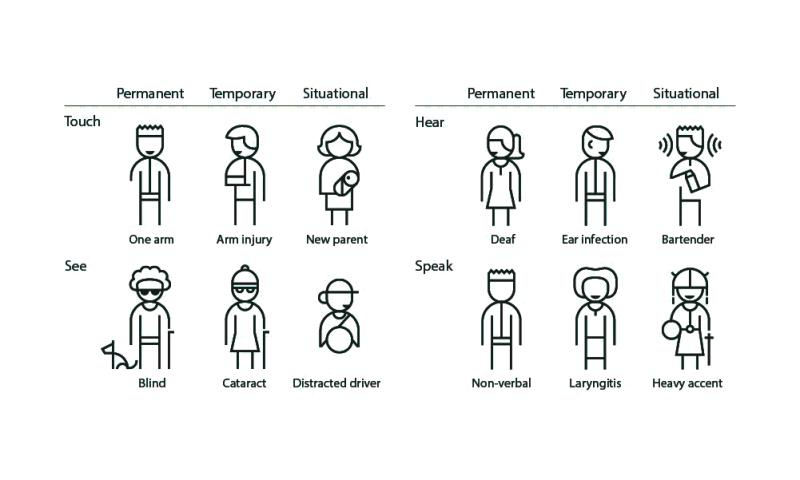 I’m not a fan of user personas. They’re meant to remind us of alternative perspectives, but tend to become either so specific as to make us blinkered, or so single-minded as to be unrealistic.
This piece does a good job of summarising how this fallacy of assuming we can identify user archetypes came about, how it misses so much vital nuance and complexity, and why we need to shake it off if we’re ever going to meet the needs of real users via a more effective, inclusive design approach to developing a better customer experience.
