This brought back fond memories of the Bullshit Bingo tracker we used to keep to try and steer clients (and ourselves) away from jargon when working on B2B projects back in my Group SJR days…
Simple, jargon-free language is almost always the best option if you want your message to be understood – but it can be hard to get it past approvers, because the more you simplify the language, the clearer the strategic recommendations become.
For some, this clarity feels like a risk – because the best strategies tend to be very simple, once you strip them of all the linguistic fluff. This is where and why business bullshit creeps in – to make the clear seem complicated, so the person presenting seems like they’re better value for money.
Of course, what this all misses is that devising the strategy *is* the easy bit (relatively). The hard part is getting others on board to start rolling it out, and to ensure the organisation as a whole doesn’t just adopt it as a mantra, but understands and acts on it.
This is why strategic development needs to take its time – the conversations and debates that inform a strategy are the first step towards helping the broader organisation accept it.
Put lots of jargon in your explanations, you’re creating barriers to understanding and adoption.
But equally. there’s always a risk that someone will call you on it – and reveal that underneath all the convoluted wording, you’re really not saying much of substance. That’s surely a far bigger reputational risk than showing you have the insight to cut through to the heart of the matter with a clear, simple strategic recommendation.
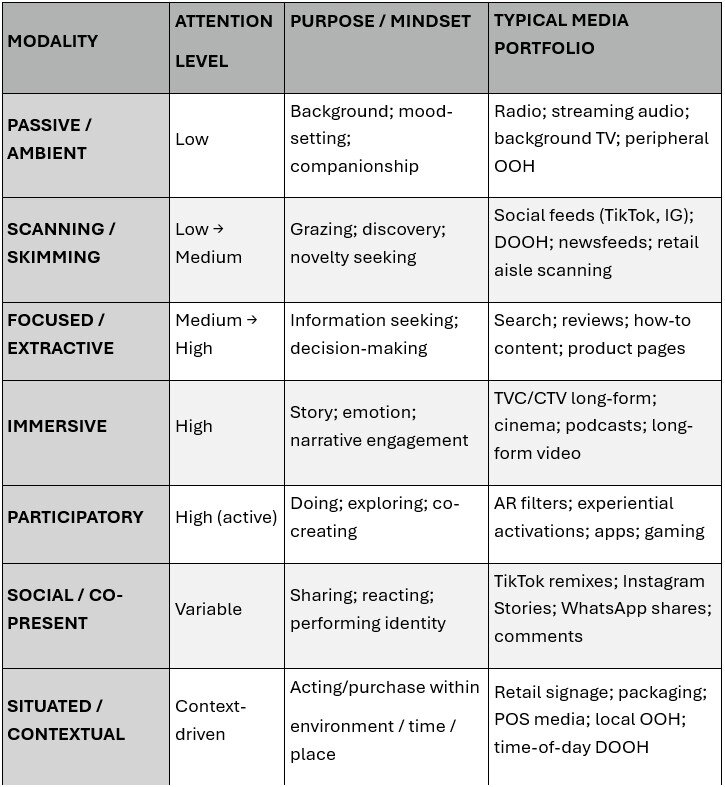
Thinking of media channels as cognitive environments – shaped by context, attention and mode of consumption – is a useful perspective shift, from this piece by Faris Yakob, via WARC.
I also like Yakob’s framing of modality (how something is experienced), momentum (how it builds), and moments (how it comes into focus). But beneath that, this still feels largely like optimisation thinking – just applied to modalities and moments rather than formats and placements.
The part that matters most for brand-building is momentum, and that’s the least clearly explained. How do ideas actually build over time across different environments, teams, markets and formats? What creates momentum deliberately and consistently – the long as well as the short of it – connecting one “moment” to the next, beyond loose consistency or a set of distinctive assets?
This need for sustained momentum becomes more obvious in B2B contexts, where “moments” are harder to engineer, cycles are longer, and distinctiveness can be difficult – even risky – to pursue.
In those environments, the question is whether the organisation can produce and sustain a coherent narrative across everything it does, over time.
That isn’t really a media or creative (or modality or moment) problem – it’s structural.
It comes down to how narratives are defined, how topics are prioritised, how content is developed and reused, and how different teams interpret and apply the same underlying ideas over time, not just over campaigns or activations.
In other words, it’s about the architecture of the system that generates the communication, not just the optimisation of what gets put into it.
Without that, modality and moments are useful lenses, but they don’t explain why some brands build momentum while others just generate activity.
I’m seeing more and more people realise that “AEO” (Answer Engine Optimisation”) is just SEO in new clothes. But are GenAI outputs even something you can optimise for?
These systems don’t just read what you publish and serve up the most relevant parts – they synthesise it, blending multiple sources based on patterns they infer across a wider field of signals:
– everything you publish
– everything others publish about you
– everything they consider adjacent or comparable
They’re also not just looking at what’s being said now. They’re conflating and combining the accumulated traces of how your organisation expresses itself over time – across campaigns, content, product information and everything in between.
Repetition and consistency may help, but they won’t just pick up what you intend. They absorb whatever is most legible – including contradictions, gaps, and overlap with competitors.
If your positioning isn’t distinctive, you’ll get flattened into the category. If your communication isn’t coherent, the model will reconstruct a version of your brand from whatever patterns it can find. And when it comes to facts and details – where accuracy actually matters – these systems are still unreliable enough to pose a real risk.
This is where a focus on structured data starts to look like a promising way forward. That was my first assumption. But it’s becoming increasingly clear that this isn’t going to be enough.
—
The key is to remember that these systems don’t *understand* information. They generate outputs by following probabilistic sequences – patterns shaped by the data they’ve seen.
It’s a sophistiated form of word association. Structure helps, but only where it clarifies those patterns to nudge the model to follow the path you’d prefer.
Over time, what you’re really creating – deliberately or not – is a set of associations the LLM learns to treat as related. What we’d normally think of as a brand “narrative” sits inside that – not as something the model understands directly, but as a pattern of connections it learns to reproduce.
—
This means “AEO” should be considered less about optimising individual outputs, and more about the long-term shape of the signals you generate – across teams, markets and years.
I’ve been doing some work on this recently, trying to make that problem more tangible and diagnosable in practice. Still early, but the direction of travel feels clearer.
The brands that show up well won’t just be the ones optimising for visibility. They’ll be the ones whose overall pattern of behaviour is coherent enough that even a probabilistic system can’t easily misread what they are.
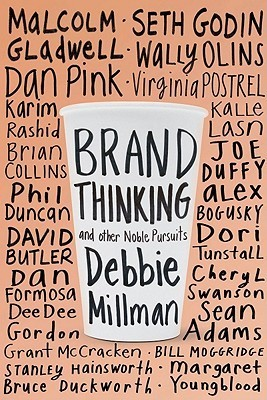
As this is a book of fairly straightforward, slightly gushing interviews with various people from the world of marketing, this would today have worked much better as a podcast. In this format it feels pretty repetitive as well as being dated (first published in 2011, with some of the focus on social media as if it’s new and Apple as if it’s a challenger brand feeling really rather quaint.
There probably were some actively thought-provoking points made somewhere in here, but everyone blurred into one in the end. so I have no idea who said what, and nothing really stood out – except the guy who was very vocal about his dislike of Daniel Kahneman and the idea of Behavioural Economics.
Of course, these “insights” may have seemed more radical 15 years ago. And for newcomers to marketing they still might.
But it’s notable how much of what’s said here sounds fine in theory but feels very hard to turn into tangible takeaways that people trying to build brands themselves could actually use. It mostly all ends up sounding like fluff and cod psychology. You can see how marketing and branding ended up getting a bit of a bad name if this is the best they had to offer.
Then again, maybe it’s because pretty much everyone featured here is American? As Mark Ritson – today’s leading marketing advocate – keeps saying, American marketing and advertising hasn’t been particularly sophisticated for decades.
In short, useful to read if in the profession, but there’s very little surprising, practical or inspiring here. It’s mostly pretty obvious platitudes.
Notes and Essays
To help shape my thinking, I write essays and shorter notes examining the ideas and narratives that shape media, marketing, technology and culture.
A core focus: The way context and assumptions can radically change how ideas are interpreted. Much of modern business, marketing, and media thinking is built on other people's frameworks, models, theories, and received wisdom. This can help clarify complex problems – but as ideas travel between disciplines and organisations they are often simplified, misapplied or treated as universal truths. I'm digging into these, across the following categories - the first being a catch-all for shorter thoughts:

 I also like Yakob’s framing of modality (how something is experienced), momentum (how it builds), and moments (how it comes into focus). But beneath that, this still feels largely like optimisation thinking – just applied to modalities and moments rather than formats and placements.
 I’m seeing more and more people realise that “AEO” (Answer Engine Optimisation”) is just SEO in new clothes. But are GenAI outputs even something you can optimise for?