by James Clive-Matthews | 16 Jun, 2026 | Structures & Models
 The 2026 Reuters Insitute Digital News Report is out, and we’ve finally reached a tipping point that’s been long coming. If this is the case for news organisations, it’s definitely the case for brands:
“even the most digitally advanced news organisations are increasingly having to contend with the reality that in most countries intermediated third-party consumption platforms are more popular than the branded digital properties publishers themselves have built”
i.e. You’re mostly no longer speaking to your audiences direct, via owned channels (or even via your own words).
From Destination to Source Material
So are owned channels no longer important in this age of third-party intermediation?
Far from it.
If anything, I’d argue that owned channels are more important than ever – not because everyone will visit them, but because they increasingly act as the source material from which other interpretations are constructed.
When people (and, increasingly, AI tools) are paraphrasing and discussing you across too many channels and conversations to track, the channels you can influence – which doesn’t just mean your official branded channels, but also those of your people – need to reflect your considered organisational position more than ever.
The Real Challenge Is Interpretation
The deeper issue here isn’t channel fragmentation – it’s how information and ideas and messages are understood and interpreted.
The more intermediated information becomes, the less organisations can rely on controlling messages, and the more they have to rely on shaping the conditions under which they’re digested.
The traditional response to fragmentation is usually more content versioning. But if audiences increasingly encounter you through recommendations, summaries, social conversations, AI-mediated discovery and third-party commentary, the challenge isn’t just producing more formats – it’s ensuring those encounters accumulate into a coherent understanding over time.
From Messaging to Narrative Systems
Messaging houses and carefully-crafted soundbites were built for a world where organisations had more control over the channel, the context, and the wording. That world hasn’t disappeared entirely, but it’s becoming harder to rely on.
In a world that’s oversaturated with content and fragmented across multiple platforms, the techniques that used to (sort of) work are becoming ever more unreliable.
Over the last few years I’ve become increasingly interested in why some organisations seem able to build a clear, coherent understanding of what they stand for over time, while others produce vast amounts of content, expertise and activity that never quite add up.
I think the answer has less to do with controlling brand messaging and content production than most marketers would assume.
That’s the problem I’ve been trying to solve. More soon.
by James Clive-Matthews | 23 Apr, 2026 | Structures & Models
 “Quietly” is quietly becoming a big GenAI copy tell, and that’s more interesting than you think.
(It may not actually be very interesting – but that’s what AI would tell you, because “more interesting than you think” is another GenAI linguistic meme it’s now nearly impossible to escape.)
The problem isn’t AI writing
This is not another rant about GenAI writing patterns. I personally hated the em-dash long before it was cool – not its use as a grammatical tool, which I use all the time, but its ugly aesthetics.
The point is that it used to take months, if not years to notice trends in headlines and framing devices – now they’re shifting far, far more rapidly.
This started with the BuzzFeed effect, more than a decade ago – everything was suddenly clickbait or a listicle, usually with an uneven number. The writing style even of newspapers of record shifted towards ever more chatty informality.
Suddenly every media brand sounded like a relatively smart Californian trying to sound dumber than they are.
The issue is systemic
GenAI has been trained on this stuff.
And because this kind of content was designed largely to cut through social and search algorithms via a brute force attack – combined with test, learn, repeat until false – it was produced in inordinately vast quantities, spamming the system.
And because LLMs are probabilistic, and they’re trained from the internet, this kind of annoyingly-formulated content is a core part of their training data.
Pattern recognition drives addictive behaviour
This kind of copy is designed to appeal to intrigue, encourage engagement, encourage a click, trigger a dopamine response when the (barely mysterious) mystery of what the hell the headline is talking about is revealed and either tells you something new or makes you feel smarter if you already guessed the answer.
It’s designed to suck you in, and keep you coming back.
There was a lawsuit about this recently. Meta and YouTube lost, found guilty of designing their platforms to suck users in and get them hooked.
GenAI is the output of a pattern recognition system. These are patterns it has recognised.
Now it’s doing its own equivalent of test, learn, double down and iterate to find new formulas that will suck in intrigue- and dopamine-hungry brains.
And so headlines written by AI – a great use case for the media – are all starting to converge into similar patterns again. Just as they did a decade ago when BuzzFeed disrupted then industry and turned almost all newspapers on the planet just that little bit dumber.
—
This is how language and culture has always evolved. The process just seems to be accelerating.
by James Clive-Matthews | 2 Apr, 2016 | Marginalia
 5/5 stars
A short, readable book, well worth a read for anyone interested in the media – specifically how to tackle the ongoing challenge of funding news, and the role of journalism in democracy.
The solution proposed for the ongoing challenges of monetisation and the maintenance of independence from vested interests is an interesting one. Plausible too – if governments can be persuaded that news is a public good, that is.
And even if you don’t buy in to the news as public good argument that underpins the entire thesis, along the way come a number of interesting – often surprising – nuggets about the media industry across various countries that make this worth a look by themselves. I was particularly intrigued by the finding that an increase in the number of newspapers leads to a decrease in democratic engagement – initially counterintuitive, but makes perfect sense once explained.
by James Clive-Matthews | 3 May, 2014 | Narratives & Meanings
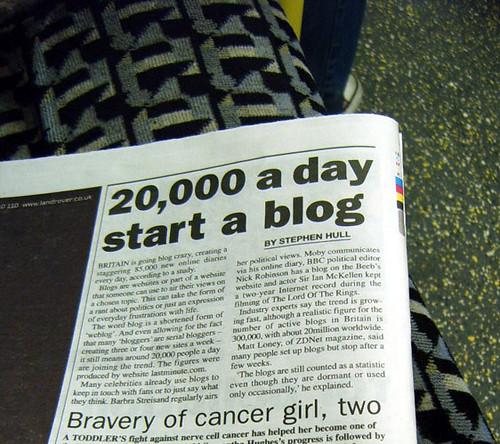
Something tells me this headline was from a fair few years ago…
A few years ago, after I won the European Parliament Prize for Journalism for a post on my politics blog, I told an interviewer that I believed that the arrival of the web heralded a new golden age for journalism (see below, or click to listen).
This – despite all the challenges that the industry still faces – I still believe.
In the last few weeks we’ve seen the launch of FiveThirtyEight, Vox and The Upshot, all trying new things that wouldn’t have been possible pre-internet.
In the last year or so, we’ve seen the rise and rise of Quartz, News Corp buy the excellent Storyful, the Mirror Group launch the interesting – and so far seemingly successful – experiments UsvsTh3m and Ampp3d, and Buzzfeed continue to expand into the realm of the serious (as well as other languages), fuelled by their success in the silly.
And that’s not to mention the increasingly experimental news apps, from Circa to Yahoo News Digest, Reuters’ WiderImage and Zite, all of which are experimenting with the vast, mostly still untapped potential of the splicing of internet and media.

Snowfall – the future, or overblown?
Over the last few years I’ve had the pleasure of attending a number of News:Rewired conferences, hosted by my colleagues at MSN UK and organised by the fine folk at Journalism.co.uk.
At these and other events, be they blogger meetups or the small number of Hacks/Hackers events I’ve managed to attend, I’ve met or listened to too many interesting people with interesting ideas to list.
At the same time, there seems to be more interesting coverage of the world of media now than ever – especially of that intersection of media and technology that is the internet. And with this coverage comes more interesting discussion. (I’ve been deeply envious of all those at the International Journalism Festival in Perugia at the moment, and have been avidly following on Twitter.)
Recently I’ve been enjoying posting the occasional comment on LinkedIn about the media/online world in which I’ve been earning my living for the last decade and a half. But the discussions on LinkedIn can be limited by the forum itself – people are reluctant to speak freely on a platform that’s little more than a glorified CV repository.
Using my existing blog to talk about my fascination with the ongoing evolution of journalism doesn’t seem quite right – that’s got 11 years’ worth of posts about European politics, with only occasional digressions on the media and the web.
And so I’m starting up this blog to give myself more space to work out my own ideas on the future of news (and how to fund it), as well as the web and communication than in any expectation of interesting anyone else. But all contributions and discussions will be most welcome – be they here (once I’ve got comments set up, at least, or elsewhere.
Journalists following the dodo?: Interview with James Clive-Matthews by tuulitoivanen
