by James Clive-Matthews | 27 Nov, 2025 | Narratives & Meanings
If you’re happy with platitudinous banality for your “thought leadership”, GenAI is great!
The trouble is, this isn’t just a GenAI issue.
Many (most?) brands have been spewing out generic nonsense with their content marketing for as long as content marketing has been a thing.
Because what GenAI content is very good at exposing is something that those of us who’ve been working in content marketing for a long time have known since forever: Coming up with genuinely original, compelling insights is *incredibly* hard.
Especially when the raw material most B2B marketers have to work with is the half-remembered received wisdom a distracted senior stakeholder has just tried to recall from their MBA days in response to a question about their business strategy that they’ve probably never even considered before.
And even more especially when these days many of those senior stakeholders are asking their PA to ask ChatGPT to come up with an answer for the question via email rather than speak with anyone.
If you want real insight that’s going to impress real experts, you need to put the work in, and give it some real thought. GenAI can help with this – I have endless conversations with various bots to refine my thinking across dozens of projects. But even that takes time. Often a hell of a lot of time.
Because even in the age of GenAI, it turns out the project management Time / Cost / Quality triangle still applies.
And you still only get to pick two.
{Post sparked by a post about how NotebookLM can now produce entire, quite decent-seeming slide decks, based on a few prompts)
by James Clive-Matthews | 10 Oct, 2025 | Systems & Technology
The rhythms and tone of AI-assisted writing are now pretty much endemic on LinkedIn
And I get why: GenAI copy is generally pretty tight, pretty focused, and flows pretty well. Certainly better than most non-professional writers can manage on their own.
Hell, it sounds annoyingly like my own natural writing style, honed over years of practice…
But people I’ve known for years are starting to no longer sound like themselves.
Their words are too polished, too slick, too much like those an American social media copywriter would use, no matter where they’re from.
None of this post was written with AI.
And despite (because of?) being a professional writer/editor, It took me over half an hour of questioning myself, rewriting, starting again, looking for the right phrase. Doing this on my phone, my thumbs now ache and the little finger on my right hand, which I always use to support the weight while writing, is begging for a break.
With GenAI I could have “written” this in a fraction of the time, and it would have been tighter, easier to follow.
But it wouldn’t have been me – and I still (naively) want my social media interactions to be authentically human to human.
(Of course, the AI version would probably have ended up getting more engagement, because this post – as well as going out on a Sunday morning when no one’s looking, and without an image – is now far too long for most people, or the LinkedIn algorithm, to give it much attention. Hey ho!)
by James Clive-Matthews | 30 Aug, 2025 | Narratives & Meanings
This:
The question of what AI does to publishing has much more to do with why people are reading than how you wrote. Do they care who you are? About your voice or your story? Or are they looking for a database output?
Benedict Evans, on LinkedIn
Context is (usually) more important to the success of content than the content itself. And that context depends on the reader/viewer/listener.
It’s the classic journalistic questioning model, but about the audience, not the story:
- Who are they?
- What are they looking for?
- Why are they looking for it?
- Where are they looking for it?
- When do they need it by?
- How else could they get the same results?
- Which options will best meet their needs?
Every one of these questions impacts that individual’s perceptions of what type of content will be most valuable to them, and therefore their choice of preferred format / platform for that specific moment in time. Sometimes they’ll want a snappy overview, other times a deep dive, yet other times to hear direct from or talk with an expert.
GenAI enables format flexibility, and chatbot interfaces encourage audience interaction through follow-up Q&As that can help make answers increasingly specific and relevant. This means it will have some pretty wide applications – but it still won’t be appropriate to every context / audience need state.
The real question is which audience needs can publishers – and human content creators – meet better than GenAI?
It’s easy to criticise “AI slop” – but the internet has been awash with utterly bland, characterless human-created slop for years. If GenAI forces those of us in the media to try a bit harder, then it’s all for the good.
by James Clive-Matthews | 21 Aug, 2024 | Systems & Technology
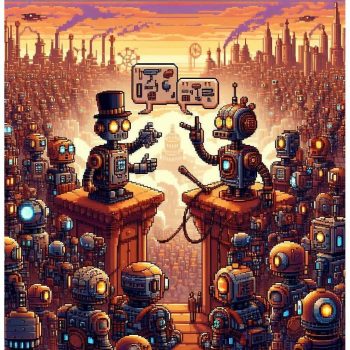 The default writing style of GenAI is becoming ever more prevalent on LinkedIn, both in posts and comments.
This GenAI standard copy has a rhythm that, because it’s becoming so common, is becoming increasingly noticeable.
Sometimes it’s really very obvious we’ve got bots talking to bots – especially on those AI-generated posts where LinkedIn tries to algorithmically flatter us by pretending we’re one of a select few experts invited to respond to a question.
—
Top tip: If you’re using LinkedIn to build a personal / professional brand, you really need a personality – a style or tone (and preferably ideas) of your own. If you sound the same as everyone else, you fade into the background noise.
So while it may be tempting to hit the “Rewrite with AI” button, or just paste a question into your Chatbot of choice, my advice: Don’t.
Or, at least, don’t without giving it some thought.
—
There are lots of good reasons to use AI to help with your writing – it’s an annoyingly good editor when used carefully, and can be a superb help for people working in their second language, or with neurodiverse needs. It can be helpful to spot ways to tighten arguments, and in suggesting additional points. But like any tool, it needs a bit of practice and skill to use well.
But seeing that this platform is about showing off professional skills, don’t use the default – that’s like turning up to a client presentation with a PowerPoint with no formatting.
Put a bit of effort in, and maybe you’ll get read and responded to by people, not just bots. And isn’t that the point of *social* media?
by James Clive-Matthews | 21 Nov, 2022 | Narratives & Meanings
“Telling stories should be a tool we use to understand ourselves better rather than a goal in and of itself.”
– from Beware the Storification of the Internet, in The Atlantic
This, for me, has always been the real value of trying to produce “Thought Leadership” in a business context: The process of thinking and constructing a coherent explanation of that thinking can have far more lasting impact on an organisation than the one-off piece of content that appears to be the end result.
Every stakeholder involved in the creation of the thought leadership content should, during its course, have at least a few moments where they really stop and question what they think and believe, why, and how they can better articulate it. This can then positively impact how they operate day to day, how they interact with clients and customers, and how they articulate the benefits of their products and services.
It’s not about the piece of content – it’s about the *thinking*.
*That* is the value of putting an emphasis on “Storytelling” – because the narrative form insists on forcing us into shaping our thoughts in ways others can follow. Ideally in a relatively entertaining, relatively memorable way.
The risk, though, is that we start buying into the myths of our own stories – and forget that they are just one way of looking at the world, created to simplify.
This is why, as we try to produce a piece of content, we need to do a Rashomon on our own thinking.
There’s never only one story, one narrative, one way of looking at the world. Look at things from only one perspective, and you risk ending up like the blind men and the elephant. If you’re serious about producing real thought leadership, you should challenge yourself to look for alternative approaches every time.
This is why Critical Thinking is probably the most important skill when writing and editing: Question your assumptions and preconceptions, consider all the objections and alternative interpretations, and – as long as you can avoid the twin traps of analysis paralysis and editing by committee – the end result *will* be stronger.
Stylistic flair can disguise sloppy thinking – but only so much. And how much better is it to have both style *and* substance?
by James Clive-Matthews | 5 Sep, 2020 | Structures & Models
I’m not a stickler for “correct” punctuation, as a rule – except when it comes to apostrophes and the Oxford Comma. This is because punctuation, mostly, is about flow and rhythm, not meaning. Misplaced apostrophes and missing commas in lists can substantially change meaning rather than flow, so their correct placement becomes vital.
This fascinating essay on the evolution of punctuation makes clear that improving flow and clarifying meaning has long been the goal – while also exploring the long history of resistance to punctuation that over-clarifies meaning.
It’s a useful reminder that words are about interpretation as much as intention. Sometimes ambiguity lets greater meaning emerge, building stronger connections with your audience by encouraging them to think more deeply about your words. Sometimes it creates confusion.
The challenge, as ever, is getting the balance right – so focus on the needs of your audience. What will most help them understand your meaning (or meanings)? What will confuse? No one wants to have to try and parse a complex run-on sentence with multiple sub-clauses and dozens of punctuation marks. Even if they do make it through to the end without giving up, your meaning is likely to be lost.
In other words, as ever, when in doubt: Keep it simple.
by James Clive-Matthews | 25 Apr, 2020 | Marginalia
Finally, some good news!
Word is going to start showing double spaces after a full-stop/period as a mistake, preventing the daily howls of frustration from copy-editors worldwide who are continually having to find/replace the damned things.
(And yes, I know lots of people were taught to type with a double space after a full-stop. I was too – because I learned on a typewriter, which is where this came from: to improve the kerning and create more readable text. Computers / word processors are rather more sophisticated than typewriters – they sort the spacing out for you. This means using a double space on a computer actually *increases* layout issues – especially when justifying text – so achieves the precise opposite of what people who do this think it does.)
I’m fairly flexible as an editor most of the time, but along with *always* advocating the Oxford Comma, killing post-period double spaces is one of the few editing hills I’m prepared to die on.
by James Clive-Matthews | 22 Feb, 2020 | Marginalia
Complaining about nonsense business-speak may be futile, but this piece – a review of a memoir about life in startup land – does a good job of summing up why spewing out business bullshit is not just intellectually offensive, but actively harmful:
“I like Anna Wiener’s term for this kind of talk: garbage language. It’s more descriptive than corporate speak or buzzwords or jargon. Corporatespeak is dated; buzzword is autological, since it is arguably an example of what it describes; and jargon conflates stupid usages with specialist languages that are actually purposeful, like those of law or science or medicine. Wiener’s garbage language works because garbage is what we produce mindlessly in the course of our days and because it smells horrible and looks ugly…
“But unlike garbage, which we contain in wastebaskets and landfills, the hideous nature of these words — their facility to warp and impede communication — is also their purpose. Garbage language permeates the ways we think of our jobs and shapes our identities as workers. It is obvious that the point is concealment; it is less obvious what so many of us are trying to hide.”
In short, if your ideas are good, don’t bury them in garbage. If they’re not, the presence of garbage is a good indicator.
by James Clive-Matthews | 28 Jun, 2014 | Marginalia
I usually hate tips for writers – writing, to me, should be a natural thing. But having seen a lot of very bad writing, more concerned with showing off the writer’s linguistic skill or subject-matter expertise than enlightening the reader, this approach strikes me as vital to keep in mind at all times:
Writing is a modern twist on an ancient, species-wide behaviour: drawing someone else’s attention to something visible. Imagine stopping during a hike to point out a distant church to your hiking companion: look, over there, in the gap between those trees – that patch of yellow stone? Now can you see the spire? “When you write,” Pinker says, “you should pretend that you, the writer, see something in the world that’s interesting, and that you’re directing the attention of your reader to that thing.”
Perhaps this seems stupidly obvious. How else could anyone write? Yet much bad writing happens when people abandon this approach. Academics can be more concerned with showcasing their knowledge; bureaucrats can be more concerned with covering their backsides; journalists can be more concerned with breaking the news first, or making their readers angry. All interfere with “joint attention”, making writing less transparent.
This isn’t a “rule for writers”; it’s a perspective shift. It’s also an answer to an old question: should you write for yourself or for an audience? The answer is “for an audience”. But not to impress them. The idea is to help them discern something you know they’d be able to see, if only they were looking in the right place.
