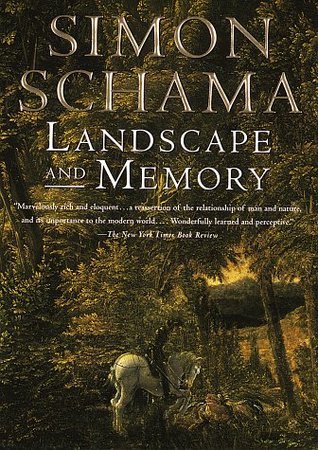
This is a big, strange, frequently fascinating, but strangely disjointed book. Impressionistic history, not narrative. It’s also far longer than the page count suggests – a huge, heavy book that needs two hands to hold even in paperback.
Effectively a collection of essays that combine to make up one big essay, it jumps around in places and time as it explores Western civilisation’s relationship with the landscapes in which that civilisation has developed.
Yet this is a bit of a misrepresentation, as really the focus is primarily on the 18th and 19th centuries, as the conscious awareness of landscape as a thing started to emerge. And primarily via England, France, the United States, and Germany / the Holy Roman Empire. Other countries do get a look in. but these four dominate.
It’s at times more lyrical memoir or art criticism than cultural history, with the schema and structure and choices of what to cover making sense only to its author – making me wonder how on earth Schama managed to get this commissioned, given it came pretty early in his career, five years before he became a household name via his TV work. It feels more like the kind of self-indulgent passion project with which someone famous is rewarded to get them to produce something a bit more commercial.
But there’s still a lot here to like. For me, it’s best when it delves into myth and legend – though it doesn’t do this as much as I think is warranted, or as much as I’d have liked, given how good Schama is on myth when he does write about it:
“how much myth is good for us? And how can we measure the dosage? Should we avoid the stuff altogether for fear of contamination or dismiss it out of hand as sinister and irrational esoterica that belong only in the most unsavory margins of ‘real’ (to wit, our own) history?
“…The real problem… is whether it is possible to take myth seriously on its own terms, and to respect its coherence and complexity, without becoming morally blinded by it’s poetic power. This is only a variation, after all, of the habitual and insoluble dilemma of the anthropologist (or for that matter the historian, though not many of us like to own up to it): of how to reproduce ‘the other,” separated from us by space, time, or cultural customs, without either losing ourselves altogether in total immersion or else rendering the subject ‘safe’ by the usual eviscerations of Western empirical analysis.
“Of one thing at least I am certain: that not to take myth seriously in the life of an ostensibly ‘disenchanted’ culture like our own is actually to impoverish our understanding of our shared world.” (p.134)
And (much) later, concluding the thought with the closest the book has to an explanation of Schama’s aim in writing it:
“it seems to me that neither the frontiers between the wild and the cultivated, nor those that lie between the past and the present, are so easily fixed. Whether we scrambled the slopes or ramble the woods, our Western sensibilities carry a bulging backpack of myth and recollection… The sum of our pasts, generation laid over generation, like the slow mold of the seasons, forms the compost of our future. We live off it .” (p.574)
Appropriately enough this book is a rambling affair, following paths that make little sense as you wander them. But gradually the intent of the person who’s staked out those paths starts to make some kind of sense – as with an Impressionist painting, the subject of which can only be seen when you take a few steps back.
Here, the details are so dense, so varied, you’re better off with your nose close to the canvas – the parts work better on their own rather than summed into a whole.
I initially loved this – effectively a popular historiography of the (Italian, mostly) Renaissance, exploring different perspectives and opinions and how these have evolved over time – while also providing overviews of some of the key events and personalities.
This is a wildly confusing period, so this approach actually works pretty well – highlighting who focused on what and offering multiple explanations as to why. Until about halfway through I loved it, and still remain convinced that looking at history by first looking at the lens of the historians and players who shaped that history is an approach more popular history books should take, rather than just run with a narrative.
But… “The Renaissance”, singular? This goes totally against the author’s core argument, which is all about how there are any number of ways of looking at this period (or even defining how long a period we’re talking about). Yet despite this we get surprisingly little about the Northern Renaissance, and almost every key figure called out was based in northern Italy – despite multiple references to Erasmus as a nexus of Renaissance correspondence, we get few investigations into how or whether what was happening in Italy was influenced by or influenced what was going on elsewhere (bar the frequent French invasions and other aspects of high politics).
Equally, about halfway through I started to find the whole thing a little overwhelming as we jump from overarching thesis (there’s no one right way of interpreting any of this) to detailed biography, so philosophical aside, to onrunning jokes. After a promising start, the structure starts to get lost, and it increasingly feels like a series of essays or blog posts loosely bound together.
The more this went on, the more I felt it could have been better if presented as essays rather than a whole – because after a while the running jokes (“Battle Pope”, “Abelarding”, references to Game of Thrones, etc etc) start to detract from rather than clarify the argument. This jokey style is one that’s been very popular the last decade or so, and can work – but in a book this long it can start to grate, even if you don’t object to it in principle, as some might.
Which is a shame, because there’s a lot of really good stuff in here. I learned a lot, and will want to go back and re-read various parts (as long as I can work out which with the jokey chapter titles) to refresh my memory – and eventually start to make a little more sense of a chaotic and challenging to understand period.
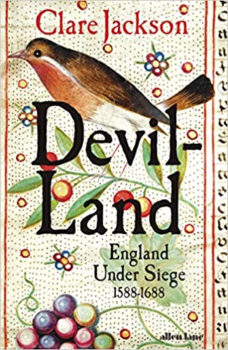
History is all about perspective, and perspectives. This history of England’s most turbulent century – a period I studied to postgrad level – is a welcome attempt to offer alternative views of events via the eyes of non-English observers. As we’re somehow still referring to the central event as the English Civil War – ignoring Scotland, Ireland and Wales – this is very much needed.
The introduction promised a lot, and got me genuinely excited to see how much this focus on foreign perspectives – and foreign policy – would shift my own understanding. But while there were some new things for me here, at its heart this was all rather familiar.
Then again, I’m not really the target audience. As well as having studied the period, I also spent some time plotting out a potential novel that hinged in part on the foreign policy of James VI/I and the (limited) British involvement in the Thirty Years War.
For anyone relatively new to the period, or looking for a refresher overview, this would be really rather good. Standard accounts do tend to focus almost exclusively on England, where here Scotland and Ireland (not so much Wales) do get their due. But more importantly, most accounts tend to obsess about the religious angle, the disputes over tax and revenue, the disputes about the limits to the power of the monarchy, the attempts by parliament to assert itself.
All those are present here too – but so too are explorations of the European horror at the execution of Mary Queen of Scots; the Spanish side of the Spanish Armada and the Spanish Match, as well as worries about the subsequent French marriage; general concern as the civil wars broke out and further horror at England’s execution of a second monarch in sixty-odd years; the Dutch rivalry and wars and invasion.
All this is necessary to a solid understanding of the era – but all too often is skipped over or sidelined. Here, while it’s still not foregrounded as much as I’d hoped – or as much as is promised in the introduction – it’s hard to avoid the fuller understand appreciation that England was not operating in isolation. That other countries existed even then, and that even the foreign relations were far more than just theoretical, largely religious concerns.
All that said, cutting this off with the Glorious Revolution (another bad name that’s stuck) makes zero sense from a non-English perspective (even if the epilogue continues the story through to George I). Logically, the cut off should be more like 1745 (that final Jacobite rising, in the midst of British involvement in the War of Austrian Succession) and the solidification of the Hanoverian dynasty, or even a century later with the death of the Young Pretender / Bonnie Prince Charlie. But I guess by that point Britain was so firmly involved in European and global affairs that the emphasis on non-English opinions about the English would hardly be surprising.
So, a good overview – even if sadly not as radical and overhaul of the period’s traditional narratives as I was hoping.
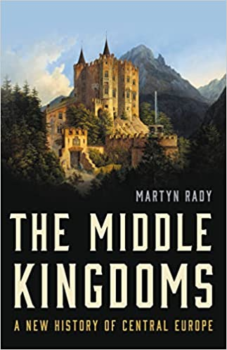
Much like the region it’s covering, this book lacks a certain coherence – and seems to be dominated by the looming presence of Germany.
This makes sense, of course – but if a region is in the middle or central, the obvious question is the middle or centre of what, and what’s surrounding it? Here, Rady seems to focus far more on contrasting central Europe to western Europe than to the east (Russia is the other obvious figure looming over the region’s history, but features far less than Germany), the north, or the south.
For me, the focus on a more or less linear, more or less political history of the region made some sense – and individual chapters were great overviews – but given the fuzziness of the definition of the region and the lack of any long political continuity for most of the countries that exist there today – this makes it even harder to keep track. When there’s no clear narrative, narrative history tends to struggle.
This is because – as Rady makes clear in the final couple of chapters – the concept of central Europe is so relatively recent.
The conclusion mentions something that shows how difficult the task the author set himself was – talking about nations without states, and states without nations, all with borders that have overlapped each other at various times. This is a perceptive and useful summary – but it makes the political history approach feel more than usually useless.
What may have been more helpful would have been a cultural history, or even a linguistic one. If this is a land of overlapping nations, how did these national identities emerge and persist given how frequently the political boundaries have shifted? That’s the book I think I was hoping for, but it’s not this one.
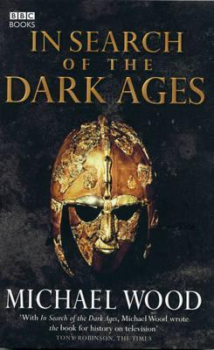
This is a strange book. Originally written to accompany a BBC TV series back in 1981, it has since been extensively revised to reflect the (substantial) changes in understanding of this long period – covering over a thousand years, from Boudicca to the Norman Conquest.
That period alone is enough to raise an eyebrow. What the hell does Wood mean by “the Dark Ages”? And why, if he’s in search of them, does he focus purely on England? Equally, why does he choose to explore them by focusing on a series of individuals?
In part, the thinking seems to be that by centering each chapter on a named individual, you can explore the sources to understand how much we can really know in an era of fragmentary record keeping and near constant conflict. This is a nice enough idea – but it’s been done better elsewhere, especially in the last decade or so, as archaeology and history have merged and a glut of good books have come out on the Vikings and Anglo-Saxons in particular.
Equally, given the use of the term “Dark Ages” – usually contrasted to the Greek/Roman Golden Age and the Renaissance – it’s strange the focus here is largely on politics and power rather than culture and learning and civilisation and society.
Not a bad book, certainly, but its episodic nature betrays its roots in television. It’s let down by the fact that there’s really no clear connecting thread, and nor is there a flowing narrative – something seemingly made worse by Woods’ laudable decision to add some new chapters about prominent women in this revised edition, to counter his early 80s patriarchal mindset and work in some more recent scholarship.
Nonetheless, Woods is a good writer, and this is engaging enough – it just feels a bit confused and incomplete.
An odd book, but very readable. Mini biographies of various leading economists of the last couple of hundred years are a mostly useful way to build the central argument: Economic ideas are a product of their time, and of their creators’ circumstances. It’s a fair argument, and one likely borne out by the fact I’m leaving this much more sympathetic to the ideas of Amartya Sen than any other person featured. He’s the only economist covered who’s still alive…
But this book is odd mostly due to its choices for who to include – and who to omit.
It starts by scene-setting with Dickens, then progresses straight to Marx and Engels, rather than going slightly further back to include Smith, Malthus, Ricardo and other earlier economists.
It’s heavily focused on British/American/Austrian thinkers to the exclusion of pretty much any others – and doesn’t include any non-Western economists other than Sen. Hell, it doesn’t even include any French economists.
The main contention other than everything progresses (it’s largely teleological in approach) is that everyone’s a Keynesian – even people you don’t think are Keynesian. Keynes hangs over the entire book, from long before he appears.
There’s a good case for this – I mean, Keynes is Keynes – but considering the general argument is that economics has been getting increasingly sophisticated, it seems odd that it largely (and rapidly) tails off in its interest in the aftermath of WWII (and, perhaps not coincidentally, Keynes’ death).
The most surprising omission, considering there’s a strong undercurrent of concern with human welfare throughout, is any reference to behavioural economics – surely one of the most fundamental shifts in approach to the discipline in the last 50-60 years.
Nor is there any coverage of the birth of game theory – arguably one of the most influential (and abused) concepts of the same period. This last is particularly surprising given the frequent use of the term “zero sum game” in latter chapters – and by the fact that the author’s previous best-known book was a biography of John Nash.
So yes, an odd book as much for its omissions as its inclusions. But engaging, readable, and (mostly) relatable. In that, it does what it set out to do – help you to understand not just *what* ideas economists had, but *why* they had them.
Impressive in ambition, wildly erratic in execution.
Parts of this overview of Western philosophy and thinking (including psychology, science, and humanity’s understanding of the world in the broadest sense) are excellent – enlightening, clear, engagingly-written.
Others are waffly, repetitive, and lack sufficient context of explanation for newcomers to the ideas being discussed.
Yet others are actively confusing – not because they don’t make sense, but because it’s unclear how they could have been written by the same author.
The Epilogue is a prime case in point. This follows a strong chapter on postmodern thinking – one of the best in the book – that has emphasised the flaws in teleological / progress-driven / narrative interpretations of history and the universe. But the conclusion is explicitly, unashamedly teleological, expounding some grand theory of destined progression of thinking to wind up with a frankly rather patronising, paternalistic suggestion of what’s next.
Apparently the same author has also done a book on how astrology can explain key moments in history. Had I known that when I picked this up, I may not have bothered – and it does explain a lot about that conclusion.
But still, some strong chapters mean I don’t utterly begrudge the time spent with this one. A kinda useful companion to other histories of philosophy – albeit one with some very odd quirks.
This didn’t get only three stars because this isn’t well-written, or that it’s not fun and interesting – but because it’s so inconsistent and hard to follow.
It purports to be the “story of a city and its people”, but can’t decide which people. Mostly it seems to be the story of kings, occasionally writers, very rarely others.
It both assumes a lot of prior knowledge of French history and explains the well-known at length – including things that have little specifically to do with Paris. But then it passes over specifically, uniquely Parisian events like the Revolution and barricades of 1848 in mere paragraphs, ignoring the vast numbers of fascinating people who could have made for great diversions.
Basically, I can’t work out the author’s criteria for what to include and ignore.
This lack of a clear schema means you’re better off with a tourist guide for the linear narrative history, a literary guide for the cultural, and a social history for an insight into the people. This covers parts of all, none of them comprehensively enough to be fully satisfying – but well enough to make me want to find out more. From a more coherent, consistent book.
A superb piecing together of disparate unreliable information from multiple countries and centuries in an effort to piece together just what medieval Europe knew of the wider world, prior to its rapid expansion after Columbus, Magellan, and Da Gama.
The legends of Prester John, the travels of Marco Polo and John Mandeville, the rediscovery of classical learning, the threat of the Mongols, the desire to reconquer Jerusalem with a new crusade, the closing of the Silk Road by Central Asian wars, the rumours of Atlantic islands, the pursuit of Paradise in Ceylon, the source of African gold, and the various pre-Columbian discoverers of the Americas – all are here, making the medieval world seem much bigger in the process.
Excellent fun stuff that makes Columbus’ voyage both make more sense and less – he had enough evidence there was something over the horizon, but much of that evidence suggested it was much further away, and he still had no real idea how to get there.
An impressive no bullshit overview of strategic thinking (and claims about the merits of such thinking) over the last two centuries. My copy is now littered with copious notes, and I’m sure I’ll be returning to it repeatedly as a reference book from now on. Particularly enjoyed the excellent destruction of pretty much all businesses guru claims about management strategy.
Well worth investing the time to read this for anyone interested in politics or business – though there are big chunks it’s perfectly possible to skip, depending on your primary interest (the lengthy detour into left-wing and radical political theory added little for me, largely because I was already familiar with it).
An immense amount of research packed into a well-written, fascinating book. Has given me untold new appreciation for the late Georgian scientists and explorers – from a period before the word scientist had even been invented, and where art and science were still far more closely intertwined. This isn’t just Banks, Herschel and Davy – Coleridge also plays a significant role, as do Shelley, Woolstonecraft, Wordsworth.
Is it a bit Anglocentric? Possibly – I don’t know enough about the period to tell. But it does amply show how much scientific dialogue there was between England and France in particular, even during the Napoleonic Wars – a kind of friendly rivalry in which England seemed to have come out on top.
Is it a bit London-centric too? Possibly, though the Davy chapters do feature the Westcounty, and there are references to the later proliferation of provincial scientific associations. And in any case, this is about the initial scientific breakthroughs, not their applications asthe Industrial Revolution spread.
I took my time reading this, as it was an ideal tube journey book – each chapter split into shorter sub-chapters, and all enjoyably worth savouring. Tiny print in the paperback also means this packs in far more words than many books of the same pagecount. Could it have been a far faster read? Yes – but I’m glad I took my time, and that I finally got around to it after years of it lying on the shelf unread.
The author is one of those irritatingly lucky people who stumbles through life being in the right place at the right time, meeting the right people. Deep envy.
Some small oddnesses and cultural misunderstandings, though – such as a passage describing the interpretation of a painted scene. He reads the image from left to right (making it about the moment before glory) rather than right to left, as Japanese people would read it (making it about the transient nature of life and success, a much more Japanese concept). Small things like that make me wonder whether, despite the author’s long years living in Japan, and his close familiarity with many aspects of its culture and history, he really does understand the place.
But then, as he says, that’s the beauty of Japan – it can’t really be explained in words, it mostly has to be experienced. And, to be fair, he has a good stab of explaining it.
The book itself is an engaging overview of the crisis of cultural identity Japan’s still going through, though mostly from the boom years of the 60s to 80s. Makes a lot of the oddness of modern Japan make a lot more sense than most other books I’ve read on the place, and so well worth a read for anyone interested in trying to understand the place.
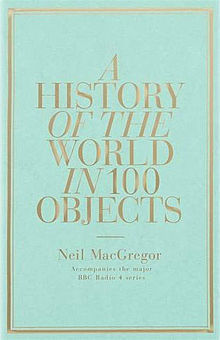
Flicked through before, this time read kinda cover to cover over a few days. Skipping bits, for sure, but reading most of it. Main observations:
1) It’s going to date badly – too much speculation about meanings, and too many interpretations that feel very of a particular moment.
2) Despite thinking it’s being critical and analytical, it’s actually kinda teleological, and definitely has an agenda. It’s an agenda I agree with and support, pushing a global, multicultural view of the world, but just because I agree with the agenda doesn’t mean I can’t see that some of the points are stretched very, very thin.
3) It doesn’t function as a linear narrative, but the thematic sections also don’t make much sense to me – largely because they’re also kinda chronological. It would make much more sense to have the first coins followed by the first ledgers and the first bank notes, but instead these objects are all grouped into other sections, to facilitate a more semi-chronological approach. Thematic makes more sense.
4) There’s a huge amount of unjustified historical equivalence, making some things sound more important than they are for world history to ensure a good geographic spread – often accompanied by enthusiastic hyperbole about the significance. But there’s also still a number of significant gaps: nowhere near enough China or Greece in particular.
That’s not to say it’s not a good book. It is. And it informed me abiut a bunch if things I never knew. But history is about selection, and here the selection was limited by the British Museum’s own collections. How would other major global museums have approached this differently? I’d be keen to find out.
An excellent achievement, original in conception, convincing in execution – a kind of reconstructed autobiography from a dauntingly chaotic array of manuscripts that gives an intriguing new perspective on the much-covered intellectual circles of mid- to late-17th century Oxford and London. It’s a perspective firmly from the sidelines, written by a bit player, a kind of hanger-on.
And that’s why only four stars. It’s fascinating for people interested in the period, and novel-like enough to be worth reading anyway. But Aubrey is so self-deprecating, so timid, so uncertain of himself, so seemingly incapable of atanding up for his own interests, so prone to prevarication, that he can become a depressing, frustrating companion. You feel like shaking him, telling him to sort his shit out and get on with it, to write that damned book at long last.
Yes, I see much of myself in Aubrey, which made this book all kinds of existentialist. I should stop prevaricating myself. Life is short. In three hundred years will they remember me as they do him?
Bookended by the author’s personal experiences hunting for Genghis’ final resting place, and explaining the persecutions the Mongol people have experienced in the last century or so along the way, the majority of the book is a fairly straight narrative of the rise and fall of the Mongol Empire, constantly at pains to point out that they weren’t a bunch of bloodthirsty barbarians.
As someone new to the subject, this was all interesting enough – but a) I was reading this to understand the post-Mongol impact on the world (as promised by the title) , not how they achieved power, and b) there was consistently far more emphasis on the eastern branch of the Empire in China than on the Middle Eastern, Indian or Russian wings.
This seems especially odd considering that:
the author emphasises how much of the Mongols’ innovations in China were deliberately suppressed after their fall,
the Indian branch lasted the longest,
the Middle Eastern angle could have surely been tied in to the instabilities and rivalries in that region that have lasted to the present day, and
that he starts and ends with personal accounts of Soviet repression of Mongol memory, implying that there remains some deep Russian connection.
None of these things are elaborated on at any length, which is a real shame, as the author is mostly good on his supposedly central thesis of how important the Mongols were on the creation of the modern world (although he is decidedly shaky on specifics in some areas).
I ended up left with the distinct impression that the book the author wanted to write was about the life, culture and history of the Mongol people, but his publisher insisted on something a bit more sellable, so tacked on the modern world pitch. The two parts may well have worked better as separate books.
Judt was obviously a master, as anyone who’s read even parts of Postwar can attest. His illness and early death was tragic. The idea for this book – to capture some of his knowledge and ways of thinking before the end – was a good, if macabre, one.
The trouble is, it’s an extended interview where the interviewer doesn’t seem to know when to shut up and let the interviewee speak. Timothy Snyder may well be a good historian in his own right (I don’t believe I’ve read any of his stuff, so can’t tell), but as an interviewer he leaves much to be desired – acting like an eager student trying to please teacher by showing off his own knowledge rather than shutting up and learning from the teacher as he’s supposed to do.
This gets particularly frustrating when Snyder keeps trying to divert Judt onto topics – such as the repeated questions about impact of Judt’s Jewish heritage on his upbringing and thought processes – that Judt continually tries to politely dismiss as largely irrelevant. Judt himself repeatedly points out that he had a more complex intellectual background than merely being a left-wing Jew – to try and shoehorn him into such a stereotype pushes the book dangerously close to being predictable, which is the last thing I’ve come to expect from Judt’s work.
That said, there’s still some fascinating stuff in here – but it needed a tighter edit, largely to remove Snyder’s voice and some of the more rambling digressions, and let Judt’s voice and opinions come through more clearly.
Obvious, but worth stating – and highlighted in an arguably overly-critical piece on the new Los Angeles Times website redesign (which, bar the lack of swipe navigation on the “browse visually” section, I like well enough – my only complaint with the look of the thing being their terrible, boring choice of photo on nearly every story):
“much of the innovation touted here has the publication playing catch up. Everyone, it seems, particularly web-only news outlets, has been treating each story as a hook to come into their sites. And nearly everyone seriously in the game is mobile-first…
“The Times is on board with best practices as the online journalism world knows them today. It’s just that the winners in this fast-moving game will be moving the ball forward and taking risks with payoffs that can’t be foreseen but that will seem obvious in the future.
“The redesign is formulaic. If you took a class on digital journalism last year, the professor would have told you this layout is what works.”
The obvious retort to which is a) “so what if it’s not a whole new thing?” and b) “who says that the pioneers win?”
The future of journalism / publishing doesn’t need to be radically different from what’s gone before. We shouldn’t need shiny bells and whistles to attract attention if the quality of the content is good enough and meets the needs of the audience.
There have arguably been only a few radical shifts in journalistic presentation over the centuries, and all have been technological: the printing press, the steam-powered printing press, radio, film, television, the Internet. These required radical shifts in thought – all else is just presentation. Don’t get me wrong: presentation matters. But it’s not the starting point.
The challenge with all journalism in all ages is in a) identifying your audience and b) providing your journalism in a format that meets the balance between cost effectiveness and convenience for both you and your audience.
Mobile first websites make sense not just because the web audience in most developed markets is moving mobile, but also because it reduces costs – no more double development for big screens and small, mouse and touch, as has been the case for the last decade or so. Potentially, if done right (as with Quartz) you can even do away with a separate app – a potentially vastly expensive undertaking that ties you into seemingly endless development cycles to catch up with each new update to iOS, Android, Windows Phone, or whatever the next big thing is.
The advent of mobile first design thinking over the last couple of years could finally give Internet journalism space to start working out the more important questions about funding and distribution. The tools could stop being the problem for the first time in twenty years of the web.
As with early print, the ink and the paper part has been more or less decided (database-driven back end, HTML/CSS front end). What’s not been worked out is the ideal size of the paper, or the ideal font / layout. And as with print, the ideal will vary depending on the purpose. A newspaper is not a novel or a photography magazine.
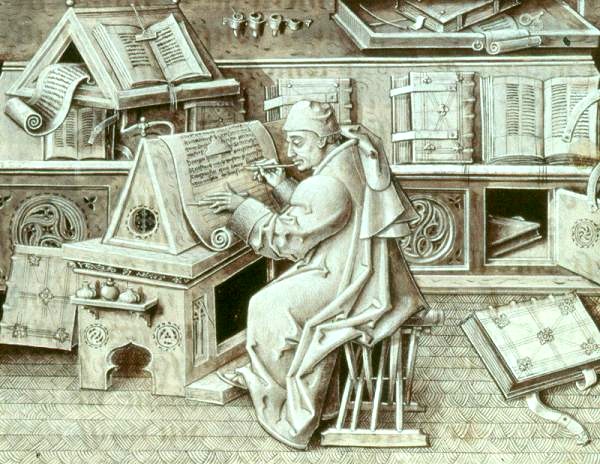
Early printing was constrained for decades by old ways of thinking – book sizes based on old hand-written manuscripts that were themselves based on the amount of useable vellum you could get out of a calf skin (a “quarto” manuscript being the size of a quarter calf skin), with fonts that were based on gothic scripts designed by monks for spectacle and constrained by how they could cut the feather quills they used for writing, not ease of reading. Later, the industry persisted with the broadsheet format – always impractical for readers – because it was cheaper to produce, because their machines had been built that way – because centuries after Guttenberg the printing press had barely evolved.
Even in this post-Guttenberg Internet age, what matters is maximising access to our content while minimising the cost of production, same as it always has been. That content may look a little different, with interactive infographics and HTML5 video and so on – but at its heart it’s not changed either. It’s still all just words and pictures, the same today as it was in the pre-Guttenberg days of monks lined up in candle-lit rooms, copying out vastly expensive manuscripts for the tiny minority who could afford them.
Meanwhile, the assumption that the pioneers win is a nonsense. The pioneers make the mistakes that those who follow after can learn from. Only a very few of the earliest settlers succeed – the Oregon Trail led to many more deaths than happy new prosperous lives.
Short version: the real debate of the future of journalism isn’t about style, it’s about technology and economics, same as it always has been.
We need to accept this – because constraints can be useful. Without constraints, the Internet is a blank canvas – but Mankind has always preferred to know where the boundaries lie.
A combination of money and tech can help us set those boundaries. Some will continue to push them outwards, but few ordinary people are interested in living on the frontiers. They prefer safe and familiar. The pioneers of new techniques and technologies should be lauded, but it is the settlers who come after that will make the new land liveable and viable in the long run.
Notes and Essays
To help shape my thinking, I write essays and shorter notes examining the ideas and narratives that shape media, marketing, technology and culture.
A core focus: The way context and assumptions can radically change how ideas are interpreted. Much of modern business, marketing, and media thinking is built on other people's frameworks, models, theories, and received wisdom. This can help clarify complex problems – but as ideas travel between disciplines and organisations they are often simplified, misapplied or treated as universal truths. I'm digging into these, across the following categories - the first being a catch-all for shorter thoughts:

 4/5
4/5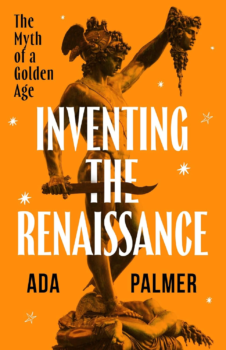
 4/5 stars
 3/5 stars
 3/5 stars
 5/5 stars
 5/5 stars
 5/5 stars
 4/5 stars
 4/5 stars
 4/5 stars
 3/5 stars
 3/5 stars
 There have arguably been only a few radical shifts in journalistic presentation over the centuries, and all have been technological: the printing press, the steam-powered printing press, radio, film, television, the Internet. These required radical shifts in thought – all else is just presentation. Don’t get me wrong: presentation matters. But it’s not the starting point.