The question of what AI does to publishing has much more to do with why people are reading than how you wrote. Do they care who you are? About your voice or your story? Or are they looking for a database output? Benedict Evans, on LinkedIn
Context is (usually) more important to the success of content than the content itself. And that context depends on the reader/viewer/listener.
It’s the classic journalistic questioning model, but about the audience, not the story:
Who are they?
What are they looking for?
Why are they looking for it?
Where are they looking for it?
When do they need it by?
How else could they get the same results?
Which options will best meet their needs?
Every one of these questions impacts that individual’s perceptions of what type of content will be most valuable to them, and therefore their choice of preferred format / platform for that specific moment in time. Sometimes they’ll want a snappy overview, other times a deep dive, yet other times to hear direct from or talk with an expert.
GenAI enables format flexibility, and chatbot interfaces encourage audience interaction through follow-up Q&As that can help make answers increasingly specific and relevant. This means it will have some pretty wide applications – but it still won’t be appropriate to every context / audience need state.
The real question is which audience needs can publishers – and human content creators – meet better than GenAI?
It’s easy to criticise “AI slop” – but the internet has been awash with utterly bland, characterless human-created slop for years. If GenAI forces those of us in the media to try a bit harder, then it’s all for the good.
“When AI is mentioned, it tends to lower emotional trust, which in turn decreases purchase intentions.”
An interesting finding, this – especially as it transcends product and service categories – though perhaps to be expected at this stage of the GenAI hype cycle.
This kind of scepticism isn’t easy to overcome – with new technologies acceptance and mass adoption is often a matter of time – but as the authors of the study point out, the key issue to address is the lack of trust in AI as a technology.
Some of this lack of trust is due to lack of familiarity – natural language GenAI seems intuitive, but actually takes a lot of practice to get decent results.
Some will be due to the opposite – follow the likes of Gary Marcus, and it’s hard not to get sceptical about the sustainability, benefits, and reliability of the current approach to GenAI.
The danger, though, is that this scepticism may be spreading to AI as a whole. The prominence of GenAI in the current AI discourse is leading to different types of artificial intelligence becoming conflated in the popular imagination – even though, just a few years ago, the form of machine learning we now call GenAI wouldn’t even have been classified as artificial intelligence.
Tech terms can rapidly become toxic – think “web3”, “NFT”, and “metaverse”. Could GenAI be starting to experience a similar branding problem? And could this damage perception of other kinds of AI in the process?
Ethos (basically the speaker’s credibility or brand)
Logos (the subject & style of the message)
Pathos (effectively the audience’s response)
Prioritising pathos
For an artist, novelist, or even journalist, the first two of these are almost always the most important, with a strong emphasis on the second. While most artists and writers *want* to have a positive audience response to their work, their primary goal is to get their idea out there. Their ethos / reputation may help them reach an audience, but this is secondary to the logos of the work they’re producing: the subject they want to convey, and the way they – the authors of the work – decide to shape it is both their focus, and the focus of their audience.
In short, for an artist or writer, often it is the act of creation itself that is the goal. Getting a positive audience response is merely a bonus – and being forced to chase an audience can stifle their creativity and lead to both stress and bad work. Hence the cliche of the difficult second album…
By contrast, for marketing it’s the last of Aristotle’s three concepts – pathos, the response of the audience – which is most important. Without the right kind of audience response, a marketer’s work will have failed. Hence the birth of focus groups, testing, and the often quite derivative nature of advertising, as “creatives” are forced to shape their work not around a great creative concept in itself, as an artist would, but how that creative concept is likely to resonate with their target audience – pushing them into creativity by committee (always a killer), and a constant recycling of ideas that are known to work.
This focus on the audience’s response is how we’ve end up jumping all the way from Aristotle to Roland Barthes, the notoriously difficult to read late-20th century French semiotician. (But still, at least he’s not Pierre Bourdieu, who I may get to in a later piece in this series…)
Everything is subjective
Barthes’ most famous idea is that of the death of the author – basically the idea that the authorial/creative intentions behind a work of art/literature don’t matter; all that is important is the response of the audience.
To understand this response, Barthes – building on some of the concepts of Ferdinand de Saussure that helped give birth to semiotics, the study of signs (combined with some of Jacques Lacan’s ideas on psychology) – began to re-conceptualise the way meaning is created in culture and society.
Where for Saussure, the importance of semiotics was to help understand the connection between a symbol/sign (the signifier) – be that a sound, a word, or an image – and the thing or concept that symbol/sign was intended to represent (the signified), Barthes effectively took this one logical step further by pointing out that this two-way connection still didn’t get to the heart of the *meaning* of that sign/symbol, because meaning is entirely a matter of interpretation. The connection between signifier and signified is entirely subjective.
Why? Well, because all of us have different knowledge, experience, ideas, attitudes, needs and expectations.
Emojis and meaning
Emojis are a good example. Take this one: Originally designed to represent a Chinese dumpling, the emoji’s creator specifically had dumplings in mind when she made it, arguing:
“The dumpling is actually universal. Georgia has khinkali. Japan has gyoza. Korea has mandoo. Italy has ravioli. Polish people have pierogi. Russian people have pelmeni. Argentians have empanadas. Jewish people have kreplachs. Chinese people have potstickers and various other dumplings. Tibet and Nepal have momos. Turkish people have manti.”
As emojis are intended as shorthand signs to speed up communication, arguing for a dumpling emoji based on that logic is pretty sound.
When I first saw it, I initially thought it was a Cornish pasty – a type of food I grew up on. This wasn’t explicitly included in the creator’s initial list – but it was there in the spirit.
In other words, a symbol that means one thing to one person could mean something very different to someone else. (A bit like when my mother kept on signing off text messages with “LOL”, meaning “Lots Of Love”, and I was reading it as “Laugh Out Loud” and wondering what was so funny.)
Back to Barthes and a multitude of meanings
Anyway, all this is to illustrate one of Barthes’ key points: Meaning isn’t as simple as there being a direct connection between a signifier (word/image/sign) and signified (thing/concept). Instead you also need to consider the interpretation of both.
This led to Barthes’ modification of Suassure’s bilateral signifier-signified relationship into a trilateral model:
Representamen: the signifier / sign / word / image / sound used to represent a concept or thing
Object: the signified / thing / concept being represented
Interpretant: the person decoding the meaning denoted by both Representamen and Object – a meaning that may vary wildly from interpretant to interpretant depending on their personal context
In other words, there is no single objective, definitive, “correct” interpretation of any given representamen, because the meaning of such signifiers (and even the objects/signifieds they are intended to represent) will constantly change according to context.
An alcoholic example
Take the phrase “I want some alcohol” to illustrate the point.
In one sense, “alcohol” always means the same thing – reading that word, you *think* you know what I mean by it in writing it down. But – as with the emoji example above – what kind of alcohol is, to you, representative? Beer? Whisky? Wine? Gin? A fancy cocktail with an umbrella in it?
In Japanese, the word for alcohol is sake – which is fairly familiar to English speakers as Japanese rice wine. Ask for sake in a Japanese bar (at least, if you’re obviously not Japanese, like me), and that’s what’ll be delivered, even though the word technically means all types of alcohol.
But what if you’re a surgeon, talking about medical alcohol to clean your scalpel? Or Muslim, and alcohol is forbidden by your religion? Or an alcoholic, and the very thought of it represents a constant temptation and potential relapse? Or, to a lesser degree, what if it’s nine o’clock on a Saturday morning and you’ve got a hangover?
And then there’s the time and place (kairos, for Aristotle). “I want some alcohol” if you’re the surgeon in the operating theatre above will be purposeful, urgent, obviously related to a specific medical need. Say it at the end of a long working day, it could be an sign that you’ve worked hard and deserve a reward, or that you’ve been worked *too* hard and are feeling depressed, or just that you’d like to spend some time with your colleagues in a social environment. Say it at seven o’clock in the morning, and it likely means you’re an alcoholic (unless you’ve been going all night, in which case it means you’re a bit of a party animal – unless you’ve been going all night and you’re in your forties, in which case it means you’re having a mid-life crisis, and probably a little bit sad).
Even if both you as author and interpretant as reader are agreed roughly on what specific type of alcohol you’re referring to, there are still additional contextual meanings that the interpretant will layer on top of your representamen, often subconsciously, that will trigger very different responses.
Again, Aristotle got in there first – because this is pretty much what he had in mind with the idea of pathos: the emotional response of the audience to the rhetorical approach you, as speaker, have taken.
It’s always about your audiences – plural
So, if everything is subjective, context is everything to interpretation, and the intended meaning and interpreted meaning can vary wildly from person to person and context to context, what does this mean for effective communication?
Well, it basically means that it’s very, very difficult to communicate effectively.
But there is hope – Barthes doesn’t go as far as his fellow postmodernist Jacques Derrida (of whom more another time, probably) and argue that all this means things are changing so much there is ultimately no such thing as meaning.
But what it does mean is that we shouldn’t make assumptions about how what we’re trying to say will be interpreted. We need to think more about principles of inclusive design when starting to craft our messages. We need to constantly self-criticise and consider the vast range of cultural, linguistic, social, educational, and personal experiences of our audiences. And to recognise that audiences are always plural – even if the audience is a single person, because their mindset and mood will vary depending on the context in which they encounter the thing it is they are interpreting.
To anticipate all these variants may well be impossible. But if your job is to convey meaning and to try to persuade – as it is for marketers and advertisers – then your job is to attempt to anticipate as many as possible.
Anticipating responses – and adapting accordingly
Which is why, to be a successful marketer, a basic understanding of the media, of creative techniques, of the product you’re marketing and the sector you’re in – the traditional needs of the industry – is not enough. To be effective needs a far broader understanding of the context in which your work will be interpreted by your target audiences. And these audiences are far more complex than can ever hope to be summed up on a PowerPoint slide as a “persona”. To try and anticipate their responses needs an awareness of a huge range of potential variables – far more than the simplistic, old-school advertising approach focusing on fairly simplistic demographics.
This is why, as I continue this series exploring the art of persuasion and the theories and best practices that underlie marketing, I’m going to continue to branch out into other areas – from semiotics to sociology to anthropology to literary criticism to linguistics to economics to psychology to philosophy to history and more. Because ultimately, the only way to get close to persuading is to try to understand and anticipate the vast range of ways what we, as creators, are doing can be interpreted, and construct our attempts at persuasion backwards from this knowledge.
Barthes never quite got to an all-encompassing theory of meaning to create a roadmap of how to do this, having died mid-flow at the age of 64 after being run over by a laundry van following a convivial lunch with future French President Francois Mitterand and the philosopher Michel Foucault (of whom, probably, more another time). I doubt I’ll be the one to pick up the baton. And it may well be impossible anyway – even tapping into the potential promise of AI to analyse vast datasets and interpret correlations and likely causations of meaning and influence.
The New Statesman has a long piece on the ongoing slow death of the advertising industry, with some fun distinctions between the ad industry (creative, visionary) and the ad business (dull, obsessed with data).
Can you guess which part the person who wrote it comes from?
Of course, the simple response to the majority of the article’s debate about whether high-impact artistic visions or hyper-efficient attempts to ensure relevancy are the best way forwards is:
But while there’s much to disagree (and agree) with throughout, it was this particular passage that sparked a realisation about the real challenge for the marketing industry:
“Now that people carry media around with them everywhere, advertisers have less incentive to create memorable brands. Instead, they concentrate on forcing our attention towards the message or offer of the moment. The ad business doesn’t care about the future of its audience, only its present.”
This, within the context of modern ad microtargeting and algorithms (as well as the general proliferation of TV channels, streaming video, and the decline in newspaper readership), is kinda true – with no clear way to ensure a follow-up interaction, the classic old ad model of trying to get a message in front of someone eight times (or whatever) and it’ll stick is no longer as straightforward as it once was. Even if you succeed, it’ll be by using cookies to track someone across multiple sites, firing the same advert at them so relentlessly that it seems desperate – and obvious.
But the obsession with the fast-paced present also shows how many marketing campaigns continue to utterly miss the point of social media.
The clue’s in the name
Social – done properly – *isn’t* simply of the moment, as much as it’s often dismissed as ephemeral.
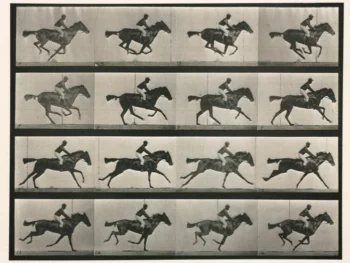
To think of social posts as throw-away one-offs, as much marketing does, is like viewing a single frame of a film that’s designed to be watched at 24 frames per second. It’s like the blind men and the elephant – you may *think* you know what’s going on, and how your audience is responding, but you’re not seeing the whole (motion) picture.
Yes, a single tweet or Facebook post *can* work in isolation. It can have impact. A person with a couple of hundred followers can see something they post go viral and reach hundreds of thousands of likes. An influencer can amplify it to the point the original poster can monetise that single moment, or use it as the starting point to become an influencer in their own right.
But the clue’s in the name – social is *social*. It’s about relationships, not one-off interactions. And the internet is the same – again, the clue’s in the name. It’s a network. It’s interconnected. Nothing online operates in isolation.
This is why an approach to online advertising that thinks only about the advert – in isolation – is always going to be doomed to fail. (And yes, if your social media post or article or video or whatever is put out on a schedule to broadcast to your followers – whether you put paid behind it or not – if you have no plan or resources to follow up and respond to the replies, then all it is is an advert.)
Even if you aggregate all your social data to see trends over time, you may *think* you’re seeing the big picture – but you’re not seeing it from the perspective of your audience. You’re lumping them together as stats, when in reality they’re all individuals – each having a distinct interaction with your brand. The long-term trends hide the fact that your audience is not always the same audience – different people will see different posts at different times, and many won’t see some of what you’re putting out at all. This means they’ll all be getting different impressions of what it is you’re about.
I remember when all this were fields…
When I started playing about in IRC and messageboards in the 90s, it took months to be recognised as a regular. When I started blogging in the early 2000s, it again took months to build a following and reputation.
And that’s months of multiple posts a day. Multiple replies to comments. Discussions. Following commenters back to their own blogs and reading *their* stuff. Getting a sense of how they thought.
This was all pre-Twitter, pre-Facebook – but post-IRC, and after messageboards, MSN Messenger and the like had become passé. We’d encounter each other on other people’s blogs, in their comment sections, and notice we were talking about the same things through trackbacks, RSS aggregators (after 2004 or so), checking now-defunct sites like Technorati, IceRocket and the like to find other people talking about the same thing (because Google was still rubbish for realtime search back then), and occasionally directly emailing.
Looking beneath the surface
The public face of blogging was our individual blogs. The individual posts. But those were just the tip of the proverbial iceberg – the starting points for interactions between blogger and reader that in some cases have lasted years. Some of the people I met virtually through my various blogs have become real-life friends. Some discussions inspired people to take up blogging for themselves, or to pursue different careers. Some of those interactions even led to real-world, paid work (as they did for me – which, in turn, led to my transition from print journalism to digital, and from there to my current role developing multiplatform, multimedia digital marketing strategies).
All these deep, lasting, sometimes life-changing relationships started with a connection around shared interests – just as, today, algorithms try to match adverts to people who may be interested in them. Superficially, to anyone looking from outside, those initial interactions in the comment sections under individual posts would have looked like that was all there was. If you’d looked at the stats on our blogs, the numbers would have looked *tiny*.
But the *real* story was the ongoing conversations and subconscious assimilation of each others’ ideas. The discussions and collaborations that stretched over months, and led to the short-lived rise of group-blogs, real-world meet-ups, grand plans that (in my case at least) never quite came to fruition. It was about the relationships and trust we built up over time.
The *real* impact took *years*, and in some cases was more significant than any of us ever imagined when we first put finger to keyboard.
How humans work
We’re all humans. We latch onto stories. We need big ideas. Emotional connections. Things to inspire and entertain. Things that speak to our gut instincts as well as to our heads. We’ve all read Daniel Kahneman, and know these heuristics are classic marketing creative territory.
And yes – as we’re humans we can also be manipulated if we’re targeted with the right message at the right time. Some of us will be more susceptible to some messaging than others. We will all have slightly different interests, meaning you can’t speak to us all in the same way. So a data-driven approach makes sense to try and finally give some clarity to John Wanamaker’s classic “Half the money I spend on advertising is wasted” conundrum.
But where big idea creative can attract attention, and data-driven targeting can increase relevance, what’s still missing for many brands is the follow-up. The vital thing that comes next.
In some cases this is where CRM comes in – but I can tell you from my blogging and chatroom days, in most cases being overly keen to initiate a conversation is going to have precisely the opposite response from the one you want. No one wants a pop-up window asking if they want help the second they land on a site any more than they want cookie notifications or requests to turn off their adblocker. Overly keen CRM = instant bounce, often with feelings of mild violation and anger. Not great for the start of a relationship. There’s a reason Microsoft killed Clippy…
My point? Let your audience go at their own pace
The reason the brief Golden Age of blogging (from around 2003-2006, by my reckoning) led to so many strong, lasting relationships is that those relationships were able to be built at our own pace.
There was no realtime chat. There was no “unread” notification to put pressure on us to respond unless and until we were ready. We all gradually built up archives of work that our readers and fellow bloggers could all check out at their leisure to get a sense of who we were and what we stood for. We linked to our past work – and each other – where relevant, showing how our thinking was developing over time, and allowing others to follow our trains of thought at their own pace to catch up and join in the conversation.
So when you encountered an unfamiliar blog or blogger – which was frequently – you could dip your toe in, test the water, and go back and check the context before engaging only when you had an idea what you were going to get involved in.
It was a slower-paced, more civilised way of communicating online that the likes of Twitter seem to have permanently destroyed with the constant need for instantaneous responses to everything.
But today’s pressure to living in the moment and make instant decisions is deeply offputting. It’s not how people like to work. It’s not how any successful relationship has ever been built. It goes against all the instincts of the high-pressured world we’re now in, but today’s emphasis on the hard sell and call to action – not just the obvious “BUY NOW!” but also the more subtle “CLICK HERE TO…” and “FIND OUT HOW…” – may give a short-term nudge but not a long-term engagement.
Engagement – true, lasting engagement – comes through recognition, familiarity, and trust. This can only ever be built over time – often a long time. It will never come through a hard sell, and rarely through a single call to action.
In short:
Rather than worry about big ideas vs targeting, what the marketing industry really needs to learn how to do is revive the art of the soft sell and the long tail. That’s the more human way of building relationships that last – but to work it needs a significantly more nuanced understanding of how people will be interacting with you than I’ve seen from pretty much any modern brand marketing campaign.
So remember:
Every interaction with every part of your brand’s marketing campaign may seem like a one-off to you, but it’s part of a series to your audience. It’s all connected – but one bad experience could break the chain.
This means you need a truly integrated combination of high-impact big ideas and detailed data and longer-term storytelling and archives of the earlier bits of the story so people can catch up and targeting to the people who’ll be most interested and a true understanding of how people – and the internet – actually work.
No one said it was easy. But some things take time.
“Now, we expect documentation, live-feeds, streaming video, real time Tweets… [Ferguson] unfolded in real time on my social media feed which was pretty soon taken over by the topic…
And then I switched to non net-neutral Internet to see what was up. I mostly have a similar a composition of friends on Facebook as I do on Twitter.
Nada, zip, nada.
This morning, though, my Facebook feed is also very heavily dominated by discussion of Ferguson. Many of those posts seem to have been written last night, but I didn’t see them then. Overnight, “edgerank” –or whatever Facebook’s filtering algorithm is called now?—?seems to have bubbled them up, probably as people engaged them more.
But I wonder: what if Ferguson had started to bubble, but there was no Twitter to catch on nationally? Would it ever make it through the algorithmic filtering on Facebook? Maybe, but with no transparency to the decisions, I cannot be sure.
Would Ferguson be buried in algorithmic censorship?
Would we even have a chance to see her?
This isn’t about Facebook per se—maybe it will do a good job, maybe not—but the fact that algorithmic filtering, as a layer, controls what you see on the Internet. Net neutrality (or lack thereof) will be yet another layer determining this. This will come on top of existing inequalities in attention, coverage and control.”
It’s a continual worry – how to ensure we see what’s important? Though, of course, the concept is nothing new – the algorithm is just an editor or an editorial policy in a different form. It’s something I’ve written about before when it relates to the EU, focusing on a BBC editorial policy that fails to cover EU affairs in mainstream news most of the time, and then serves up extremes.
This kind of human editorial determination of the appropriate news agenda based on perceived audience interests is arguably no massive degree different from a Facebook algorithm determining what is important based on how it interprets user interests. If anything, there’s a strong argument to be made that Facebook knows its audience better than any editor on any publication or TV show ever, due to the sheer quantities of data it possesses on its userbase.
But then what of *importance* – who determines this? Who overrides the algorithmic or standard editorial policy assumption? Is there a chance that an important story will get buried because a bit of code doesn’t see it as significant? Yes. But the same is true of any number of important news stories that human editors don’t pick up on, or choose to bury on page 23 because they don’t think their readers will be that interested.
As so often, the web may be a bit different, but there’s nothing that *new* here.
Nothing new, but this is worth a read on web writing and hate-reading – that old trick of being as controversial as possible in order to get an extreme response, purely because extremes get more attention, and in a pageview-driven business model, controversy is seen as good purely because, based on the metrics, it’s the controversial stuff that’s driving engagement.
This infantile attitude of provocation to get attention is increasingly being combined with ream upon ream of cheap content, because the more content you’ve got, the more potential PVs you can attract. We end up with the most depressing (and false) equation of online publishing:
Cheap content + Controversy = Clicks = Cash
It’s an attitude that’s lazy *and* massively short-termist in thinking – over the long term, quality can and should trump quantity. But even if it doesn’t, cheap, crappy content is a turn-off for audiences. The more sites that start to rely on hastily-produced, poorly-checked copy, or lazy semi-plagiarisms of things that desperate teams of poorly-paid hacks with deadlines and quotas to hit have found elsewhere, the less distinctive sites get, and the fewer returning visitors you’ll get. As that linked article puts it:
“With a business model based on a ton of cheap content, Web publishers can rely too heavily on acid-reflux-style aggregation, in which young writers destroy the savor of interesting stories and an interesting world by constantly regurgitating the news with added bile.”
There’s also an interesting point made from John Waters in the Irish Times (now behind a paywall), on the impact of comment sections under online articles:
“Because everything written specifically for online consumption is written in the expectation of addressing a hostile community, the writing process demands, as a prerequisite, either a defensive or antagonistic demeanor.”
Having learned my online publishing trade in the realm of message boards, chatrooms and blogs, I’m incredibly aware of the vast levels of bile that exist in comment sections. But it doesn’t have to be this way. With careful community management, it’s perfectly possible to build online communities that are supportive, friendly, and constructive, rather than the supposed default of objectionable and offensive. Check out the likes of b3ta, imgur and Metafilter for some prime examples of sites with vast *positive* communities of commenters. And then contrast those with the comments sections of pretty much any national newspaper site – packed with trolls and maniacs.
“There are many more listicles of length 10 published compared to other numbers. This is primarily because BuzzFeed is selling the 10-length listicle to partner brands, such as the Michael J. Fox Show, Nordstrom Topman, and Buick. The second most popular length is 15, followed by 12. Listicle length drops off quite rapidly in the 20’s, although surprisingly, lengths 11-21 are far more popular than those under 10…
“If we look the bar chart by audience score we see a completely different picture — odd number length listicles… tend to have a higher audience score on average, where in our dataset, the number 29 tends to have an advantage over the rest.”
I usually hate tips for writers – writing, to me, should be a natural thing. But having seen a lot of very bad writing, more concerned with showing off the writer’s linguistic skill or subject-matter expertise than enlightening the reader, this approach strikes me as vital to keep in mind at all times:
Writing is a modern twist on an ancient, species-wide behaviour: drawing someone else’s attention to something visible. Imagine stopping during a hike to point out a distant church to your hiking companion: look, over there, in the gap between those trees – that patch of yellow stone? Now can you see the spire? “When you write,” Pinker says, “you should pretend that you, the writer, see something in the world that’s interesting, and that you’re directing the attention of your reader to that thing.”
Perhaps this seems stupidly obvious. How else could anyone write? Yet much bad writing happens when people abandon this approach. Academics can be more concerned with showcasing their knowledge; bureaucrats can be more concerned with covering their backsides; journalists can be more concerned with breaking the news first, or making their readers angry. All interfere with “joint attention”, making writing less transparent.
This isn’t a “rule for writers”; it’s a perspective shift. It’s also an answer to an old question: should you write for yourself or for an audience? The answer is “for an audience”. But not to impress them. The idea is to help them discern something you know they’d be able to see, if only they were looking in the right place.
Notes and Essays
To help shape my thinking, I write essays and shorter notes examining the ideas and narratives that shape media, marketing, technology and culture.
A core focus: The way context and assumptions can radically change how ideas are interpreted. Much of modern business, marketing, and media thinking is built on other people's frameworks, models, theories, and received wisdom. This can help clarify complex problems – but as ideas travel between disciplines and organisations they are often simplified, misapplied or treated as universal truths. I'm digging into these, across the following categories - the first being a catch-all for shorter thoughts:

 “When AI is mentioned, it tends to lower emotional trust, which in turn decreases purchase intentions.”
 In Japanese, the word for alcohol is sake – which is fairly familiar to English speakers as Japanese rice wine. Ask for sake in a Japanese bar (at least, if you’re obviously not Japanese, like me), and that’s what’ll be delivered, even though the word technically means all types of alcohol.