by James Clive-Matthews | 10 May, 2014 | Structures & Models
 3/5 stars
Judt was obviously a master, as anyone who’s read even parts of Postwar can attest. His illness and early death was tragic. The idea for this book – to capture some of his knowledge and ways of thinking before the end – was a good, if macabre, one.
The trouble is, it’s an extended interview where the interviewer doesn’t seem to know when to shut up and let the interviewee speak. Timothy Snyder may well be a good historian in his own right (I don’t believe I’ve read any of his stuff, so can’t tell), but as an interviewer he leaves much to be desired – acting like an eager student trying to please teacher by showing off his own knowledge rather than shutting up and learning from the teacher as he’s supposed to do.
This gets particularly frustrating when Snyder keeps trying to divert Judt onto topics – such as the repeated questions about impact of Judt’s Jewish heritage on his upbringing and thought processes – that Judt continually tries to politely dismiss as largely irrelevant. Judt himself repeatedly points out that he had a more complex intellectual background than merely being a left-wing Jew – to try and shoehorn him into such a stereotype pushes the book dangerously close to being predictable, which is the last thing I’ve come to expect from Judt’s work.
That said, there’s still some fascinating stuff in here – but it needed a tighter edit, largely to remove Snyder’s voice and some of the more rambling digressions, and let Judt’s voice and opinions come through more clearly.
by James Clive-Matthews | 7 May, 2014 | Structures & Models
Obvious, but worth stating – and highlighted in an arguably overly-critical piece on the new Los Angeles Times website redesign (which, bar the lack of swipe navigation on the “browse visually” section, I like well enough – my only complaint with the look of the thing being their terrible, boring choice of photo on nearly every story):
“much of the innovation touted here has the publication playing catch up. Everyone, it seems, particularly web-only news outlets, has been treating each story as a hook to come into their sites. And nearly everyone seriously in the game is mobile-first…
“The Times is on board with best practices as the online journalism world knows them today. It’s just that the winners in this fast-moving game will be moving the ball forward and taking risks with payoffs that can’t be foreseen but that will seem obvious in the future.
“The redesign is formulaic. If you took a class on digital journalism last year, the professor would have told you this layout is what works.”
The obvious retort to which is a) “so what if it’s not a whole new thing?” and b) “who says that the pioneers win?”
The future of journalism / publishing doesn’t need to be radically different from what’s gone before. We shouldn’t need shiny bells and whistles to attract attention if the quality of the content is good enough and meets the needs of the audience.
 There have arguably been only a few radical shifts in journalistic presentation over the centuries, and all have been technological: the printing press, the steam-powered printing press, radio, film, television, the Internet. These required radical shifts in thought – all else is just presentation. Don’t get me wrong: presentation matters. But it’s not the starting point.
The challenge with all journalism in all ages is in a) identifying your audience and b) providing your journalism in a format that meets the balance between cost effectiveness and convenience for both you and your audience.
Mobile first websites make sense not just because the web audience in most developed markets is moving mobile, but also because it reduces costs – no more double development for big screens and small, mouse and touch, as has been the case for the last decade or so. Potentially, if done right (as with Quartz) you can even do away with a separate app – a potentially vastly expensive undertaking that ties you into seemingly endless development cycles to catch up with each new update to iOS, Android, Windows Phone, or whatever the next big thing is.
The advent of mobile first design thinking over the last couple of years could finally give Internet journalism space to start working out the more important questions about funding and distribution. The tools could stop being the problem for the first time in twenty years of the web.
As with early print, the ink and the paper part has been more or less decided (database-driven back end, HTML/CSS front end). What’s not been worked out is the ideal size of the paper, or the ideal font / layout. And as with print, the ideal will vary depending on the purpose. A newspaper is not a novel or a photography magazine.
Early printing was constrained for decades by old ways of thinking – book sizes based on old hand-written manuscripts that were themselves based on the amount of useable vellum you could get out of a calf skin (a “quarto” manuscript being the size of a quarter calf skin), with fonts that were based on gothic scripts designed by monks for spectacle and constrained by how they could cut the feather quills they used for writing, not ease of reading. Later, the industry persisted with the broadsheet format – always impractical for readers – because it was cheaper to produce, because their machines had been built that way – because centuries after Guttenberg the printing press had barely evolved.
Even in this post-Guttenberg Internet age, what matters is maximising access to our content while minimising the cost of production, same as it always has been. That content may look a little different, with interactive infographics and HTML5 video and so on – but at its heart it’s not changed either. It’s still all just words and pictures, the same today as it was in the pre-Guttenberg days of monks lined up in candle-lit rooms, copying out vastly expensive manuscripts for the tiny minority who could afford them.
Meanwhile, the assumption that the pioneers win is a nonsense. The pioneers make the mistakes that those who follow after can learn from. Only a very few of the earliest settlers succeed – the Oregon Trail led to many more deaths than happy new prosperous lives.
Short version: the real debate of the future of journalism isn’t about style, it’s about technology and economics, same as it always has been.
We need to accept this – because constraints can be useful. Without constraints, the Internet is a blank canvas – but Mankind has always preferred to know where the boundaries lie.
A combination of money and tech can help us set those boundaries. Some will continue to push them outwards, but few ordinary people are interested in living on the frontiers. They prefer safe and familiar. The pioneers of new techniques and technologies should be lauded, but it is the settlers who come after that will make the new land liveable and viable in the long run.
by James Clive-Matthews | 3 May, 2014 | Narratives & Meanings
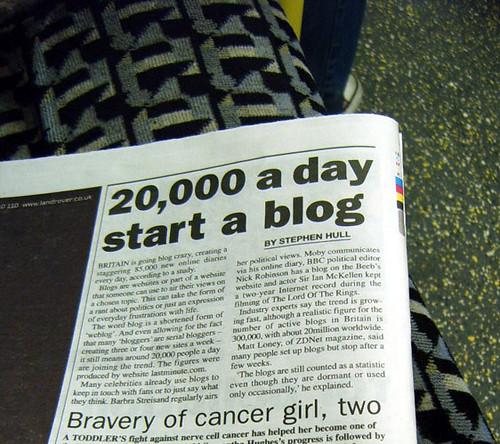
Something tells me this headline was from a fair few years ago…
A few years ago, after I won the European Parliament Prize for Journalism for a post on my politics blog, I told an interviewer that I believed that the arrival of the web heralded a new golden age for journalism (see below, or click to listen).
This – despite all the challenges that the industry still faces – I still believe.
In the last few weeks we’ve seen the launch of FiveThirtyEight, Vox and The Upshot, all trying new things that wouldn’t have been possible pre-internet.
In the last year or so, we’ve seen the rise and rise of Quartz, News Corp buy the excellent Storyful, the Mirror Group launch the interesting – and so far seemingly successful – experiments UsvsTh3m and Ampp3d, and Buzzfeed continue to expand into the realm of the serious (as well as other languages), fuelled by their success in the silly.
And that’s not to mention the increasingly experimental news apps, from Circa to Yahoo News Digest, Reuters’ WiderImage and Zite, all of which are experimenting with the vast, mostly still untapped potential of the splicing of internet and media.
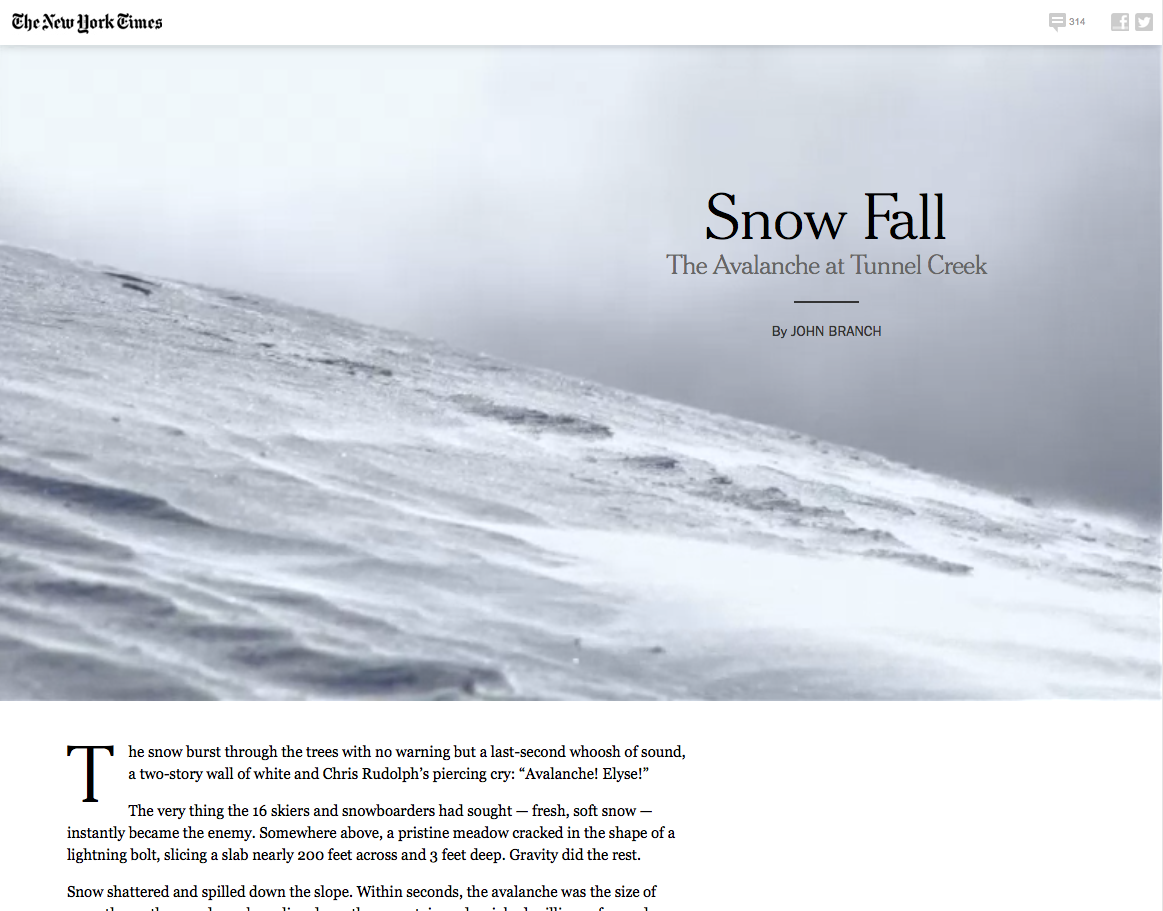
Snowfall – the future, or overblown?
Over the last few years I’ve had the pleasure of attending a number of News:Rewired conferences, hosted by my colleagues at MSN UK and organised by the fine folk at Journalism.co.uk.
At these and other events, be they blogger meetups or the small number of Hacks/Hackers events I’ve managed to attend, I’ve met or listened to too many interesting people with interesting ideas to list.
At the same time, there seems to be more interesting coverage of the world of media now than ever – especially of that intersection of media and technology that is the internet. And with this coverage comes more interesting discussion. (I’ve been deeply envious of all those at the International Journalism Festival in Perugia at the moment, and have been avidly following on Twitter.)
Recently I’ve been enjoying posting the occasional comment on LinkedIn about the media/online world in which I’ve been earning my living for the last decade and a half. But the discussions on LinkedIn can be limited by the forum itself – people are reluctant to speak freely on a platform that’s little more than a glorified CV repository.
Using my existing blog to talk about my fascination with the ongoing evolution of journalism doesn’t seem quite right – that’s got 11 years’ worth of posts about European politics, with only occasional digressions on the media and the web.
And so I’m starting up this blog to give myself more space to work out my own ideas on the future of news (and how to fund it), as well as the web and communication than in any expectation of interesting anyone else. But all contributions and discussions will be most welcome – be they here (once I’ve got comments set up, at least, or elsewhere.
Journalists following the dodo?: Interview with James Clive-Matthews by tuulitoivanen
