by James Clive-Matthews | 12 Mar, 2021 | Systems & Technology
As the FT points out, big tech has so much data on us, surely ad targeting should be good by now?
The real solution to increasing your chances of reaching the right people isn’t marketing automation, it’s user experience. One’s a tactic, the other’s a strategy.
After all, if even Facebook struggles to identify audience interests with any degree of accuracy, what hope do more limited platforms have?
The risk isn’t just that you’re wasting your paid media spend on micro-targeting, it’s that you’re wasting your production budget producing multiple variants of marketing content for audiences that may never see your material. It’s lose-lose.
The magic bullet isn’t audience segmentation in promotion plans – it’s focusing on your audiences’ interests in the content and messaging development phase. This helps ensure what you’re saying (and how you’re saying it) can appeal to multiple target groups at the same time – from niche to broad. Then you can let your audiences self-select the next step on their customer journey via clear signposting of where to go to find what they want.
One size may not fit all perfectly, but with a skilled tailor one size can be given the *illusion* of fitting all. People will pay attention to the things they’re interested in, not the things they aren’t. Which makes people far more capable of deciding what’s relevant to them than any algorithm.
by James Clive-Matthews | 11 Mar, 2020 | Marginalia
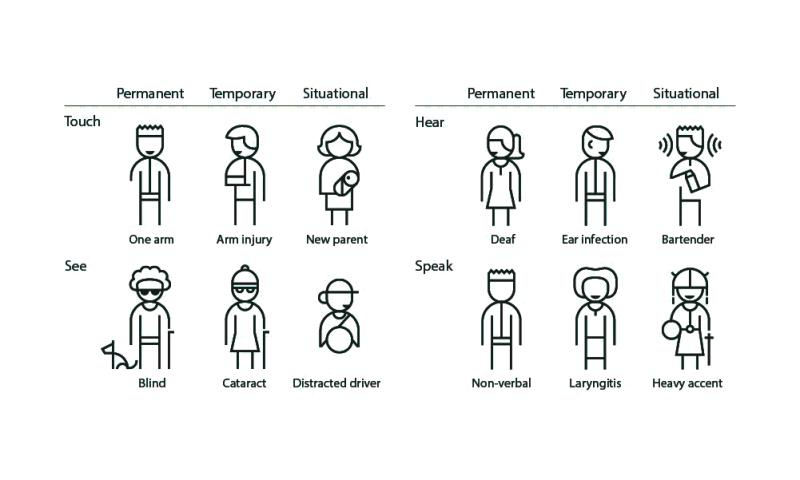 I’m not a fan of user personas. They’re meant to remind us of alternative perspectives, but tend to become either so specific as to make us blinkered, or so single-minded as to be unrealistic.
This piece does a good job of summarising how this fallacy of assuming we can identify user archetypes came about, how it misses so much vital nuance and complexity, and why we need to shake it off if we’re ever going to meet the needs of real users via a more effective, inclusive design approach to developing a better customer experience.
by James Clive-Matthews | 9 Sep, 2014 | Systems & Technology
Here it is. The new, multiplatform MSN.

Engadget has a solid overview piece.
The content proposition is fairly straightforward – a customisable mix of useful tools and the best content from many of the world’s biggest publishing brands across a bunch of key topic areas or verticals, curated by teams of in-market editors.
The aim on a technical level is actually the most interesting part of it – we’ve been developing a cloud-hosted CMS that enables single-publish across all devices and platforms, for both web and apps, running across 55 markets in 27 languages, with a coherent look and feel no matter your screen size or operating system. That’s properly ambitious.
Most of my input has been procedural (improving multimarket and multiplatform publishing processes) and hidden in the back end (I was part of the CMS superuser group that’s been working on back-end UX and workflow). I’ve not had as much involvement in the front-end design, architecture, or overall content strategy as I’d like, but still – a most definite improvement on one of the web’s longest-running major publishers (20 years old this year, and still doing a good 22 billion pageviews every month).
by James Clive-Matthews | 6 Sep, 2014 | Marginalia
This is exactly why I always try to muscle in on the design process:
“what are the ethics of platform design? …When designers create a… news app, they aren’t just designing software. They are creating a platform that participates in constructing an *idea* of news.”
by James Clive-Matthews | 14 May, 2014 | Structures & Models
I love Quartz.
I love news “atomisation” app Circa.
I am fascinated by the future of news.
So unsurprisingly yesterday’s launch of Quartz’s new Glass site – focused on the future of news via an experimental bite-sized format – got me rather excited.
But a day in, I can’t see the point of the atomisation format for this kind of site.
The perils of high expectations
What we get are Tweet-length (or thereabouts) snippets of media news, usually with a link – similar to the linklogs popular around the late 90s / early 2000s (think Memepool, Fark, LinkMachineGo) – or some kind of opinion, often with a little arrow indicating that you can click for more.
A linklog aggregating media news is fine – a useful addition to my Twitter list of handy sources of industry info, with some useful selections.
But why this atomised opinion approach? It’s like a choose your own adventure book, only with argument/opinion – subsequent points hidden until you click – for reasons that largely escape me.
Form vs function
Take this piece on the (excellent) Fargo TV series. That link takes you to the full post – with all the subsections expanded. It reads fine – just like a regular blog post.
But come to it from the front page? You get the first paragraph only.
Click down, you are presented with the tier two paragraphs (numbers 2, 4, 6, 8 and 10).
To get the full post, you have to click an additional four times to get paragraphs 3, 5, 7, 9 and 11. That’s five clicks to get one story.
What matters more – metrics or readers?
Now yes, this will give Quartz lots of useful data that they can analyse to check reader engagement – just as Circa does with their atomised news stories.
But where Circa’s use of “atoms” for presenting their stories makes sense and is backed up by a clear philosophy*, for the opinion piece parts of Glass I simply can’t see the rationale.
If I’m interested in your opinions about Fargo, I’m interested – so give them to me when I click. Don’t make me work harder to get your nuggets of wisdom – you risk annoying and disappointing me when the additional clicks prove pointless.
So from being excited, I’ve become annoyed – the content may be good, but the presentation is annoying. It’s bullet point lists with hidden child bullets, nothing more.
Or am I missing something?
* Short version of my understanding of Circa’s news philosophy (as an aside):
1) news is fast-paced, so keep coverage short and to the point
2) news is made up of facts, and facts change, but themes and stories persist/evolve
3) some facts can be recycled into new stories on the same theme
4) therefore breaking stories into their component (factual) parts makes sense both in the long and short term, as they
a) make the news easier/quicker to understand (when properly presented),
b) can be recycled into other stories on the same theme down the line, and
c) can have tracking attached to each element to see how/if audiences are engaging with that content, giving far more detail about user behavior than is possible from a standard article
by James Clive-Matthews | 7 May, 2014 | Structures & Models
Obvious, but worth stating – and highlighted in an arguably overly-critical piece on the new Los Angeles Times website redesign (which, bar the lack of swipe navigation on the “browse visually” section, I like well enough – my only complaint with the look of the thing being their terrible, boring choice of photo on nearly every story):
“much of the innovation touted here has the publication playing catch up. Everyone, it seems, particularly web-only news outlets, has been treating each story as a hook to come into their sites. And nearly everyone seriously in the game is mobile-first…
“The Times is on board with best practices as the online journalism world knows them today. It’s just that the winners in this fast-moving game will be moving the ball forward and taking risks with payoffs that can’t be foreseen but that will seem obvious in the future.
“The redesign is formulaic. If you took a class on digital journalism last year, the professor would have told you this layout is what works.”
The obvious retort to which is a) “so what if it’s not a whole new thing?” and b) “who says that the pioneers win?”
The future of journalism / publishing doesn’t need to be radically different from what’s gone before. We shouldn’t need shiny bells and whistles to attract attention if the quality of the content is good enough and meets the needs of the audience.
 There have arguably been only a few radical shifts in journalistic presentation over the centuries, and all have been technological: the printing press, the steam-powered printing press, radio, film, television, the Internet. These required radical shifts in thought – all else is just presentation. Don’t get me wrong: presentation matters. But it’s not the starting point.
The challenge with all journalism in all ages is in a) identifying your audience and b) providing your journalism in a format that meets the balance between cost effectiveness and convenience for both you and your audience.
Mobile first websites make sense not just because the web audience in most developed markets is moving mobile, but also because it reduces costs – no more double development for big screens and small, mouse and touch, as has been the case for the last decade or so. Potentially, if done right (as with Quartz) you can even do away with a separate app – a potentially vastly expensive undertaking that ties you into seemingly endless development cycles to catch up with each new update to iOS, Android, Windows Phone, or whatever the next big thing is.
The advent of mobile first design thinking over the last couple of years could finally give Internet journalism space to start working out the more important questions about funding and distribution. The tools could stop being the problem for the first time in twenty years of the web.
As with early print, the ink and the paper part has been more or less decided (database-driven back end, HTML/CSS front end). What’s not been worked out is the ideal size of the paper, or the ideal font / layout. And as with print, the ideal will vary depending on the purpose. A newspaper is not a novel or a photography magazine.
Early printing was constrained for decades by old ways of thinking – book sizes based on old hand-written manuscripts that were themselves based on the amount of useable vellum you could get out of a calf skin (a “quarto” manuscript being the size of a quarter calf skin), with fonts that were based on gothic scripts designed by monks for spectacle and constrained by how they could cut the feather quills they used for writing, not ease of reading. Later, the industry persisted with the broadsheet format – always impractical for readers – because it was cheaper to produce, because their machines had been built that way – because centuries after Guttenberg the printing press had barely evolved.
Even in this post-Guttenberg Internet age, what matters is maximising access to our content while minimising the cost of production, same as it always has been. That content may look a little different, with interactive infographics and HTML5 video and so on – but at its heart it’s not changed either. It’s still all just words and pictures, the same today as it was in the pre-Guttenberg days of monks lined up in candle-lit rooms, copying out vastly expensive manuscripts for the tiny minority who could afford them.
Meanwhile, the assumption that the pioneers win is a nonsense. The pioneers make the mistakes that those who follow after can learn from. Only a very few of the earliest settlers succeed – the Oregon Trail led to many more deaths than happy new prosperous lives.
Short version: the real debate of the future of journalism isn’t about style, it’s about technology and economics, same as it always has been.
We need to accept this – because constraints can be useful. Without constraints, the Internet is a blank canvas – but Mankind has always preferred to know where the boundaries lie.
A combination of money and tech can help us set those boundaries. Some will continue to push them outwards, but few ordinary people are interested in living on the frontiers. They prefer safe and familiar. The pioneers of new techniques and technologies should be lauded, but it is the settlers who come after that will make the new land liveable and viable in the long run.
