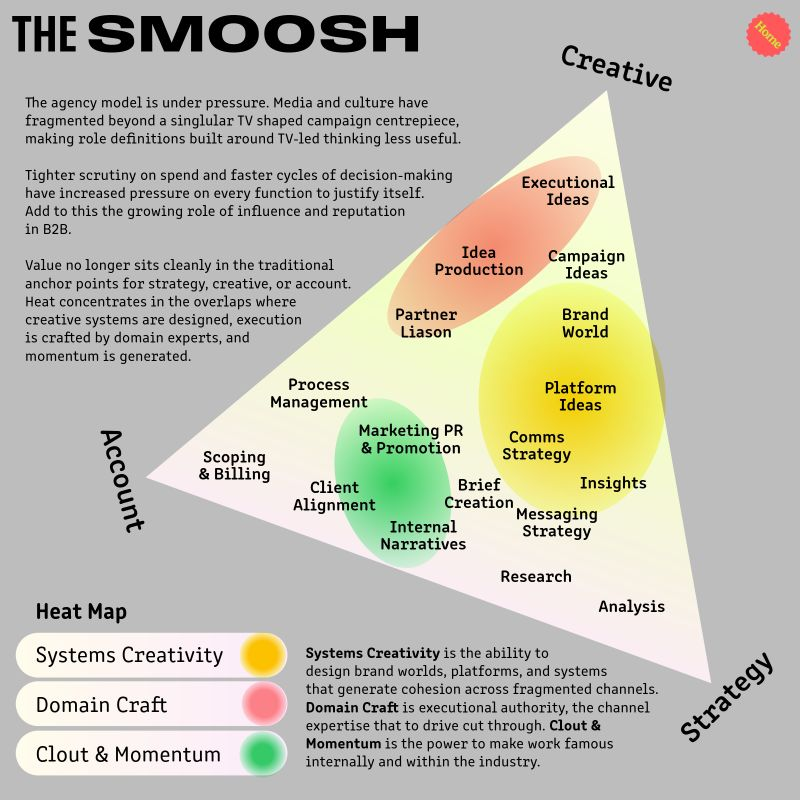
This is pretty much what I’ve been talking about for the last few years, via Joe Burns.
The problem isn’t just that the old model doesn’t work in a more complex environment – it’s that the very terminology precludes understanding and alignment, as everyone has a different idea of what the labels mean.
The key to success has always been systems thinking – but many agencies (and even more so in-house marketing teams) continue work in siloes, with nowhere near as much discussion and collaboration as is needed to come up with truly effective approaches.
As Joe Burns put it in his post on this:
“Coherence has to come from the system, not just one execution. The idea of a ‘Campaign’ only works if you can muster a critical mass of attention to carry people through it.”
Maybe it’s my “content” background speaking – because really strong content strategies need to work at multiple levels, across multiple channels and formats, and for multiple audiences with multiple needs. Without understanding the big picture *and* the details, it’s impossible to deliver effectively content across a campaign – individual assets may be solid, but the whole ends up less than the sum of its parts.
This is why I’ll continue trying to play in those overlap areas – not only do I find the diversity and clash of approaches and ideas stimulating, but I see it as the only way to work out the best way to succeed. You have to try to see the big picture to work out the best individual brush strokes.
I’ve seen this piece shared a lot, and like it. I’ve long been a fan of Systems Thinking (check my bio, it’s at the heart of my approach to everything).
But I’ve always seen Systems Thinking as more of a mental model or reminder to look beyond the immediately obvious causes and effects that could impact a strategy, rather than an enjoinder to try and literally map out interactions between all the different components.
As this piece notes, if you try to map out every interaction in a complex, shifting, uncertain system, you’ll never succeed. There are too many variables, all changing. Complexity Theory – even Chaos Theory and the Heisenberg Uncertainty Principle – rapidly becomes more helpful. Only these usually aren’t of much *practical* help at all.
It’s like playing chess – you don’t bother mapping out ALL the possible moves, as that would take forever (look up the Shannon number to get a sense of how many there could be – it’s more than the number of atoms in the observable universe…), and is therefore useless.
With experience, good chess players (and good strategists) can rapidly, intuitively home in on the moves most likely to work – both now and several moves down the line.
The problem is that the same moves will rarely work twice – at least not against the same opponent. And in a complex, ever-changing system, you’ll rarely have the opportunity to make the same sequence of moves more than once anyway, as the pieces will be constantly changing position on the board. Which will also be constantly changing size and shape.
“But metaphor isn’t method.”
That’s the key line from the linked piece. Business strategy isn’t chess – because you’re not restricted to making just one move at a time, or moving specific pieces in specific ways.
The challenge is to keep as flexible as possible while still moving forwards, which is why this bit of advice – one line of many I like, especially when combined with the recommendation to design in a modular, adaptive way – is one I pushed (sadly unsuccessfully) in a previous role:
“Instead of placing one big bet, leaders need a mix of pilots, partnerships, and minority stakes, ready to scale or abandon as conditions change.”
The problem is that strategy decks – still at the heart of most businesses and almost every marketing agency – are intrinsically linear, despite trying to address nonlinear, complex systems.
This is why most strategies end up not really being strategies, but plans, or lists of tactics.
And thats why most “strategies” fail.
Don’t focus on the *what* – focus on the *how*. Great advice from my former boss Jane O’Connell, which took me a long time to truly understand. It’s a concept that’s core to this excellent piece – and incredibly hard to explain.
I’ve been getting increasingly sucked into the systems thinking wormhole in recent months, and this piece brings together a lot of the reasons why in a wonderfully readable bit of weekend lean-back longform food for thought – on the pandemic, society, science, economics, politics, and everything in between.
The concepts of information flux, robustness mechanisms, Sauron’s bias and monkey fights are definitely ones I can see myself obsessing over and trying to work into future strategy decks…
(Also, one of the co-authors of which has the truly awesome job title “Professor of Complexity”, giving me a whole new career aspiration.)
A teaser:
As the mathematician John Allen Paulos remarked about complex systems: ‘Uncertainty is the only certainty there is. And knowing how to live with insecurity is the only security.’ Instead of prioritising outcomes based on the last bad thing that happened – applying laser focus to terrorism or inequality, or putting vast resources into healthcare – we might take inspiration from complex systems in nature and design processes that foster adaptability and robustness for a range of scenarios that could come to pass.
This approach has been called emergent engineering. It’s profoundly different from traditional engineering, which is dominated by forecasting, trying to control the behaviour of a system and designing it to achieve specific outcomes. By contrast, emergent engineering embraces uncertainty as a fact of life that’s potentially constructive.
When applied to society-wide challenges, emergent engineering yields a different kind of problem-solving.
Notes and Essays
To help shape my thinking, I write essays and shorter notes examining the ideas and narratives that shape media, marketing, technology and culture.
A core focus: The way context and assumptions can radically change how ideas are interpreted. Much of modern business, marketing, and media thinking is built on other people's frameworks, models, theories, and received wisdom. This can help clarify complex problems – but as ideas travel between disciplines and organisations they are often simplified, misapplied or treated as universal truths. I'm digging into these, across the following categories - the first being a catch-all for shorter thoughts:

 I’ve seen