by James Clive-Matthews | 24 Mar, 2026 | Narratives & Meanings |
Apparently a new Cornell University study has found that workers who use / fall for corporate bullshit are worse at their jobs…
This brought back fond memories of the Bullshit Bingo tracker we used to keep to try and steer clients (and ourselves) away from jargon when working on B2B projects back in my Group SJR days…
Simple, jargon-free language is almost always the best option if you want your message to be understood – but it can be hard to get it past approvers, because the more you simplify the language, the clearer the strategic recommendations become.
For some, this clarity feels like a risk – because the best strategies tend to be very simple, once you strip them of all the linguistic fluff. This is where and why business bullshit creeps in – to make the clear seem complicated, so the person presenting seems like they’re better value for money.
Of course, what this all misses is that devising the strategy *is* the easy bit (relatively). The hard part is getting others on board to start rolling it out, and to ensure the organisation as a whole doesn’t just adopt it as a mantra, but understands and acts on it.
This is why strategic development needs to take its time – the conversations and debates that inform a strategy are the first step towards helping the broader organisation accept it.
Put lots of jargon in your explanations, you’re creating barriers to understanding and adoption.
But equally. there’s always a risk that someone will call you on it – and reveal that underneath all the convoluted wording, you’re really not saying much of substance. That’s surely a far bigger reputational risk than showing you have the insight to cut through to the heart of the matter with a clear, simple strategic recommendation.
by James Clive-Matthews | 28 Sep, 2025 | Structures & Models
 I’ve seen this piece shared a lot, and like it. I’ve long been a fan of Systems Thinking (check my bio, it’s at the heart of my approach to everything).
But I’ve always seen Systems Thinking as more of a mental model or reminder to look beyond the immediately obvious causes and effects that could impact a strategy, rather than an enjoinder to try and literally map out interactions between all the different components.
As this piece notes, if you try to map out every interaction in a complex, shifting, uncertain system, you’ll never succeed. There are too many variables, all changing. Complexity Theory – even Chaos Theory and the Heisenberg Uncertainty Principle – rapidly becomes more helpful. Only these usually aren’t of much *practical* help at all.
It’s like playing chess – you don’t bother mapping out ALL the possible moves, as that would take forever (look up the Shannon number to get a sense of how many there could be – it’s more than the number of atoms in the observable universe…), and is therefore useless.
With experience, good chess players (and good strategists) can rapidly, intuitively home in on the moves most likely to work – both now and several moves down the line.
The problem is that the same moves will rarely work twice – at least not against the same opponent. And in a complex, ever-changing system, you’ll rarely have the opportunity to make the same sequence of moves more than once anyway, as the pieces will be constantly changing position on the board. Which will also be constantly changing size and shape.
“But metaphor isn’t method.”
That’s the key line from the linked piece. Business strategy isn’t chess – because you’re not restricted to making just one move at a time, or moving specific pieces in specific ways.
The challenge is to keep as flexible as possible while still moving forwards, which is why this bit of advice – one line of many I like, especially when combined with the recommendation to design in a modular, adaptive way – is one I pushed (sadly unsuccessfully) in a previous role:
“Instead of placing one big bet, leaders need a mix of pilots, partnerships, and minority stakes, ready to scale or abandon as conditions change.”
The problem is that strategy decks – still at the heart of most businesses and almost every marketing agency – are intrinsically linear, despite trying to address nonlinear, complex systems.
This is why most strategies end up not really being strategies, but plans, or lists of tactics.
And thats why most “strategies” fail.
Don’t focus on the *what* – focus on the *how*. Great advice from my former boss Jane O’Connell, which took me a long time to truly understand. It’s a concept that’s core to this excellent piece – and incredibly hard to explain.
Have a read – and a think.
by James Clive-Matthews | 16 Aug, 2024 | Marginalia
 This from John Hegarty resonated. Unpopular opinion, but awards – especially in B2B marketing – are the ad industry equivalent of social media vanity metrics. They may get you marginally more reach (usually long after the campaign’s over), but rarely with your real target audiences.
What’s worse, the positive signals award wins send out can create feedback loops of groupthink about tactics that can actively harm your ability to deliver.
I know it’s tough to demonstrate marketing effectiveness, but award wins rarely prove much beyond that marketing people like something. So unless you’re selling to marketers, they don’t really have much value.
This means awards make perfect sense for agencies (and individuals) to enter – but for their clients? The point of marketing is to improve brand perception and make sales with your buyers, not getting a round of applause from other marketers.
Which is why, often, I find the less glamorous side of marketing is where the real businesses impact can be found.
by James Clive-Matthews | 12 Mar, 2021 | Systems & Technology
As the FT points out, big tech has so much data on us, surely ad targeting should be good by now?
The real solution to increasing your chances of reaching the right people isn’t marketing automation, it’s user experience. One’s a tactic, the other’s a strategy.
After all, if even Facebook struggles to identify audience interests with any degree of accuracy, what hope do more limited platforms have?
The risk isn’t just that you’re wasting your paid media spend on micro-targeting, it’s that you’re wasting your production budget producing multiple variants of marketing content for audiences that may never see your material. It’s lose-lose.
The magic bullet isn’t audience segmentation in promotion plans – it’s focusing on your audiences’ interests in the content and messaging development phase. This helps ensure what you’re saying (and how you’re saying it) can appeal to multiple target groups at the same time – from niche to broad. Then you can let your audiences self-select the next step on their customer journey via clear signposting of where to go to find what they want.
One size may not fit all perfectly, but with a skilled tailor one size can be given the *illusion* of fitting all. People will pay attention to the things they’re interested in, not the things they aren’t. Which makes people far more capable of deciding what’s relevant to them than any algorithm.
by James Clive-Matthews | 22 Aug, 2020 | Structures & Models
I’ve been getting increasingly sucked into the systems thinking wormhole in recent months, and this piece brings together a lot of the reasons why in a wonderfully readable bit of weekend lean-back longform food for thought – on the pandemic, society, science, economics, politics, and everything in between.
The concepts of information flux, robustness mechanisms, Sauron’s bias and monkey fights are definitely ones I can see myself obsessing over and trying to work into future strategy decks…
(Also, one of the co-authors of which has the truly awesome job title “Professor of Complexity”, giving me a whole new career aspiration.)
A teaser:
As the mathematician John Allen Paulos remarked about complex systems: ‘Uncertainty is the only certainty there is. And knowing how to live with insecurity is the only security.’ Instead of prioritising outcomes based on the last bad thing that happened – applying laser focus to terrorism or inequality, or putting vast resources into healthcare – we might take inspiration from complex systems in nature and design processes that foster adaptability and robustness for a range of scenarios that could come to pass.
This approach has been called emergent engineering. It’s profoundly different from traditional engineering, which is dominated by forecasting, trying to control the behaviour of a system and designing it to achieve specific outcomes. By contrast, emergent engineering embraces uncertainty as a fact of life that’s potentially constructive.
When applied to society-wide challenges, emergent engineering yields a different kind of problem-solving.
by James Clive-Matthews | 15 Jun, 2020 | Narratives & Meanings
So, as I’m going to start writing about what I’m reading (and occasionally watching or listening to), primarily to explore a bit more about what I do for a living, I should at least start at the beginning. Even if I’m likely to jump around a lot afterwards.
The true beginnings of the art of persuasion came earlier, but Aristotle was one of the first (that we have surviving records for) to start codifying it into more of a science. As with a surprisingly large amount of Aristotle, a lot still stands.
First, what does Aristotle define rhetoric as being?
“The faculty of observing in any given case the available means of persuasion.”
In other words, rhetoric is all about knowing how to select the right tactics to effectively persuade a given audience on a given topic in a given circumstance.
There are “non-technical” means of persuasion – evidence, witnesses, etc. – but these lie outside the speaker’s direct control. Instead Aristotle’s rhetoric mostly focuses on “technical” approaches, which he terms “appeals” .
These he focuses on the three key elements of the situation:
- Speaker
- Subject
- Audience
With a bit of elaboration and nuance, these become the three core elements of classical rhetoric – and remain insanely relevant today:
1) Ethos: the speaker’s character
Basically the impression you give. Your character as given through your approach – but also your past reputation. Your ethos needs to inspire confidence, and increase the perception that you are credible.
This, in other words, is pretty much your brand.
It’s built up by a combination, Aristotle reckons, of good sense, good will, and good morals. If any of these are suspect – or successfully undermined by a rival (or an annoying comment on social media pointing out a bit of hypocrisy), your attempt at persuasion is less likely to succeed.
2) Logos: the argument made about the subject
This covers both substance – what you’re arguing – and the style – how you present it.
A combination of the idea and the wording, this is what many marketers and advertisers focus on the most. It’s the concept. The copywriting. The compelling call to action.
Most important – and something I keep focusing on, frustrated with seeing far too much shallow marketing – Aristotle insists that style and substance need to work hand in hand. They need to complement each other, not compete.
Fancy words without depth are pointless sophistry, empty rhetoric – and your audience will soon find you out.
3) Pathos: the emotion conjured in the audience
Positive or negative, triggering emotional reactions in your audience makes them more likely to pay attention and remember what you’re telling them. This is now proven by science – brain scans and clinical trials have demonstrated this point pretty much conclusively. Aristotle just got in a couple of thousand years early.
The challenge, of course, is to trigger the appropriate emotional response for the argument you’re making, among the audience you’re trying to persuade, to achieve the desired response. Aristotle lists 14 emotions – fear, confidence, anger, friendship, calm, enmity, shame, shamelessness, pity, kindness, envy, indignation, emulation, and contempt – but more recent psychologists have expanded this.
Balancing the sell
To be persuasive requires a balance of all three elements. But, of course, the balance needed varies depending on subject, audience, intention, and the reputation of the speaker/brand doing the persuading.
But, let’s face it, this is pretty much the core of selling:
- Ethos: This product / brand is good / reliable
- Logos: Because it will do X in Y way
- Pathos: And make your life better / prevent it from getting worse
Of course, it’s all a lot more complicated than that. That’s why there’s so many other rhetorical devices out there to play with. Of all these, there’s one more from Aristotle it’s important to cover in an introductory piece:
4) Kairos: it’s all about timing
You can be credible, emotionally considered, and have style and substance dripping from every pore – but if you time your appeal wrong, it’s never going to work.
Take this very post…
I’m writing this on a Monday evening. That’s a decent enough time for writing – especially as I had the day off and am feeling fresh and relaxed. But is it a good time for publishing? Most advice would say no. Even if I’d clearly defined my target audience, 10:30pm UK time is just about the worst time to publish anything: European audiences are heading to bed; American audiences are finishing up work for the day; Asian audiences are still asleep. If I wanted to reach my audience immediately, publishing now would be madness.
But it’s not just about the time on the clock – it’s also about appropriateness. We’ve had plenty of examples of this in the last few months of coronavirus lockdowns – some messages simply became out of place, and various ad campaigns have had to be pulled as businesses have shut down and travel and gatherings of people stopped.
Bringing it all together – or screwing it all up
The last couple of weeks of Black Lives Matter protests has also underscored the importance of appropriateness of messaging.
While some brands were quick to put out messages of support, others dithered – making them look bad.
Of the brands that did put out supportive messages, most got the emotion (rousing, empathetic) and style right (adopting the plain black background of the main BLM movement in solidarity), but some were accused of failing on substance. Vague supportive noises were simply not seen as strong enough by many – because to be an ally is to speak up, take a stand, and act, not just stand there mumbling platitudes.
And many more brands fell down on the ethos side: They may have said the right things, in the right way, at the right time, with the right emotion – but their actions behind the scenes ensured they simply weren’t credible. How many brands were called out for their claims to want more racial equity, only to receive the (fair) response: “How many Black people are on your board?” or “What’s the racial pay gap in your company?”
Persuasion can be a technical thing, in other words. You can study the art of rhetoric to develop appropriate strategies and deploy the right tactics. But while you can fool some of the people some of the time, and persuade some people for a while, you can’t fool everyone for ever.
Still, use these four points from Aristotle as a foundation for working out your strategy, and at least you’ve got the basics in place.
Which is probably why pretty much every marketing strategy deck still includes them in some form or other, albeit in agency speak rather than ancient Greek… At my current place we do this quite directly, referring to Wisdom (a form of ethos), Wonder (a form of logos) and Delight (a form of pathos), topped off with a bit of Velocity (one approach to kairos) – as well as a few additions like Atomisation, designed to acknowledge that different audiences (and different media) require different approaches.
There’s a lot more to it than this, of course. Aristotle alone wrote enough for a whole book about it… I’m planning on following up with more on the art and science of persuasion in the coming weeks and months. Watch this space.
The art of persuasion series:
- Aristotle’s rhetoric: the foundations of modern marketing
- Barthes and anticipating audience responses
by James Clive-Matthews | 30 May, 2020 | Marginalia
“We are the losers in this crisis.”
Sadly unsurprising, but still anger-making. Being child-free, I’ve mostly been enjoying working from home – but if this *is* going to be the new normal, we urgently need to find ways to make homeworking work for everyone.
This shift away from the office could and should have been a fantastic opportunity to break down barriers to employment for people who have previously struggled to participate in the traditional office-based nine to five – whether due to caring commitments, location, disability, or simple hiring prejudice.
We 100% cannot afford to allow it to reinforce structural inequality or outdated stereotypes.
by James Clive-Matthews | 17 Jan, 2018 | Marginalia
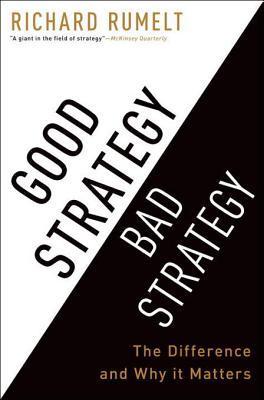 4/5 stars
One of the few strategy books recommended by Lawrence Freedman in his chunky Strategy: A History, largely for its gleeful destruction of the fatuous nonsense that passes for most business strategy.
There’s a lot of good stuff in here. Useful ideas. Good tips for clarifying thinking and approaching problems in a more strategic way.
But, as with so many business books, it’s very heavy on anecdote and case study, few of which are well told, and all of which could do with succinct, clearly formsttd summaries of the point so you can skip the details if needed. Only one section tries to do this, and it doesn’t do it well.
Nonetheless, where the thinking is clear and clearly presented, it’s got some excellent short sumaries of ways to think and act that can be invaluable to anyone in a leadership position. If you are, it’s definitely worth a read.
by James Clive-Matthews | 14 Nov, 2017 | Marginalia
 5/5 stars
An impressive no bullshit overview of strategic thinking (and claims about the merits of such thinking) over the last two centuries. My copy is now littered with copious notes, and I’m sure I’ll be returning to it repeatedly as a reference book from now on. Particularly enjoyed the excellent destruction of pretty much all businesses guru claims about management strategy.
Well worth investing the time to read this for anyone interested in politics or business – though there are big chunks it’s perfectly possible to skip, depending on your primary interest (the lengthy detour into left-wing and radical political theory added little for me, largely because I was already familiar with it).
