by James Clive-Matthews | 24 Feb, 2026 | Systems & Technology
This, on the resurgence of the Rise of the Robots fears about the threat of widespread AI job losses, gets some of the way to articulating the niggling issues I have with this apocalyptic narrative:
Even if you do believe the technology has got or can get good enough to replace workers at scale, the economics simply don’t make sense.
Of course, we’ve spent the last two decades witnessing many, many things that made no economic sense yet that happened anyway thanks to a combination of complacency, willful ignorance, ideology, bloody-mindedness, and spite. Just because something makes no economic sense doesn’t mean it won’t happen.
But despite non-AI industry stocks having been hammered over the last couple of weeks, think what needs to happen to enable this AI revolution. Most developed nations had energy and clean water supply challenges even before factoring in a data centre building boom. We still have a deep reliance on rare earth metals for the hardware that the AI needs to function (the clue’s in the name).
What happens to prices when demand surges to unprecedented levels and supply struggles to keep up? And how does that change the balance sheet projections when deciding whether to replace human workers with a grandiose form of a new SaaS subscription, whose monthly costs and reliability could shift at any moment?
Remember the $7 *trillion* Sam Altman was asking for to invest in infrastructure? That’s likely to be a substantial under-estimate of the amounts needed given how much every industry upstream of the AI companies is already struggling to meet their projected needs.
by James Clive-Matthews | 20 Jan, 2026 | Narratives & Meanings
 4/5 stars
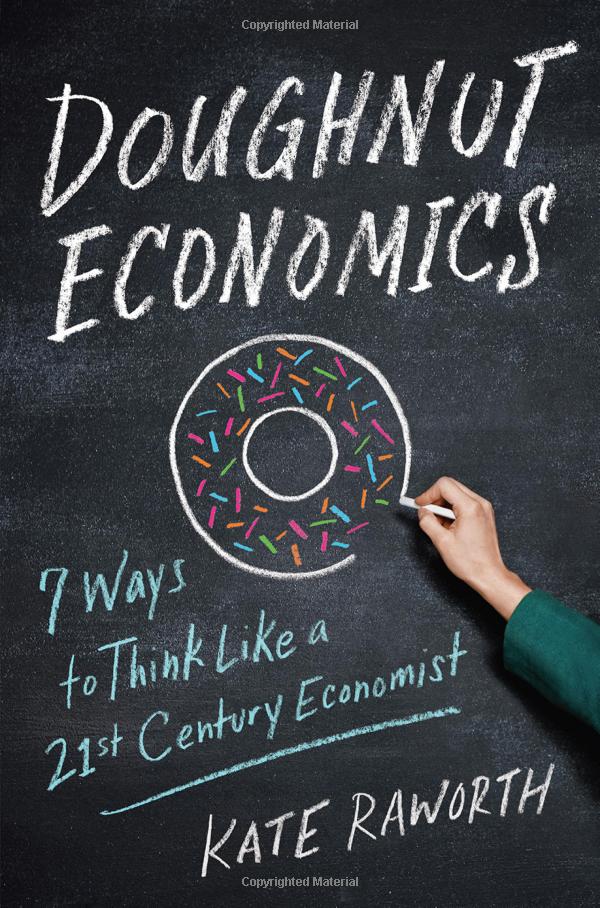
Interesting, thought-provoking and convincing about what needs to be done, while being realistic about how likely it is such vast changes to how the world works will come about. Yet also packed with examples of ways in which such changes are already taking place, giving some room for optimism.
A good polemic, in other words – and made even better by continually citing sources and experts from non-traditional backgrounds – neither ostentatiously nor explicitly, it made me realise how few economics and politics books regularly cite women or people from non-Western countries. Which may well be part of the reason why our economics and politics are so broken.
The only real criticism: The book itself is well enough written in terms of individual sentences and paragraphs, but lacks enough variety of tone and pacing to really keep the attention, and the author has a tendency to both repeat herself and extend metaphors well beyond the point where they have impact.
by James Clive-Matthews | 10 Apr, 2020 | Narratives & Meanings
 4/5 stars
An odd book, but very readable. Mini biographies of various leading economists of the last couple of hundred years are a mostly useful way to build the central argument: Economic ideas are a product of their time, and of their creators’ circumstances. It’s a fair argument, and one likely borne out by the fact I’m leaving this much more sympathetic to the ideas of Amartya Sen than any other person featured. He’s the only economist covered who’s still alive…
But this book is odd mostly due to its choices for who to include – and who to omit.
It starts by scene-setting with Dickens, then progresses straight to Marx and Engels, rather than going slightly further back to include Smith, Malthus, Ricardo and other earlier economists.
It’s heavily focused on British/American/Austrian thinkers to the exclusion of pretty much any others – and doesn’t include any non-Western economists other than Sen. Hell, it doesn’t even include any French economists.
The main contention other than everything progresses (it’s largely teleological in approach) is that everyone’s a Keynesian – even people you don’t think are Keynesian. Keynes hangs over the entire book, from long before he appears.
There’s a good case for this – I mean, Keynes is Keynes – but considering the general argument is that economics has been getting increasingly sophisticated, it seems odd that it largely (and rapidly) tails off in its interest in the aftermath of WWII (and, perhaps not coincidentally, Keynes’ death).
The most surprising omission, considering there’s a strong undercurrent of concern with human welfare throughout, is any reference to behavioural economics – surely one of the most fundamental shifts in approach to the discipline in the last 50-60 years.
Nor is there any coverage of the birth of game theory – arguably one of the most influential (and abused) concepts of the same period. This last is particularly surprising given the frequent use of the term “zero sum game” in latter chapters – and by the fact that the author’s previous best-known book was a biography of John Nash.
So yes, an odd book as much for its omissions as its inclusions. But engaging, readable, and (mostly) relatable. In that, it does what it set out to do – help you to understand not just *what* ideas economists had, but *why* they had them.
by James Clive-Matthews | 20 May, 2018 | Systems & Technology
 4/5 stars
Impressively prescient, considering it was published five years ago but is about technology – something that’s been moving madly fast during that timeframe. The Facebook / Cambridge Analytica scandal effectively predicted, many of the debates still going on in business and government today about things like the gig economy, autonomous vehicles and more were anticipated and summarised before they’d really started happening. The impression is that Lanier had seen all this coming decades ago – and he probably did.
As such, lots here to spark thought, lots to be impressed with, and it’s hard to disagree with the central thesis that the informational economics of the internet age are fundamentally broken. But at the same time, the only alternative to the current way of doing things – micropayments for data exhange/generation – still seems insanely impractical, even employing a technology like blockchain (something similar to which Lanier kinda proposes here).
So while Lanier ends on an optimistic note, the book left me more pessimistic than ever about our tech-driven future.
