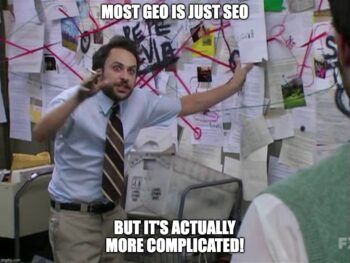
I’m seeing more and more people realise that “AEO” (Answer Engine Optimisation”) is just SEO in new clothes. But are GenAI outputs even something you can optimise for?
These systems don’t just read what you publish and serve up the most relevant parts – they synthesise it, blending multiple sources based on patterns they infer across a wider field of signals:
– everything you publish
– everything others publish about you
– everything they consider adjacent or comparable
They’re also not just looking at what’s being said now. They’re conflating and combining the accumulated traces of how your organisation expresses itself over time – across campaigns, content, product information and everything in between.
Repetition and consistency may help, but they won’t just pick up what you intend. They absorb whatever is most legible – including contradictions, gaps, and overlap with competitors.
If your positioning isn’t distinctive, you’ll get flattened into the category. If your communication isn’t coherent, the model will reconstruct a version of your brand from whatever patterns it can find. And when it comes to facts and details – where accuracy actually matters – these systems are still unreliable enough to pose a real risk.
This is where a focus on structured data starts to look like a promising way forward. That was my first assumption. But it’s becoming increasingly clear that this isn’t going to be enough.
—
The key is to remember that these systems don’t *understand* information. They generate outputs by following probabilistic sequences – patterns shaped by the data they’ve seen.
It’s a sophistiated form of word association. Structure helps, but only where it clarifies those patterns to nudge the model to follow the path you’d prefer.
Over time, what you’re really creating – deliberately or not – is a set of associations the LLM learns to treat as related. What we’d normally think of as a brand “narrative” sits inside that – not as something the model understands directly, but as a pattern of connections it learns to reproduce.
—
This means “AEO” should be considered less about optimising individual outputs, and more about the long-term shape of the signals you generate – across teams, markets and years.
I’ve been doing some work on this recently, trying to make that problem more tangible and diagnosable in practice. Still early, but the direction of travel feels clearer.
The brands that show up well won’t just be the ones optimising for visibility. They’ll be the ones whose overall pattern of behaviour is coherent enough that even a probabilistic system can’t easily misread what they are.
As this is a book of fairly straightforward, slightly gushing interviews with various people from the world of marketing, this would today have worked much better as a podcast. In this format it feels pretty repetitive as well as being dated (first published in 2011, with some of the focus on social media as if it’s new and Apple as if it’s a challenger brand feeling really rather quaint.
There probably were some actively thought-provoking points made somewhere in here, but everyone blurred into one in the end. so I have no idea who said what, and nothing really stood out – except the guy who was very vocal about his dislike of Daniel Kahneman and the idea of Behavioural Economics.
Of course, these “insights” may have seemed more radical 15 years ago. And for newcomers to marketing they still might.
But it’s notable how much of what’s said here sounds fine in theory but feels very hard to turn into tangible takeaways that people trying to build brands themselves could actually use. It mostly all ends up sounding like fluff and cod psychology. You can see how marketing and branding ended up getting a bit of a bad name if this is the best they had to offer.
Then again, maybe it’s because pretty much everyone featured here is American? As Mark Ritson – today’s leading marketing advocate – keeps saying, American marketing and advertising hasn’t been particularly sophisticated for decades.
In short, useful to read if in the profession, but there’s very little surprising, practical or inspiring here. It’s mostly pretty obvious platitudes.
“When AI is mentioned, it tends to lower emotional trust, which in turn decreases purchase intentions.”
An interesting finding, this – especially as it transcends product and service categories – though perhaps to be expected at this stage of the GenAI hype cycle.
This kind of scepticism isn’t easy to overcome – with new technologies acceptance and mass adoption is often a matter of time – but as the authors of the study point out, the key issue to address is the lack of trust in AI as a technology.
Some of this lack of trust is due to lack of familiarity – natural language GenAI seems intuitive, but actually takes a lot of practice to get decent results.
Some will be due to the opposite – follow the likes of Gary Marcus, and it’s hard not to get sceptical about the sustainability, benefits, and reliability of the current approach to GenAI.
The danger, though, is that this scepticism may be spreading to AI as a whole. The prominence of GenAI in the current AI discourse is leading to different types of artificial intelligence becoming conflated in the popular imagination – even though, just a few years ago, the form of machine learning we now call GenAI wouldn’t even have been classified as artificial intelligence.
Tech terms can rapidly become toxic – think “web3”, “NFT”, and “metaverse”. Could GenAI be starting to experience a similar branding problem? And could this damage perception of other kinds of AI in the process?
A (comedy) textbook lesson in why it’s vital to check existing trademarks and uses before launching a new brand, as the latest branch of the US military discovers that Netflix got there first…
I loved the concept when I first heard about it, and love that it seems to be working. Proof of concept done – now it’s time to take that concept and expand. Preferably globally.
In short, it’s a cunning system that allows you to pay for individual articles from publications, thus avoiding the constant fustration of not being able to read that great piece from the likes of the FT, Times or Economist because it’s hiding behind a paywall.
If this sort of thing takes off, it could be a whole new business-model – making paywalls more viable, while allowing monetisable ways around them.
But there’s also an interesting quote from Blendle’s founder:
“People want to read articles or want to follow specific journalists but aren’t particularly interested in the newspaper that it comes from anymore.”
This is especially true in the age of social, where URL-shorteners are so endemic that half the time you have no idea which site you’ll end up on.
I’ve got used to reading content that’s been de-branded via a hefty RSS addiction. That’s been replaced in recent years with an addiction to aggregation apps like Zite, Flipboard and Feedly, where what matters is the content itself, not the packaging, or where it’s from.
If the content is good enough, it will stand on its own – it won’t need to hide behind the brand. In fact, the brand can sometimes be a disadvantage, because it leads to preconceptions that can skew the reader’s opinion before they’ve even started to read a piece. There are some publications I avoid simply because I assume that they have nothing to offer me, for reasons of politics, prejudices, or whatever – and I know I’m far from being alone in this.
Remove the publication’s branding and present me with their content as is, would my preconceptions be different? Of course. And if I like the content, this could win them a new long-term reader.
Fascinating, thought-provoking piece – another of those ones you come away from thinking “damn, that’s so obvious – why didn’t I make the connection before?” A few highlights:
Quality doesn’t mean popularity:
every single newspaper that I talk with. They are saying the same thing, which is that their journalistic work is top of the line and amazing. The problem is ‘only’ with the secondary thing of how it is presented to the reader.
And we have been hearing this for the past five to ten years, and yet the problem still remains. There is a complete and total blind spot in the newspaper industry that, just maybe, part of the problem is also the journalism itself.
Instead, they move the problem out of the editorial room, and into separate and isolated ‘innovation teams’… who are then charged with coming up with ideas for how to reformat their existing journalistic product in a digital way.
But let me ask you this. If The NYT is ‘winning at journalism‘, why is its readership falling significantly? If their daily report is smart and engaging, why are they failing to get its journalism to its readers?
If its product is ‘the world’s best journalism‘, why does it have a problem growing its audience?
Newspapers (and all-in-one-place sites) are an outdated concept:
No matter how hard they try, supermarkets with a mass-market/low-relevancy appeal will never appear on a list of the most ‘engaging brands’, or on list of brands that people love.
And this is the essence of the trouble newspapers are facing today. It’s not that we now live in a digital world, and that we are behaving in a different way. It’s that your editorial focus is to be the supermarket of news.
The New York Times is publishing 300 new articles every single day, and in their Innovation Report they discuss how to surface even more from their archives. This is the Walmart business model.
The problem with this model is that supermarkets only work when visiting the individual brands is too hard to do. That’s why we go to supermarkets. In the physical world, visiting 40 different stores just to get your groceries would take forever, so we prefer to only go to one place, the supermarket, where we can get everything… even if most of the other products there aren’t what we need.
It’s the same with how print newspapers used to work. We needed this one place to go because it was too hard to get news from multiple sources.
But on the internet, we have solved this problem. You can follow as many sources as you want, and it’s as easy to visit 1000 different sites as it is to just visit one. Everything is just one click away. In fact, that’s how people use social media. It’s all about the links.
One of clearest examples of this is how Washington Post is absolutely failing to engage people on YouTube. Every single day, they are posting a bunch of news videos about random things. Each video is well made (great production quality), but there is no editorial focus.
The result is this:
Here we have a large US newspaper that is barely reaching any people when it uploads a video to YouTube. And it’s not that the videos are uninteresting. There is one about iPhone cases that you can buy at the 9/11 museum (and the controversy of that), with only 687 views. There is a motivational speech (usually a popular thing to post on YouTube), with only 819 views. We have social tactics, like “5 awkward political fundraising moments”, with only 101 views.
Then we have a video by the super-popular George Takei that we all know from Star Trek. This is a person with millions of fans, but his video on Washington Post only attracted 844 views… in two weeks! If this had been posted by any Star Trek focused channel, this very same video would have reached 50,000 views, easy!
What the Washington Post is doing can only be described as a complete and total failure. It cannot get any worse than this.
Notes and Essays
To help shape my thinking, I write essays and shorter notes examining the ideas and narratives that shape media, marketing, technology and culture.
A core focus: The way context and assumptions can radically change how ideas are interpreted. Much of modern business, marketing, and media thinking is built on other people's frameworks, models, theories, and received wisdom. This can help clarify complex problems – but as ideas travel between disciplines and organisations they are often simplified, misapplied or treated as universal truths. I'm digging into these, across the following categories - the first being a catch-all for shorter thoughts:

 I’m seeing more and more people realise that “AEO” (Answer Engine Optimisation”) is just SEO in new clothes. But are GenAI outputs even something you can optimise for?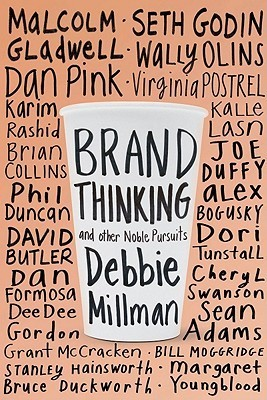
 “When AI is mentioned, it tends to lower emotional trust, which in turn decreases purchase intentions.”