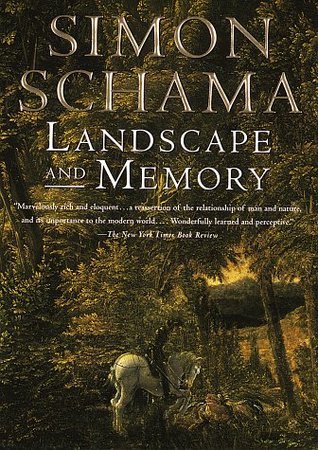
This is a big, strange, frequently fascinating, but strangely disjointed book. Impressionistic history, not narrative. It’s also far longer than the page count suggests – a huge, heavy book that needs two hands to hold even in paperback.
Effectively a collection of essays that combine to make up one big essay, it jumps around in places and time as it explores Western civilisation’s relationship with the landscapes in which that civilisation has developed.
Yet this is a bit of a misrepresentation, as really the focus is primarily on the 18th and 19th centuries, as the conscious awareness of landscape as a thing started to emerge. And primarily via England, France, the United States, and Germany / the Holy Roman Empire. Other countries do get a look in. but these four dominate.
It’s at times more lyrical memoir or art criticism than cultural history, with the schema and structure and choices of what to cover making sense only to its author – making me wonder how on earth Schama managed to get this commissioned, given it came pretty early in his career, five years before he became a household name via his TV work. It feels more like the kind of self-indulgent passion project with which someone famous is rewarded to get them to produce something a bit more commercial.
But there’s still a lot here to like. For me, it’s best when it delves into myth and legend – though it doesn’t do this as much as I think is warranted, or as much as I’d have liked, given how good Schama is on myth when he does write about it:
“how much myth is good for us? And how can we measure the dosage? Should we avoid the stuff altogether for fear of contamination or dismiss it out of hand as sinister and irrational esoterica that belong only in the most unsavory margins of ‘real’ (to wit, our own) history?
“…The real problem… is whether it is possible to take myth seriously on its own terms, and to respect its coherence and complexity, without becoming morally blinded by it’s poetic power. This is only a variation, after all, of the habitual and insoluble dilemma of the anthropologist (or for that matter the historian, though not many of us like to own up to it): of how to reproduce ‘the other,” separated from us by space, time, or cultural customs, without either losing ourselves altogether in total immersion or else rendering the subject ‘safe’ by the usual eviscerations of Western empirical analysis.
“Of one thing at least I am certain: that not to take myth seriously in the life of an ostensibly ‘disenchanted’ culture like our own is actually to impoverish our understanding of our shared world.” (p.134)
And (much) later, concluding the thought with the closest the book has to an explanation of Schama’s aim in writing it:
“it seems to me that neither the frontiers between the wild and the cultivated, nor those that lie between the past and the present, are so easily fixed. Whether we scrambled the slopes or ramble the woods, our Western sensibilities carry a bulging backpack of myth and recollection… The sum of our pasts, generation laid over generation, like the slow mold of the seasons, forms the compost of our future. We live off it .” (p.574)
Appropriately enough this book is a rambling affair, following paths that make little sense as you wander them. But gradually the intent of the person who’s staked out those paths starts to make some kind of sense – as with an Impressionist painting, the subject of which can only be seen when you take a few steps back.
Here, the details are so dense, so varied, you’re better off with your nose close to the canvas – the parts work better on their own rather than summed into a whole.
An excellent companion to Rée’s superb Witcraft, his history of how philosophical ideas made their way into English (often with a considerable delay). The chapters here on Kierkegaard and Sartre neatly fill some gaps in that earlier book’s narrative, as it (mistakenly and frustratingly, in my view) ended the story largely with Wittgenstein. (Yes, Kierkegaard was earlier, but didn’t get translated into English until the early-mid 20th century.)
The introductory interview was also a nice touch, with Rée’s dislike of histories of philosophy – and especially of Bertrand Russell’s, and of Russell more broadly – an entertaining educated rant that helped shift my perspective on what has become one of my favourite genres of book over the last few years. I knew it’s not just me who sometimes, when reading the original works rather than someone else’s summary of them, struggles to understand and needs to re-read paragraphs repeatedly – but it was very reassuring to hear that the same is true for Rée.
Philosophy is hard, basically. Intellectual biographies and histories of philosophy may make it more accessible – but the point is philosophy is all about the act of thinking, not just understanding ideas.
This feels like a particularly useful insight in the age of GenAI, when it’s easier than ever to find a summary of an idea, and to have someone (albeit a bot) explain a complex concept in simple terms. This may be a shortcut to understanding, but sometimes this can mean your understanding is only superficial – by reaching your knowledge via an intermediary, rather than working at it yourself, you’re likely to be missing nuances and details, as well as to be picking up received wisdom and interpretative assumptions from other people, rather than determining your own understanding.
Taking shortcuts via other people’s interpretations isn’t always a bad thing, by any means – but it’s worth being aware of what you may be missing by doing so. I’m probably never going to read Heidegger’s Being and Time or Sartre’s Being and Nothing in English, let alone in the original German and French. I’ve always known I’m going to be missing something as a result – the summaries of these books that I *have* read have convinced me there are aspects of both I’d find fascinating. But Rée’s emphasis on taking the time to digest philosophical works, to ruminate on them, to make the effort to truly understand them has given me pause.
Much to think about here, in other words – not bad for what is at its core a collection of book reviews.
As this is a book of fairly straightforward, slightly gushing interviews with various people from the world of marketing, this would today have worked much better as a podcast. In this format it feels pretty repetitive as well as being dated (first published in 2011, with some of the focus on social media as if it’s new and Apple as if it’s a challenger brand feeling really rather quaint.
There probably were some actively thought-provoking points made somewhere in here, but everyone blurred into one in the end. so I have no idea who said what, and nothing really stood out – except the guy who was very vocal about his dislike of Daniel Kahneman and the idea of Behavioural Economics.
Of course, these “insights” may have seemed more radical 15 years ago. And for newcomers to marketing they still might.
But it’s notable how much of what’s said here sounds fine in theory but feels very hard to turn into tangible takeaways that people trying to build brands themselves could actually use. It mostly all ends up sounding like fluff and cod psychology. You can see how marketing and branding ended up getting a bit of a bad name if this is the best they had to offer.
Then again, maybe it’s because pretty much everyone featured here is American? As Mark Ritson – today’s leading marketing advocate – keeps saying, American marketing and advertising hasn’t been particularly sophisticated for decades.
In short, useful to read if in the profession, but there’s very little surprising, practical or inspiring here. It’s mostly pretty obvious platitudes.
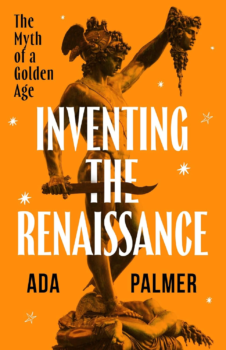
I initially loved this – effectively a popular historiography of the (Italian, mostly) Renaissance, exploring different perspectives and opinions and how these have evolved over time – while also providing overviews of some of the key events and personalities.
This is a wildly confusing period, so this approach actually works pretty well – highlighting who focused on what and offering multiple explanations as to why. Until about halfway through I loved it, and still remain convinced that looking at history by first looking at the lens of the historians and players who shaped that history is an approach more popular history books should take, rather than just run with a narrative.
But… “The Renaissance”, singular? This goes totally against the author’s core argument, which is all about how there are any number of ways of looking at this period (or even defining how long a period we’re talking about). Yet despite this we get surprisingly little about the Northern Renaissance, and almost every key figure called out was based in northern Italy – despite multiple references to Erasmus as a nexus of Renaissance correspondence, we get few investigations into how or whether what was happening in Italy was influenced by or influenced what was going on elsewhere (bar the frequent French invasions and other aspects of high politics).
Equally, about halfway through I started to find the whole thing a little overwhelming as we jump from overarching thesis (there’s no one right way of interpreting any of this) to detailed biography, so philosophical aside, to onrunning jokes. After a promising start, the structure starts to get lost, and it increasingly feels like a series of essays or blog posts loosely bound together.
The more this went on, the more I felt it could have been better if presented as essays rather than a whole – because after a while the running jokes (“Battle Pope”, “Abelarding”, references to Game of Thrones, etc etc) start to detract from rather than clarify the argument. This jokey style is one that’s been very popular the last decade or so, and can work – but in a book this long it can start to grate, even if you don’t object to it in principle, as some might.
Which is a shame, because there’s a lot of really good stuff in here. I learned a lot, and will want to go back and re-read various parts (as long as I can work out which with the jokey chapter titles) to refresh my memory – and eventually start to make a little more sense of a chaotic and challenging to understand period.
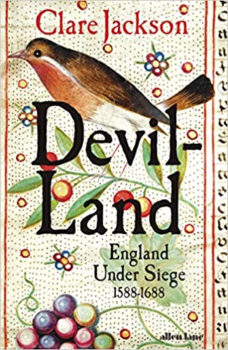
History is all about perspective, and perspectives. This history of England’s most turbulent century – a period I studied to postgrad level – is a welcome attempt to offer alternative views of events via the eyes of non-English observers. As we’re somehow still referring to the central event as the English Civil War – ignoring Scotland, Ireland and Wales – this is very much needed.
The introduction promised a lot, and got me genuinely excited to see how much this focus on foreign perspectives – and foreign policy – would shift my own understanding. But while there were some new things for me here, at its heart this was all rather familiar.
Then again, I’m not really the target audience. As well as having studied the period, I also spent some time plotting out a potential novel that hinged in part on the foreign policy of James VI/I and the (limited) British involvement in the Thirty Years War.
For anyone relatively new to the period, or looking for a refresher overview, this would be really rather good. Standard accounts do tend to focus almost exclusively on England, where here Scotland and Ireland (not so much Wales) do get their due. But more importantly, most accounts tend to obsess about the religious angle, the disputes over tax and revenue, the disputes about the limits to the power of the monarchy, the attempts by parliament to assert itself.
All those are present here too – but so too are explorations of the European horror at the execution of Mary Queen of Scots; the Spanish side of the Spanish Armada and the Spanish Match, as well as worries about the subsequent French marriage; general concern as the civil wars broke out and further horror at England’s execution of a second monarch in sixty-odd years; the Dutch rivalry and wars and invasion.
All this is necessary to a solid understanding of the era – but all too often is skipped over or sidelined. Here, while it’s still not foregrounded as much as I’d hoped – or as much as is promised in the introduction – it’s hard to avoid the fuller understand appreciation that England was not operating in isolation. That other countries existed even then, and that even the foreign relations were far more than just theoretical, largely religious concerns.
All that said, cutting this off with the Glorious Revolution (another bad name that’s stuck) makes zero sense from a non-English perspective (even if the epilogue continues the story through to George I). Logically, the cut off should be more like 1745 (that final Jacobite rising, in the midst of British involvement in the War of Austrian Succession) and the solidification of the Hanoverian dynasty, or even a century later with the death of the Young Pretender / Bonnie Prince Charlie. But I guess by that point Britain was so firmly involved in European and global affairs that the emphasis on non-English opinions about the English would hardly be surprising.
So, a good overview – even if sadly not as radical and overhaul of the period’s traditional narratives as I was hoping.
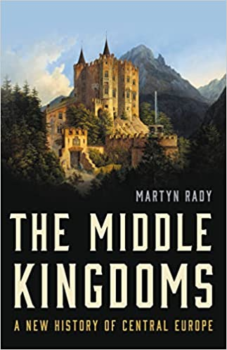
Much like the region it’s covering, this book lacks a certain coherence – and seems to be dominated by the looming presence of Germany.
This makes sense, of course – but if a region is in the middle or central, the obvious question is the middle or centre of what, and what’s surrounding it? Here, Rady seems to focus far more on contrasting central Europe to western Europe than to the east (Russia is the other obvious figure looming over the region’s history, but features far less than Germany), the north, or the south.
For me, the focus on a more or less linear, more or less political history of the region made some sense – and individual chapters were great overviews – but given the fuzziness of the definition of the region and the lack of any long political continuity for most of the countries that exist there today – this makes it even harder to keep track. When there’s no clear narrative, narrative history tends to struggle.
This is because – as Rady makes clear in the final couple of chapters – the concept of central Europe is so relatively recent.
The conclusion mentions something that shows how difficult the task the author set himself was – talking about nations without states, and states without nations, all with borders that have overlapped each other at various times. This is a perceptive and useful summary – but it makes the political history approach feel more than usually useless.
What may have been more helpful would have been a cultural history, or even a linguistic one. If this is a land of overlapping nations, how did these national identities emerge and persist given how frequently the political boundaries have shifted? That’s the book I think I was hoping for, but it’s not this one.
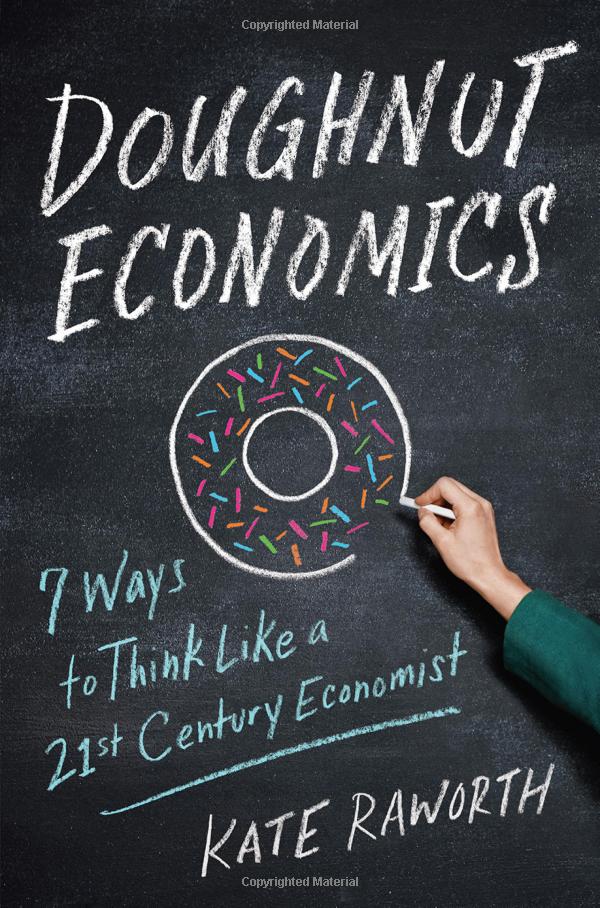
Interesting, thought-provoking and convincing about what needs to be done, while being realistic about how likely it is such vast changes to how the world works will come about. Yet also packed with examples of ways in which such changes are already taking place, giving some room for optimism.
A good polemic, in other words – and made even better by continually citing sources and experts from non-traditional backgrounds – neither ostentatiously nor explicitly, it made me realise how few economics and politics books regularly cite women or people from non-Western countries. Which may well be part of the reason why our economics and politics are so broken.
The only real criticism: The book itself is well enough written in terms of individual sentences and paragraphs, but lacks enough variety of tone and pacing to really keep the attention, and the author has a tendency to both repeat herself and extend metaphors well beyond the point where they have impact.
This is a strange book. Originally written to accompany a BBC TV series back in 1981, it has since been extensively revised to reflect the (substantial) changes in understanding of this long period – covering over a thousand years, from Boudicca to the Norman Conquest.
That period alone is enough to raise an eyebrow. What the hell does Wood mean by “the Dark Ages”? And why, if he’s in search of them, does he focus purely on England? Equally, why does he choose to explore them by focusing on a series of individuals?
In part, the thinking seems to be that by centering each chapter on a named individual, you can explore the sources to understand how much we can really know in an era of fragmentary record keeping and near constant conflict. This is a nice enough idea – but it’s been done better elsewhere, especially in the last decade or so, as archaeology and history have merged and a glut of good books have come out on the Vikings and Anglo-Saxons in particular.
Equally, given the use of the term “Dark Ages” – usually contrasted to the Greek/Roman Golden Age and the Renaissance – it’s strange the focus here is largely on politics and power rather than culture and learning and civilisation and society.
Not a bad book, certainly, but its episodic nature betrays its roots in television. It’s let down by the fact that there’s really no clear connecting thread, and nor is there a flowing narrative – something seemingly made worse by Woods’ laudable decision to add some new chapters about prominent women in this revised edition, to counter his early 80s patriarchal mindset and work in some more recent scholarship.
Nonetheless, Woods is a good writer, and this is engaging enough – it just feels a bit confused and incomplete.
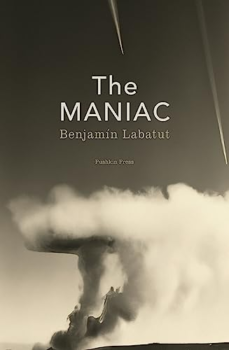
At times I liked this a lot – a neat companion to Neal Stephenson’s Cryptonomicon as a novel about the birth of the computer age. It could equally work as a companion to Sebastian Mallaby’s non-fiction The Power Law, focused on the venture capitalists and somewhat unstable, potentially sociopathic tech bros who have built the modern tech industry into the morally suspect force that it is.
Effectively a montage rather than a narrative, with surprisingly little-known polymath genius John von Neumann and the various hugely influential ideas he had as its centre of gravity, it’s as wide-ranging as he was. This is the guy who co-created Game Theory (an approach many tech types seem to consciously adopt), helped develop not just the atomic bomb, but also the hydrogen bomb and concept of Mutually Assured Destruction – with its wonderfully appropriate acronym.
But he also came up with some initial concepts for artificial intelligence, notably the self-teaching, self-reproducing, self-improving Von Neumann machines that he envisioned spreading through the universe long after his (and humankind’s) death.
It’s this that the book is really building to throughout: Pretty much all modern AI systems are Von Neumann machines – at least, to an extent.
This makes this extremely timely and thought-provoking, despite being about someone who died 70 years ago.
How will these systems continue to evolve? Given von Neumann himself is, throughout, compared to the machines and systems he developed – his utterly alien way of thinking, his apparent disregard for his fellow humans, his neglect of his family, his apparent patronising contempt for people not as smart as he was – the suggestion that these alien intelligences are something to be wary and probably scared of starts coming through stronger and stronger.
This culminates in the final section, a detailed narrative of the significance and a blow by blow account of DeepMind’s 2016 victory over the world’s leading human Go player with their AlphaGo system.
Yet while an impressive achievement, as a whole the book didn’t quite work for me. The different voices talking about their relationships and experiences with von Neumann, done as if being interviewed, eventually all started to sound too similar. The opening and closing sections were thematically clearly linked, but the structure as a whole leaves the reader doing much of the work to connect the dots and get to the point the author’s making. A final coda to wrap it all up would, for me at least, have been appreciated.
Goodreads tells me I finished 74 books in 2025, some 35,000 pages. I almost made it to 75, but just ran out of time… Most were nonfiction, but mostly history, philosophy and science, so not exactly classic LinkedIn fodder.
Here’s a few I’d definitely recommend to better navigate the world of business / work (in no particular order):
1) Alchemy, by Rory Sutherland – a useful corrective to the idea that logic and reason should drive strategy, and a timely reminder (in this age of GenAI probability-driven “thinking”) that it’s often necessary to go lateral to succeed. But Sutherland’s a marketer at heart – of *course* he’d say that…
2) The Art of Explanation, by Ros Atkins – a guide to more effective communication, borrowing from a couple of decades’ experience in journalism; a book many non-journalists could do with reading, and almost the opposite of Sutherland’s approach.
3) Economics, The User’s Guide, by Ha-Joon Chang – as the debate about AI bubbles and the future of the job market drags on, this is one of the very best overviews of the history and post-financial crisis state of economic thinking I’ve come across; thought-provoking and accessible via short, clear chapters. An excellent read.
4) The Corporation in the 21st Century, by John Kay – a slight cheat as I’ve got a couple of dozen pages to go, but this is an excellent companion to the previous one, providing a potted history of how we’ve got to where we are in the world of business organisations and ecosystems, and how it all seems to be changing. Again.
5) The Power Law, by Sebastian Mallaby – a deep dive into the history, mentality and working methods of the venture capitalists that have done so much to influence the tech industry and global economy over the last few decades. It helpfully shows that Elon Musk (among others) has been problematic for years…
—
Of course, all of these were written before the rise of GenAI and the advent of Trump 2, so.who knows how helpful they’ll be in navigating 2026?
Somehow I’d not already read this, despite loving magic realism a bit more than it probably deserves. It was different to what I was expecting. Far less realism, much more absurdity.
Still, it was mostly very enjoyable – and packed full of fantastic (in both senses) imagery and phrases.
But there’s just so much of this descriptive oddness that halfway through the sheer unrelenting imagination, sidetracks, asides, quirkiness, and deliberately meaningless obsessions becomes somehow repetitive. Pointless. Frustrating. No longer enjoyable.
But then the final chapter wraps it all up with a kind of thematic unity that makes this very repetition – the way the various stories blur into one despite their wild differences – all make sense. After enduring one hundred plus pages of annoyance, that wrap-up means I’ve ended up leaving One Hundred Years Of Solitude with affection – if not the love I was expecting.
A strange book, hinting at some of Rushdie’s later brilliance, but not anywhere near as clever or profound as it seems to think it is.
This quote, from page 141, just as you start to wonder what the point of it all is, pretty much sums up the book:
“I do not care for stories that are so, so tight. Stories should be like life, slightly frayed at the edges, full of loose ends and lives juxtaposed by accident rather than some grand design. Most of life has no meaning – so it must surely be a distortion of life to tell tales in which every single element is meaningful… How terrible to have to see a meaning or a great import in everything around one, everything one does, everything that happens to one!”
Very readably written (hence the extra star and bothering to finish it), but for a 700-page character study it’s impressive just how shallow all the characters are.
Every single one – from the principles to the supporting cast – has one defining characteristic, and one only. There’s so little complexity or depth they may as well all be described as deeply as the two characters known throughout only as “black Henry Young” and “Asian Henry Young”.
There’s Withdrawn Trauma, our hero – the life of the title – defined purely by his childhood abuse, and still acting like a child decades later. Selfish, closed-minded, suspicious. Worthy of pity, certainly – but it’s hard to see why so many other characters deem him worthy of so much loyalty for so long, in the face of so much predictable nonsense. Normally after spending 700 pages with a character you empathise with them. Not this guy, despite having winced through scene upon scene of abuse and suffering.
There’s the three friends, Compassion (who, at least, briefly shows signs of developing some complexity where Compassion briefly turns to Conflicted), Obvious Unrequited Secret Admirer, and Architect (supposedly one of the core group of four friends at the heart of the story, but with no personality beyond his career).
There’s also Ineffective Father-figure, always wanting to help but never quite knowing how. There’s Doctor, who inexplicably keeps staying on call 24/7 – unpaid too, in America! – for one of the most difficult, selfish patients anyone could ever hope not to encounter. And then there’s Violent Rapist, Manipulative Rapist, Psycho Rapist, and a succession of other anonymous rapists undeserving of description.
And it’s still astonishing, 700 pages later, that a woman was able to write such a long novel without a single substantive female character.
Plus, it’s incredibly predictable. In the final quarter I found myself actively laughing as it unfolded, because everything was so obvious. No surprises at all.
But worst of all, this is a novel that exists to smother the concept of hope for change and redemption. To confirm the worst suspicions of the traumatised and suicidal. To encourage the suicidal to go through with it. It’s repeated message is that things don’t get better – at least, not for long. It’s Keynes’ “In the long run we’re all dead” in brutal, unforgiving, waffling novel form.
It contains nothing positive, says nothing new or substantive, is packed with stereotypes, and, considering the subject matter, is deeply irresponsible.
An odd book, but very readable. Mini biographies of various leading economists of the last couple of hundred years are a mostly useful way to build the central argument: Economic ideas are a product of their time, and of their creators’ circumstances. It’s a fair argument, and one likely borne out by the fact I’m leaving this much more sympathetic to the ideas of Amartya Sen than any other person featured. He’s the only economist covered who’s still alive…
But this book is odd mostly due to its choices for who to include – and who to omit.
It starts by scene-setting with Dickens, then progresses straight to Marx and Engels, rather than going slightly further back to include Smith, Malthus, Ricardo and other earlier economists.
It’s heavily focused on British/American/Austrian thinkers to the exclusion of pretty much any others – and doesn’t include any non-Western economists other than Sen. Hell, it doesn’t even include any French economists.
The main contention other than everything progresses (it’s largely teleological in approach) is that everyone’s a Keynesian – even people you don’t think are Keynesian. Keynes hangs over the entire book, from long before he appears.
There’s a good case for this – I mean, Keynes is Keynes – but considering the general argument is that economics has been getting increasingly sophisticated, it seems odd that it largely (and rapidly) tails off in its interest in the aftermath of WWII (and, perhaps not coincidentally, Keynes’ death).
The most surprising omission, considering there’s a strong undercurrent of concern with human welfare throughout, is any reference to behavioural economics – surely one of the most fundamental shifts in approach to the discipline in the last 50-60 years.
Nor is there any coverage of the birth of game theory – arguably one of the most influential (and abused) concepts of the same period. This last is particularly surprising given the frequent use of the term “zero sum game” in latter chapters – and by the fact that the author’s previous best-known book was a biography of John Nash.
So yes, an odd book as much for its omissions as its inclusions. But engaging, readable, and (mostly) relatable. In that, it does what it set out to do – help you to understand not just *what* ideas economists had, but *why* they had them.
A strange book. Well written, entertaining, but largely pointless – and doesn’t deliver on its core promise of explaining *how to use* rhetoric more effectively.
Instead, its basic argument consists of the astonishing revelation that:
language can be used to make a case that’s designed to persuade
people have been doing this for a long time
people used to study the techniques involved and gave them all fancy Greek names
people no longer use the fancy Greek names but still use the techniques.
All of which is illustrated with examples, including deconstructions, showing what techniques were used.
So far, so good – but that’s a *what*, not a *how*. As such, so what?
This book starts out as a plea for the restitution of rhetoric as a field of study – but then fails to follow through with a convincing case to do so because it never manages to demonstrate the practical application of an understanding of rhetorical theory. About halfway through there’s even a line that tells us to ignore the detailed analysis and use of rhetorical terminology via the double dismissal:
“in the end, these distinctions… can safely be left to the theorists.” (p.131-2)
If those distinctions can be ignored, what is the benefit of learning *any* of the terminology of rhetoric that is scattered throughout the book? It seems to be just to make you look clever by spouting archaic Greekisms.
(That question was, of course, a rhetorical device.do I know the *name* of the rhetorical device? No. But I knew how to deploy it. I rest my case.)
Because the problem is that while Leith shows how an understanding of rhetoric can be used to analyse words and see how arguments were constructed, at no point does he coherently illustrate how to use this knowledge in a practical way to construct arguments of your own. Nor does he provide a single example of how anyone has done so – beyond references to great speakers of the past reading lots of past great speeches, which is not the same thing at all.
All of which means that, while this is a perfectly entertaining enough book, I’ve come out of it *less* convinced that there’s any point in trying to memorise what hendiadys or hypallage, pleonasmus or polysyndeton are. All I need to know is that I know how to use them. And this book, despite giving plentiful examples of how these techniques have been used by other people, is no practical use on that front at all.
In short, if you want to learn more about how to write or speak in a more convincing rhetorical style, this may be good to point you to some of the greats of the past so you can go and read their stuff (as long as you’re happy focusing primarily on British and American greats, that us), but that’s about it.
And, most importantly, that’s not what the dust jacket promises.
Parts of this were very good, and the writing mostly flows well. Parts were a bit confused – or confusing, or both.
Some characters are fully fleshed out, with clear story arcs that make sense. Most flit in and out with little clear purpose beyond serving as an excuse to explore some aspect of Zambian life.
All this is fine enough, as it goes, as the whole book is effectively a montage of snapshots of loosely intertwined lives designed to give a sense of the country’s own confused identity – but it’s a montage building to something that feels unfinished.
Unless that’s the point – which, in part, I think it is. But if so it’s a bit frustrating for the reader who’s just invested all that time reading the best part of 600 pages, even if it may well be thematically appropriate.
A postmodern, magic realist extended analogy about efforts to recover a pre-colonial sense of identity and belonging? Yes. Very much yes.
Brutal in places, though, as I suppose should be expected from a book that opens with a murder and that revolves around a curse – but that magical element is more subtle for the most part. It’s more a McGuffin than central, and the book more realist than magic realist for the most part.
The true centrality is instead Uganda itself – a country invented by outsiders who couldn’t pronounce its name, torn apart and warily trying to put itself back together while trying to avoid having to look too closely at its past.
So many very well thought-through metaphors, many of which I’m sure I’ve missed in my ignorance – but a superbly constructed and considered book.
One of the better books in the series, and certainly the most adult in terms of content. Contains a number of pretty clear parallels with the real-world events of the last few years, from the refugee crisis to dodgy, divisive politics – as well as almost certainly not child-friendly descriptions of how men leer at young women, and even a brutal attempted rape.
There are some more suspect elements too, from stereotypical portrayals of non-English people and cultures (even the Welsh are all miners, and people from the Middle East all seem to be either downtrodden victims of oppression or oppressors, with little in between) to some familiar characters behaving in ways that seem unlikely based on past behaviour in previous books.
There’s a fair bit of quite simplistic philosophising as well, but of a rather more pretentious kind than the straight-up Atheism 101 of The Amber Spyglass, which again suddenly pulls you back into realising this is still a book for kids / teens.
This shouldn’t be a surprise – of *course* it’s a kids book – but tonally it makes the whole feel inconsistent, as Pullman evidently has aspirations for this to appeal to an older audience – and to really *say* something, especially in the latter parts – but can’t quite break out if the writing for kids style that nudges him into a less complex view of the world.
Still a solid four stars on a re-read, despite getting a bit unsubtle and preachy in places. Still kinda impressed that this got published as a book for kids 20 years ago, considering how soon after the pissy responses to things like The Life of Brian and The Last Temptation of Christ that was.
The strange thing is the logical inconsistency in the anti-religion message.
This is a book that basically says religion is actively bad – but:
1) The final message is that something went wrong when science arrived. It’s science that is the cause of Dust leaving the universe – in the age of religious credulity, which Pullman dislikes so much, Dust was stable and even growing. The only way to reverse the damage caused by the Subtle Knife (a product of the new science in the same way Newton was) is to meticulously fix the damage it’s caused and destroy the knife. The message there? Science is bad, and the universe was healthier in the age of religion.
2) At the same time, “The Authority” (aka God) turns out to be a delicate, senile, but seemingly benevolent being who – despite having been set up as something evil and a usurper – has himself been usurped by a much more malevolent, lust-filled angel (who used to be a man). Every other angel we meet is also benevolent. The implication? Not aspects of religion are literally true (god and angels both really exist, and are “good” despite the protestations that there’s no such thing as good and evil), and it’s only humans who have perverted it – be it ex-human angel usurpers or the fanatics of the Church.
3) The world of the mulefa – with its natural roads, seed pod wheels, and creatures perfectly evolved to use those wheels – is repeatedly hinted at being evidence of something closer to intelligent design than evolution. And “the Creator” is mentioned on a few occasions throughout the seriea in a way that heavily implies this was a literally true being, again supporting the core idea if (Christian) religion of a created universe.
4) The alethiometer allows Lyra to communicate with some kind of (never fully explained) higher power that reveals “truth” and appears to be omniscient, aware of the future as well as the present. This same force – and the witches’ prophecy – firmly underscore the idea that there is such a thing as fate / predestination. Despite suggestions that Lyra may not follow her fate, or that her destiny could be shifted by others, follow it she does. Is there actually free will in Pullman’s universe? It seems unlikely. Everything happens for a reason. The higher power, whatever it is, knows best.
The implication is, therefore, not that atheism is the way forward, as I remembered it, but only that organised religion has perverted the deeper literal truths underlying Christianity. Which makes this a much more conservative trilogy than I remembered it – effectively a fantasy version of Martin Luther.
A strange, dreamlike extended metaphor for the eastern European experience of the mid-late 20th century.
After the shift in tone and narrative between books one and two, it wraps up with a third book of gloriously appropriate confusing ambiguity about the nature of identity and truth.
Constantly odd, occasionally nasty, sometimes showing warmth and kindness, but always detached, it’s surprisingly readable and engaging considering the unlikeable nature of the main character(s?) / narrator(s?). Four stars simply because it’s hard to love a book like this – but very easy to admire.
To help shape my thinking, I write essays and shorter notes examining the ideas and narratives that shape media, marketing, technology and culture.
A core focus: The way context and assumptions can radically change how ideas are interpreted. Much of modern business, marketing, and media thinking is built on other people's frameworks, models, theories, and received wisdom. This can help clarify complex problems – but as ideas travel between disciplines and organisations they are often simplified, misapplied or treated as universal truths. I'm digging into these, across the following categories - the first being a catch-all for shorter thoughts:

 4/5
4/5 4/5 stars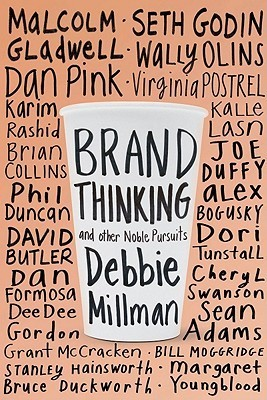
 4/5 stars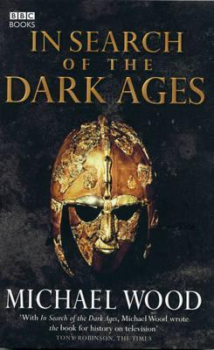
 4/5 stars
 2/5 stars
 2/5 stars
 4/5 stars
 3/5 stars
 3/5 stars
 5/5 stars
 4/5 stars
 4/5 stars
 4/5 stars