“While 82% of advertising executives believe Gen Z and millennial consumers feel positively about AI-generated ads, only 45% of these consumers actually feel that way”
But this is hardly a surprise. A couple of years back I referred to GenAI being at every stage of the Gartner hype cycle simultaneously, and that remains true today – it’s just that more people have passed over the peak of inflated expectations.
Meanwhile, the AI companies need to keep on trying to inflate those expectations further to keep the investment money coming in to allow them to build the infrastructure they need to keep delivering.
But we’re at a stage now where high level promises like those you get in an advert or keynote are hitting the law of diminishing returns. These companies are selling to an increasingly sceptical crowd – as a global society, we’re further down the funnel and are looking for more proof points before we buy in.
(This is part of why I’m convinced Elon Musk knew exactly what he was doing with his Grok porn bot – the uproar was great free publicity for Grok’s ability to create photorealistic images and video… PR can be cynical…)
Given this, is an old school Super bowl campaign really going to make any difference? or is this now just another old school brand awareness play, given Google seems to be on the verge of demolishing OpenAI’s previous lead?
Either way, we’re definitely entering a new phase in the AI play – and the emphasis is increasingly going to need to be on proof of impact, not just proof of concept. The narrative needs to shift.
This from John Hegarty resonated. Unpopular opinion, but awards – especially in B2B marketing – are the ad industry equivalent of social media vanity metrics. They may get you marginally more reach (usually long after the campaign’s over), but rarely with your real target audiences.
What’s worse, the positive signals award wins send out can create feedback loops of groupthink about tactics that can actively harm your ability to deliver.
I know it’s tough to demonstrate marketing effectiveness, but award wins rarely prove much beyond that marketing people like something. So unless you’re selling to marketers, they don’t really have much value.
This means awards make perfect sense for agencies (and individuals) to enter – but for their clients? The point of marketing is to improve brand perception and make sales with your buyers, not getting a round of applause from other marketers.
Which is why, often, I find the less glamorous side of marketing is where the real businesses impact can be found.
The most surprising thing with this growing move away from social media advertising is that it has taken this long for brands to realise that they can’t control the context in which their adverts appear – and that context can change perception of their messaging.
The real lesson here is not that social media needs stricter controls (an ethical debate), it’s that in the classic Paid/Earned/Owned model, the *only* part brands can fully control is Owned. Many are only now beginning to wake up to the fact that their social accounts are not Owned platforms.
All this should have been obvious for years – every fresh story about an algorithm change destroying business models that were relying on social audiences has been an alarm bell. But perhaps now brands are finally realising that social isn’t as straightforward as they’ve long seemed to believe.
What does this mean for brands?
1) They need more robust, nuanced social strategies. Chucking money at paid posts and adverts doesn’t cut it. It never has.
2) The quality of their genuinely Owned platforms is becoming more important than ever. These are the only places they have complete control over the context and the message.
And it’s also notable that many brands joining the boycott have solid Owned strategies in place…
As an ex-journo I’ve always put more emphasis on substance than style in marketing, but that’s not to deny style’s essential role in making the substance shine. The very best content (and advertising) has always had a perfect balance between both. The best copy in the world won’t do anything for you if it doesn’t stand out and get noticed by the right audiences.
Now, however: “Chrome is setting the thresholds to 4MB of network data or 15 seconds of CPU usage in any 30 second span”.
I get the thinking behind this – both for consumers (to save their data/battery) and for Google (to re-emphasise the importance and value of data-light search marketing) – but it feels a decade late. Modern phones, and most data packages, surely won’t even blink at a meagre 4 megs – and 5G will make it a nothing.
A good digital ad is a rare thing (most are, let’s face it, either annoying or ignored), but many of the best are creative, interactive experiences that maximise the potential of the medium. This means they need more bandwidth to make better user experiences.
So while I may focus on organic distribution and the message before the medium, I do worry this restriction of ad options will create a blander, less creative digital future. At least give users the choice to turn this on or off.
“the next two years will be characterized by ‘madness and transition’ as the [media] industry devises an entirely new infrastructure”
FWIW, I’m pretty sure that, in the long run, this will be a good thing for everyone. Adtech has long promised more than it really delivered, while programmatic ads are really little better than spam – microtargeting claiming sophistication, but really just encouraging lowest-common-denominator, purely transactional digital nagging.
And because hardly anyone *willingly* clicks on those adverts, bounce rates on accidental clicks are mad high, making it harder to spot which things are actually performing well, so hiding potential opportunities to identify trends that could help you boost organic growth.
We’ve long needed more sophistication in digital advertising – this will hopefully be the kick up the backside that sees this start to happen.
“View-through attribution, third-party data, DMP and multitouch attribution will be ‘dead’ under the proposals. We’re now facing a world with significantly less measurement and targeting.”
What does this mean? Initial thoughts:
Less audience targeting from 3rd party cookies => more need for audience insights from other data sources. Owned web properties will become more important.
Google’s stranglehold on advertising will tighten, as Chrome will track engagement metrics instead.
Throwing money at supposedly targeted distribution will stop appealing to advertisers, many of whom are already suspicious of the purported ROI of such campaigns.
Digital ads we see will become less obviously personalised to us.
Instead, marketing will need to work on its merits – attracting audiences via sustained campaigns based around creative concepts rather than algorithms.
Yet another revenue source will be cut off for publishers, making it harder than ever to fund traditional journalism.
This will in turn either open up more gaps for niche non-profit publishers (and brands) to fill, or lead to a decline in the amount of content produced.
The New Statesman has a long piece on the ongoing slow death of the advertising industry, with some fun distinctions between the ad industry (creative, visionary) and the ad business (dull, obsessed with data).
Can you guess which part the person who wrote it comes from?
Of course, the simple response to the majority of the article’s debate about whether high-impact artistic visions or hyper-efficient attempts to ensure relevancy are the best way forwards is:
But while there’s much to disagree (and agree) with throughout, it was this particular passage that sparked a realisation about the real challenge for the marketing industry:
“Now that people carry media around with them everywhere, advertisers have less incentive to create memorable brands. Instead, they concentrate on forcing our attention towards the message or offer of the moment. The ad business doesn’t care about the future of its audience, only its present.”
This, within the context of modern ad microtargeting and algorithms (as well as the general proliferation of TV channels, streaming video, and the decline in newspaper readership), is kinda true – with no clear way to ensure a follow-up interaction, the classic old ad model of trying to get a message in front of someone eight times (or whatever) and it’ll stick is no longer as straightforward as it once was. Even if you succeed, it’ll be by using cookies to track someone across multiple sites, firing the same advert at them so relentlessly that it seems desperate – and obvious.
But the obsession with the fast-paced present also shows how many marketing campaigns continue to utterly miss the point of social media.
The clue’s in the name
Social – done properly – *isn’t* simply of the moment, as much as it’s often dismissed as ephemeral.
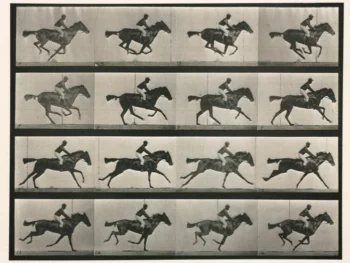
To think of social posts as throw-away one-offs, as much marketing does, is like viewing a single frame of a film that’s designed to be watched at 24 frames per second. It’s like the blind men and the elephant – you may *think* you know what’s going on, and how your audience is responding, but you’re not seeing the whole (motion) picture.
Yes, a single tweet or Facebook post *can* work in isolation. It can have impact. A person with a couple of hundred followers can see something they post go viral and reach hundreds of thousands of likes. An influencer can amplify it to the point the original poster can monetise that single moment, or use it as the starting point to become an influencer in their own right.
But the clue’s in the name – social is *social*. It’s about relationships, not one-off interactions. And the internet is the same – again, the clue’s in the name. It’s a network. It’s interconnected. Nothing online operates in isolation.
This is why an approach to online advertising that thinks only about the advert – in isolation – is always going to be doomed to fail. (And yes, if your social media post or article or video or whatever is put out on a schedule to broadcast to your followers – whether you put paid behind it or not – if you have no plan or resources to follow up and respond to the replies, then all it is is an advert.)
Even if you aggregate all your social data to see trends over time, you may *think* you’re seeing the big picture – but you’re not seeing it from the perspective of your audience. You’re lumping them together as stats, when in reality they’re all individuals – each having a distinct interaction with your brand. The long-term trends hide the fact that your audience is not always the same audience – different people will see different posts at different times, and many won’t see some of what you’re putting out at all. This means they’ll all be getting different impressions of what it is you’re about.
I remember when all this were fields…
When I started playing about in IRC and messageboards in the 90s, it took months to be recognised as a regular. When I started blogging in the early 2000s, it again took months to build a following and reputation.
And that’s months of multiple posts a day. Multiple replies to comments. Discussions. Following commenters back to their own blogs and reading *their* stuff. Getting a sense of how they thought.
This was all pre-Twitter, pre-Facebook – but post-IRC, and after messageboards, MSN Messenger and the like had become passé. We’d encounter each other on other people’s blogs, in their comment sections, and notice we were talking about the same things through trackbacks, RSS aggregators (after 2004 or so), checking now-defunct sites like Technorati, IceRocket and the like to find other people talking about the same thing (because Google was still rubbish for realtime search back then), and occasionally directly emailing.
Looking beneath the surface
The public face of blogging was our individual blogs. The individual posts. But those were just the tip of the proverbial iceberg – the starting points for interactions between blogger and reader that in some cases have lasted years. Some of the people I met virtually through my various blogs have become real-life friends. Some discussions inspired people to take up blogging for themselves, or to pursue different careers. Some of those interactions even led to real-world, paid work (as they did for me – which, in turn, led to my transition from print journalism to digital, and from there to my current role developing multiplatform, multimedia digital marketing strategies).
All these deep, lasting, sometimes life-changing relationships started with a connection around shared interests – just as, today, algorithms try to match adverts to people who may be interested in them. Superficially, to anyone looking from outside, those initial interactions in the comment sections under individual posts would have looked like that was all there was. If you’d looked at the stats on our blogs, the numbers would have looked *tiny*.
But the *real* story was the ongoing conversations and subconscious assimilation of each others’ ideas. The discussions and collaborations that stretched over months, and led to the short-lived rise of group-blogs, real-world meet-ups, grand plans that (in my case at least) never quite came to fruition. It was about the relationships and trust we built up over time.
The *real* impact took *years*, and in some cases was more significant than any of us ever imagined when we first put finger to keyboard.
How humans work
We’re all humans. We latch onto stories. We need big ideas. Emotional connections. Things to inspire and entertain. Things that speak to our gut instincts as well as to our heads. We’ve all read Daniel Kahneman, and know these heuristics are classic marketing creative territory.
And yes – as we’re humans we can also be manipulated if we’re targeted with the right message at the right time. Some of us will be more susceptible to some messaging than others. We will all have slightly different interests, meaning you can’t speak to us all in the same way. So a data-driven approach makes sense to try and finally give some clarity to John Wanamaker’s classic “Half the money I spend on advertising is wasted” conundrum.
But where big idea creative can attract attention, and data-driven targeting can increase relevance, what’s still missing for many brands is the follow-up. The vital thing that comes next.
In some cases this is where CRM comes in – but I can tell you from my blogging and chatroom days, in most cases being overly keen to initiate a conversation is going to have precisely the opposite response from the one you want. No one wants a pop-up window asking if they want help the second they land on a site any more than they want cookie notifications or requests to turn off their adblocker. Overly keen CRM = instant bounce, often with feelings of mild violation and anger. Not great for the start of a relationship. There’s a reason Microsoft killed Clippy…
My point? Let your audience go at their own pace
The reason the brief Golden Age of blogging (from around 2003-2006, by my reckoning) led to so many strong, lasting relationships is that those relationships were able to be built at our own pace.
There was no realtime chat. There was no “unread” notification to put pressure on us to respond unless and until we were ready. We all gradually built up archives of work that our readers and fellow bloggers could all check out at their leisure to get a sense of who we were and what we stood for. We linked to our past work – and each other – where relevant, showing how our thinking was developing over time, and allowing others to follow our trains of thought at their own pace to catch up and join in the conversation.
So when you encountered an unfamiliar blog or blogger – which was frequently – you could dip your toe in, test the water, and go back and check the context before engaging only when you had an idea what you were going to get involved in.
It was a slower-paced, more civilised way of communicating online that the likes of Twitter seem to have permanently destroyed with the constant need for instantaneous responses to everything.
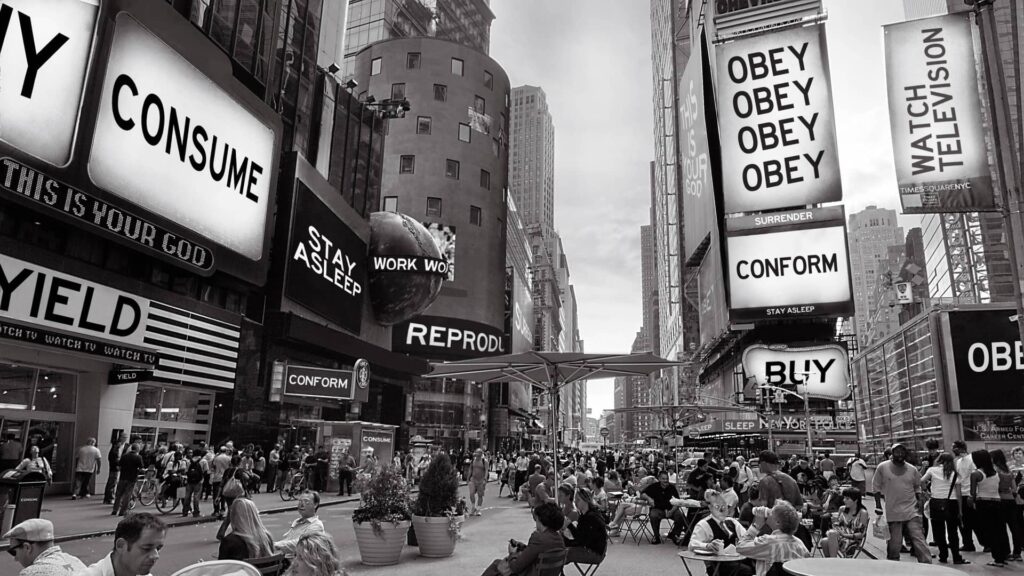
But today’s pressure to living in the moment and make instant decisions is deeply offputting. It’s not how people like to work. It’s not how any successful relationship has ever been built. It goes against all the instincts of the high-pressured world we’re now in, but today’s emphasis on the hard sell and call to action – not just the obvious “BUY NOW!” but also the more subtle “CLICK HERE TO…” and “FIND OUT HOW…” – may give a short-term nudge but not a long-term engagement.
Engagement – true, lasting engagement – comes through recognition, familiarity, and trust. This can only ever be built over time – often a long time. It will never come through a hard sell, and rarely through a single call to action.
In short:
Rather than worry about big ideas vs targeting, what the marketing industry really needs to learn how to do is revive the art of the soft sell and the long tail. That’s the more human way of building relationships that last – but to work it needs a significantly more nuanced understanding of how people will be interacting with you than I’ve seen from pretty much any modern brand marketing campaign.
So remember:
Every interaction with every part of your brand’s marketing campaign may seem like a one-off to you, but it’s part of a series to your audience. It’s all connected – but one bad experience could break the chain.
This means you need a truly integrated combination of high-impact big ideas and detailed data and longer-term storytelling and archives of the earlier bits of the story so people can catch up and targeting to the people who’ll be most interested and a true understanding of how people – and the internet – actually work.
No one said it was easy. But some things take time.
This obsession with measurable outcomes from online advertising – something it’s impossible to do with TV or print or billboards – is idiotic. Advertising is about brand/product recognition and building familiarity/trust as much if not more than direct sales, and always has been.
This is a solid overview of the issues. Maybe, one day, the industry will wake up to its idiocy. Yes, detailed data is useful – but just because some things are measurable doesn’t mean everything is. A sale may be a long time in coming.
Notes and Essays
To help shape my thinking, I write essays and shorter notes examining the ideas and narratives that shape media, marketing, technology and culture.
A core focus: The way context and assumptions can radically change how ideas are interpreted. Much of modern business, marketing, and media thinking is built on other people's frameworks, models, theories, and received wisdom. This can help clarify complex problems – but as ideas travel between disciplines and organisations they are often simplified, misapplied or treated as universal truths. I'm digging into these, across the following categories - the first being a catch-all for shorter thoughts:

 This from John Hegarty