
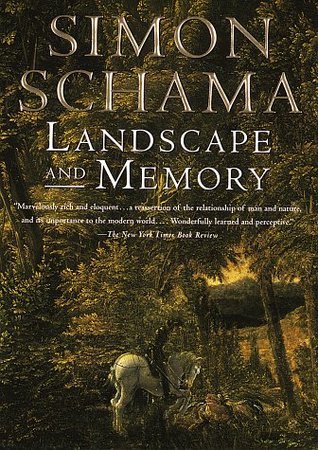
 4/5
4/5
This is a big, strange, frequently fascinating, but strangely disjointed book. Impressionistic history, not narrative. It’s also far longer than the page count suggests – a huge, heavy book that needs two hands to hold even in paperback.
Effectively a collection of essays that combine to make up one big essay, it jumps around in places and time as it explores Western civilisation’s relationship with the landscapes in which that civilisation has developed.
Yet this is a bit of a misrepresentation, as really the focus is primarily on the 18th and 19th centuries, as the conscious awareness of landscape as a thing started to emerge. And primarily via England, France, the United States, and Germany / the Holy Roman Empire. Other countries do get a look in. but these four dominate.
It’s at times more lyrical memoir or art criticism than cultural history, with the schema and structure and choices of what to cover making sense only to its author – making me wonder how on earth Schama managed to get this commissioned, given it came pretty early in his career, five years before he became a household name via his TV work. It feels more like the kind of self-indulgent passion project with which someone famous is rewarded to get them to produce something a bit more commercial.
But there’s still a lot here to like. For me, it’s best when it delves into myth and legend – though it doesn’t do this as much as I think is warranted, or as much as I’d have liked, given how good Schama is on myth when he does write about it:
“how much myth is good for us? And how can we measure the dosage? Should we avoid the stuff altogether for fear of contamination or dismiss it out of hand as sinister and irrational esoterica that belong only in the most unsavory margins of ‘real’ (to wit, our own) history?
“…The real problem… is whether it is possible to take myth seriously on its own terms, and to respect its coherence and complexity, without becoming morally blinded by it’s poetic power. This is only a variation, after all, of the habitual and insoluble dilemma of the anthropologist (or for that matter the historian, though not many of us like to own up to it): of how to reproduce ‘the other,” separated from us by space, time, or cultural customs, without either losing ourselves altogether in total immersion or else rendering the subject ‘safe’ by the usual eviscerations of Western empirical analysis.
“Of one thing at least I am certain: that not to take myth seriously in the life of an ostensibly ‘disenchanted’ culture like our own is actually to impoverish our understanding of our shared world.” (p.134)
And (much) later, concluding the thought with the closest the book has to an explanation of Schama’s aim in writing it:
“it seems to me that neither the frontiers between the wild and the cultivated, nor those that lie between the past and the present, are so easily fixed. Whether we scrambled the slopes or ramble the woods, our Western sensibilities carry a bulging backpack of myth and recollection… The sum of our pasts, generation laid over generation, like the slow mold of the seasons, forms the compost of our future. We live off it .” (p.574)
Appropriately enough this book is a rambling affair, following paths that make little sense as you wander them. But gradually the intent of the person who’s staked out those paths starts to make some kind of sense – as with an Impressionist painting, the subject of which can only be seen when you take a few steps back.
Here, the details are so dense, so varied, you’re better off with your nose close to the canvas – the parts work better on their own rather than summed into a whole.