by JCM | 16 Aug, 2014 | Systems & Technology
Nothing new, but this is worth a read on web writing and hate-reading – that old trick of being as controversial as possible in order to get an extreme response, purely because extremes get more attention, and in a pageview-driven business model, controversy is seen as good purely because, based on the metrics, it’s the controversial stuff that’s driving engagement.
This infantile attitude of provocation to get attention is increasingly being combined with ream upon ream of cheap content, because the more content you’ve got, the more potential PVs you can attract. We end up with the most depressing (and false) equation of online publishing:
Cheap content + Controversy = Clicks = Cash
It’s an attitude that’s lazy *and* massively short-termist in thinking – over the long term, quality can and should trump quantity. But even if it doesn’t, cheap, crappy content is a turn-off for audiences. The more sites that start to rely on hastily-produced, poorly-checked copy, or lazy semi-plagiarisms of things that desperate teams of poorly-paid hacks with deadlines and quotas to hit have found elsewhere, the less distinctive sites get, and the fewer returning visitors you’ll get. As that linked article puts it:
“With a business model based on a ton of cheap content, Web publishers can rely too heavily on acid-reflux-style aggregation, in which young writers destroy the savor of interesting stories and an interesting world by constantly regurgitating the news with added bile.”
There’s also an interesting point made from John Waters in the Irish Times (now behind a paywall), on the impact of comment sections under online articles:
“Because everything written specifically for online consumption is written in the expectation of addressing a hostile community, the writing process demands, as a prerequisite, either a defensive or antagonistic demeanor.”
Having learned my online publishing trade in the realm of message boards, chatrooms and blogs, I’m incredibly aware of the vast levels of bile that exist in comment sections. But it doesn’t have to be this way. With careful community management, it’s perfectly possible to build online communities that are supportive, friendly, and constructive, rather than the supposed default of objectionable and offensive. Check out the likes of b3ta, imgur and Metafilter for some prime examples of sites with vast *positive* communities of commenters. And then contrast those with the comments sections of pretty much any national newspaper site – packed with trolls and maniacs.
It doesn’t have to be this way.
by JCM | 6 Jul, 2014 | Marginalia
There’s a perfect quote in this piece that I’m surprised doesn’t appear more often in discussions of online journalism’s monetisation potential: “Ultimately, the problem might be one of unrealistic expectations“
by JCM | 5 Jul, 2014 | Marginalia
We still don’t know why, though…
“There are many more listicles of length 10 published compared to other numbers. This is primarily because BuzzFeed is selling the 10-length listicle to partner brands, such as the Michael J. Fox Show, Nordstrom Topman, and Buick. The second most popular length is 15, followed by 12. Listicle length drops off quite rapidly in the 20’s, although surprisingly, lengths 11-21 are far more popular than those under 10…
“If we look the bar chart by audience score we see a completely different picture — odd number length listicles… tend to have a higher audience score on average, where in our dataset, the number 29 tends to have an advantage over the rest.”
by JCM | 4 Jul, 2014 | Marginalia
Lots of good stuff in this about how journalist types need to get less prissy about monetisation, and how they can learn from the PR/marketing industry to make journalism better – this is opportunity, not dilution of the purity of a noble profession. And there’s a whole bunch of transferable skills to pick up along the way…
(Title stolen from Kevin Anderson on LinkedIn)
by JCM | 28 Jun, 2014 | Marginalia
I usually hate tips for writers – writing, to me, should be a natural thing. But having seen a lot of very bad writing, more concerned with showing off the writer’s linguistic skill or subject-matter expertise than enlightening the reader, this approach strikes me as vital to keep in mind at all times:
Writing is a modern twist on an ancient, species-wide behaviour: drawing someone else’s attention to something visible. Imagine stopping during a hike to point out a distant church to your hiking companion: look, over there, in the gap between those trees – that patch of yellow stone? Now can you see the spire? “When you write,” Pinker says, “you should pretend that you, the writer, see something in the world that’s interesting, and that you’re directing the attention of your reader to that thing.”
Perhaps this seems stupidly obvious. How else could anyone write? Yet much bad writing happens when people abandon this approach. Academics can be more concerned with showcasing their knowledge; bureaucrats can be more concerned with covering their backsides; journalists can be more concerned with breaking the news first, or making their readers angry. All interfere with “joint attention”, making writing less transparent.
This isn’t a “rule for writers”; it’s a perspective shift. It’s also an answer to an old question: should you write for yourself or for an audience? The answer is “for an audience”. But not to impress them. The idea is to help them discern something you know they’d be able to see, if only they were looking in the right place.
by JCM | 22 Jun, 2014 | Systems & Technology
Upworthy have released the code they use to track user engagement, with a nice bit of methodology explaining what they’re tracking and why they care:
“In the age of ever-present social media, our collective attentions have never been spread thinner. According to Facebook, each user has the potential to be served 1,500 stories in their newsfeed each time. For a heavy user, that number could be as much as 15,000. In this climate, how do you get people to pay attention? And, more importantly, how do you know they’re actually engaged?
“Clicks and pageviews, long the industry standards, are drastically ill-equipped for the job. Even the share isn’t a surefire measure that the user has spent any time engaging with the content itself. It’s in everyone’s interest — from publishers to readers to advertisers — to move to a metric that more fully measures attention spent consuming content. In other words, the best way to answer the question is to measure what happens between the click and the share. Enter Attention Minutes.”
by JCM | 15 Jun, 2014 | Systems & Technology
“Know your enemy” – the first rule of everything competitive. But we’re mostly doing it wrong – speaking with my MSN hat on, it’s all too easy to fall into the trap of assuming that our main competition is Yahoo, Buzzfeed or the Huffington Post, and base strategy on what they are/aren’t doing to get ahead of the competition.
But if you’re in publishing, no matter what kind, your competition isn’t other publishers – it’s anything and everything that competes for your audience’s time and attention. And this is only getting more obvious for anyone in the online world now that mobile is one of the key entrypoints for news.
What do we use mobile phones for? Communication, obviously. Information, naturally. But mostly? Proscrastination. Have a few minutes to kill waiting for a bus, for someone to turn up for a meeting, for the line and the checkout to run down, and what are we all doing? Pissing about on our phones. Some read ebooks, some play games, some do work, some watch videos, some learn a language, some catch up on the news and lastest gossip, look for lifestyle tips, browse recipes, check holiday destinations – all the other stuff that broad-catchment websites like the one I work on offer up to attract readers.
Even news itself is as much about wasting time as it is about getting information – because, let’s face it, most news doesn’t directly affect most people. Even the most horrific news – terrorist attacks, mass shootings, kidnappings, wars and natural disasters – only directly affect the tiniest fraction of our audiences. They are effectively entertainment to readers – macabre entertainment, perhaps, but entertainment nonetheless. Diversions from their daily lives. Time-wasters.
It’s obvious once you realise it, but it still seems strange to hear the managing editor of the Financial Times name Candy Crush as the paper’s main competitor.
So we as news publishers need to think about how we make *our* product the most attractive time-waster:
– Is it snackable enough?
– Is it engaging enough?
– Will it keep me coming back for another hit like those addictive game apps?
– Do I get any rewards or points or prizes?
– Does it give me things I can share with my friends to show off or entertain them?
– Is it respectable enough that I wouldn’t mind the people behind me on the bus seeing what I’m looking at?
– Is it always fresh?
– Does it have depth to dig deeper if I want to, or does it simply finish and leave me with nothing to do?
– How long will it entertain me for?
These questions are the same for games as they are for media. As everyone carries on catching up with the concept of mobile first, we need to keep reminding ourselves that the questions are the same no matter what kind of mobile product you’re creating.
by JCM | 14 Jun, 2014 | Structures & Models
 3/5 stars
Foucault’s Pendulum remains one of my favourite novels, and as this is another conspiracy theory piece from Eco I was looking forward to it. The unrelenting antisemitism (and general racism) of the central character was unpleasant, but bearable – I’d been warned what to expect – but still stumbled to a halt halfway through on my first attempt, mostly due to frustration with the amnesia conceit and the inconsistently intermittent interruptions of the mysterious narrator, which occasionally seemed to forget they were meant to be the narrator rather than a diary entry.
I’ve since restarted, and have been enjoying it more on the second attempt. Not one of Eco’s best, but evocative of the time and place – a grotty, unpleasant time and place, from his portrayal, and as such a refreshing alternative to the usual depiction of late 19th century Europe as some kind of golden age.
Finally finished, after another long break. Dense with information and impressive research, it’s an interesting fictionalised history. But I’m still unconvinced by the contrived structure – the pointless addition of a decidedly intermittent narrator, the found diary conceit, and (most of all) the split-personality amnesiac concept that forms the core of the book’s narrative reveal. Why did Eco think this necessary? For me, it merely distracted from the substance with unnecessary, not very well done style.
by JCM | 14 Jun, 2014 | Structures & Models
Fascinating, thought-provoking piece – another of those ones you come away from thinking “damn, that’s so obvious – why didn’t I make the connection before?” A few highlights:
Quality doesn’t mean popularity:
every single newspaper that I talk with. They are saying the same thing, which is that their journalistic work is top of the line and amazing. The problem is ‘only’ with the secondary thing of how it is presented to the reader.
And we have been hearing this for the past five to ten years, and yet the problem still remains. There is a complete and total blind spot in the newspaper industry that, just maybe, part of the problem is also the journalism itself.
Instead, they move the problem out of the editorial room, and into separate and isolated ‘innovation teams’… who are then charged with coming up with ideas for how to reformat their existing journalistic product in a digital way.
But let me ask you this. If The NYT is ‘winning at journalism‘, why is its readership falling significantly? If their daily report is smart and engaging, why are they failing to get its journalism to its readers?
If its product is ‘the world’s best journalism‘, why does it have a problem growing its audience?
Newspapers (and all-in-one-place sites) are an outdated concept:
No matter how hard they try, supermarkets with a mass-market/low-relevancy appeal will never appear on a list of the most ‘engaging brands’, or on list of brands that people love.
And this is the essence of the trouble newspapers are facing today. It’s not that we now live in a digital world, and that we are behaving in a different way. It’s that your editorial focus is to be the supermarket of news.
The New York Times is publishing 300 new articles every single day, and in their Innovation Report they discuss how to surface even more from their archives. This is the Walmart business model.
The problem with this model is that supermarkets only work when visiting the individual brands is too hard to do. That’s why we go to supermarkets. In the physical world, visiting 40 different stores just to get your groceries would take forever, so we prefer to only go to one place, the supermarket, where we can get everything… even if most of the other products there aren’t what we need.
It’s the same with how print newspapers used to work. We needed this one place to go because it was too hard to get news from multiple sources.
But on the internet, we have solved this problem. You can follow as many sources as you want, and it’s as easy to visit 1000 different sites as it is to just visit one. Everything is just one click away. In fact, that’s how people use social media. It’s all about the links.
One of clearest examples of this is how Washington Post is absolutely failing to engage people on YouTube. Every single day, they are posting a bunch of news videos about random things. Each video is well made (great production quality), but there is no editorial focus.
The result is this:

Here we have a large US newspaper that is barely reaching any people when it uploads a video to YouTube. And it’s not that the videos are uninteresting. There is one about iPhone cases that you can buy at the 9/11 museum (and the controversy of that), with only 687 views. There is a motivational speech (usually a popular thing to post on YouTube), with only 819 views. We have social tactics, like “5 awkward political fundraising moments”, with only 101 views.
Then we have a video by the super-popular George Takei that we all know from Star Trek. This is a person with millions of fans, but his video on Washington Post only attracted 844 views… in two weeks! If this had been posted by any Star Trek focused channel, this very same video would have reached 50,000 views, easy!
What the Washington Post is doing can only be described as a complete and total failure. It cannot get any worse than this.
by JCM | 14 Jun, 2014 | Marginalia
This obsession with measurable outcomes from online advertising – something it’s impossible to do with TV or print or billboards – is idiotic. Advertising is about brand/product recognition and building familiarity/trust as much if not more than direct sales, and always has been.
This is a solid overview of the issues. Maybe, one day, the industry will wake up to its idiocy. Yes, detailed data is useful – but just because some things are measurable doesn’t mean everything is. A sale may be a long time in coming.
by JCM | 11 Jun, 2014 | Marginalia
A great set of guidelines.
A few I especially like – largely because they apply far more widely than just in the newsroom – partly paraphrased:
- gather data relentlessly, but learn how to use it (and when to ignore it)
- evaluate fads, don’t chase them
- reward good failures
- ask “why would anyone see value in this?”
- you can’t judge success if you don’t know what it looks like
by JCM | 10 Jun, 2014 | Marginalia
Some great charts here – the overhype of social has been increasingly grating in recent years, a repeat of the 2003-5 excitement over blogging as the future of everything journalism, or the great SEO craze of approximately the same period, where the right combination of metadata and keywords were seen as some kind of magic bullet that could take any site to the top of the first page of Google.
Thankfully, everyone’s woken up to the limitations of both blogging and SEO. We’re now hopefully now coming to the same realisation with social, with more and more myths about clicks, engagement, sales, and all sorts being shattered left, right and centre.
But what we really need is the backlash to the backlash will hopefully follow soon after. Because although neither blogging nor SEO were quite the massive game changers they were made out to be, both have had (and continue to have) a huge positive impact on both the online world and the media as a whole. We simply now have a better understanding of their limitations as well as their strengths – which puts us in a much stronger position. Add the same rational approach to social (an approach that anyone with a Twitter addiction as bad as mine could have told you about years ago), and we should end up stronger yet again.
by JCM | 23 May, 2014 | Systems & Technology
Another Google algo update and, as ever, original, interesting, useful content is key to SEO success.
The hit eBay’s taken is interesting, though… An 80% drop in Google traffic coukd be a business-killer for anyone less big. And their content surely *is* original and relevant, what with the products changing all the time?
Possibly another impact from the authorship/Google+ changes the Google guys have introduced? After all, eBay product page writers are hardly likely to be verified Google+ authors. Is this why eBay are starting to invest in creating narrative content around their auctions?
Update: See also the ever-excellent Matthew Ingram on this, who points out the extremely worrying hit the long-running and much-loved Metafilter has taken:
“Reliant on Google not only for the bulk of its traffic but also the bulk of its advertising revenue, Metafilter has had to lay off almost half of its staff.”
The lesson?
Google can kill a site on a whim, and even the experts can’t tell us how or why, because Google’s algorithms are even more secret than the Colonel’s delicious blend of herbs and spices. Any site dependent on search for the bulk of its traffic is playing a very, very dangerous game.
Update 2: More detail on the Metafilter revenue/traffic decline, complete with stats.
The related power of Facebook to stifle updates from sources it has deemed to be suspect for whatever reason simply – and even the New York Times’ recently-leaked innovation report’s charts In the decline of its homepage – makes an obvious cliché all the more true even it comes to Web traffic: don’t put all your eggs in one basket.
If more than 25% of your traffic/revenue comes from one source, you’re in danger. More than 50%, you have a potential death sentence. All it takes is one thing to change, and you’re screwed.
by JCM | 14 May, 2014 | Structures & Models
I love Quartz.
I love news “atomisation” app Circa.
I am fascinated by the future of news.
So unsurprisingly yesterday’s launch of Quartz’s new Glass site – focused on the future of news via an experimental bite-sized format – got me rather excited.
But a day in, I can’t see the point of the atomisation format for this kind of site.
The perils of high expectations
What we get are Tweet-length (or thereabouts) snippets of media news, usually with a link – similar to the linklogs popular around the late 90s / early 2000s (think Memepool, Fark, LinkMachineGo) – or some kind of opinion, often with a little arrow indicating that you can click for more.
A linklog aggregating media news is fine – a useful addition to my Twitter list of handy sources of industry info, with some useful selections.
But why this atomised opinion approach? It’s like a choose your own adventure book, only with argument/opinion – subsequent points hidden until you click – for reasons that largely escape me.
Form vs function
Take this piece on the (excellent) Fargo TV series. That link takes you to the full post – with all the subsections expanded. It reads fine – just like a regular blog post.
But come to it from the front page? You get the first paragraph only.
Click down, you are presented with the tier two paragraphs (numbers 2, 4, 6, 8 and 10).
To get the full post, you have to click an additional four times to get paragraphs 3, 5, 7, 9 and 11. That’s five clicks to get one story.
What matters more – metrics or readers?
Now yes, this will give Quartz lots of useful data that they can analyse to check reader engagement – just as Circa does with their atomised news stories.
But where Circa’s use of “atoms” for presenting their stories makes sense and is backed up by a clear philosophy*, for the opinion piece parts of Glass I simply can’t see the rationale.
If I’m interested in your opinions about Fargo, I’m interested – so give them to me when I click. Don’t make me work harder to get your nuggets of wisdom – you risk annoying and disappointing me when the additional clicks prove pointless.
So from being excited, I’ve become annoyed – the content may be good, but the presentation is annoying. It’s bullet point lists with hidden child bullets, nothing more.
Or am I missing something?
* Short version of my understanding of Circa’s news philosophy (as an aside):
1) news is fast-paced, so keep coverage short and to the point
2) news is made up of facts, and facts change, but themes and stories persist/evolve
3) some facts can be recycled into new stories on the same theme
4) therefore breaking stories into their component (factual) parts makes sense both in the long and short term, as they
a) make the news easier/quicker to understand (when properly presented),
b) can be recycled into other stories on the same theme down the line, and
c) can have tracking attached to each element to see how/if audiences are engaging with that content, giving far more detail about user behavior than is possible from a standard article
by JCM | 13 May, 2014 | Marginalia
Being a foreign affairs geek, the decline of overseas bureaus has long been a concern.
Yes, the web could mean that information from overseas is easier to access and verify remotely than ever before (see the success of the Dublin-based Storyful in rapidly verifying UK from all over the world), but having your own trusted people on the ground? Surely that’s an advantage?
Well, yes and no. A correspondent can’t be everywhere at once. In a fast-moving situation like the one ongoing in Ukraine, with so many unverified stories and deliberate falsehoods and fabrications being set up, this becomes even more of a problem.
And so the just-announced Ukraine Desk collaboration between Vice, Quartz, Mashable, Digg, Mother Jones, and BreakingNews.com – pooling their on the ground resources to improve the reliability of their information – is a fascinating one, which I’ll be following with interest (both in the subject and the process).
Could collaborative newsgathering and media coalitions be a way to break down the economic challenges of having reporters on the ground?
by JCM | 10 May, 2014 | Structures & Models
 3/5 stars
Judt was obviously a master, as anyone who’s read even parts of Postwar can attest. His illness and early death was tragic. The idea for this book – to capture some of his knowledge and ways of thinking before the end – was a good, if macabre, one.
The trouble is, it’s an extended interview where the interviewer doesn’t seem to know when to shut up and let the interviewee speak. Timothy Snyder may well be a good historian in his own right (I don’t believe I’ve read any of his stuff, so can’t tell), but as an interviewer he leaves much to be desired – acting like an eager student trying to please teacher by showing off his own knowledge rather than shutting up and learning from the teacher as he’s supposed to do.
This gets particularly frustrating when Snyder keeps trying to divert Judt onto topics – such as the repeated questions about impact of Judt’s Jewish heritage on his upbringing and thought processes – that Judt continually tries to politely dismiss as largely irrelevant. Judt himself repeatedly points out that he had a more complex intellectual background than merely being a left-wing Jew – to try and shoehorn him into such a stereotype pushes the book dangerously close to being predictable, which is the last thing I’ve come to expect from Judt’s work.
That said, there’s still some fascinating stuff in here – but it needed a tighter edit, largely to remove Snyder’s voice and some of the more rambling digressions, and let Judt’s voice and opinions come through more clearly.
by JCM | 7 May, 2014 | Structures & Models
Obvious, but worth stating – and highlighted in an arguably overly-critical piece on the new Los Angeles Times website redesign (which, bar the lack of swipe navigation on the “browse visually” section, I like well enough – my only complaint with the look of the thing being their terrible, boring choice of photo on nearly every story):
“much of the innovation touted here has the publication playing catch up. Everyone, it seems, particularly web-only news outlets, has been treating each story as a hook to come into their sites. And nearly everyone seriously in the game is mobile-first…
“The Times is on board with best practices as the online journalism world knows them today. It’s just that the winners in this fast-moving game will be moving the ball forward and taking risks with payoffs that can’t be foreseen but that will seem obvious in the future.
“The redesign is formulaic. If you took a class on digital journalism last year, the professor would have told you this layout is what works.”
The obvious retort to which is a) “so what if it’s not a whole new thing?” and b) “who says that the pioneers win?”
The future of journalism / publishing doesn’t need to be radically different from what’s gone before. We shouldn’t need shiny bells and whistles to attract attention if the quality of the content is good enough and meets the needs of the audience.
 There have arguably been only a few radical shifts in journalistic presentation over the centuries, and all have been technological: the printing press, the steam-powered printing press, radio, film, television, the Internet. These required radical shifts in thought – all else is just presentation. Don’t get me wrong: presentation matters. But it’s not the starting point.
The challenge with all journalism in all ages is in a) identifying your audience and b) providing your journalism in a format that meets the balance between cost effectiveness and convenience for both you and your audience.
Mobile first websites make sense not just because the web audience in most developed markets is moving mobile, but also because it reduces costs – no more double development for big screens and small, mouse and touch, as has been the case for the last decade or so. Potentially, if done right (as with Quartz) you can even do away with a separate app – a potentially vastly expensive undertaking that ties you into seemingly endless development cycles to catch up with each new update to iOS, Android, Windows Phone, or whatever the next big thing is.
The advent of mobile first design thinking over the last couple of years could finally give Internet journalism space to start working out the more important questions about funding and distribution. The tools could stop being the problem for the first time in twenty years of the web.
As with early print, the ink and the paper part has been more or less decided (database-driven back end, HTML/CSS front end). What’s not been worked out is the ideal size of the paper, or the ideal font / layout. And as with print, the ideal will vary depending on the purpose. A newspaper is not a novel or a photography magazine.
Early printing was constrained for decades by old ways of thinking – book sizes based on old hand-written manuscripts that were themselves based on the amount of useable vellum you could get out of a calf skin (a “quarto” manuscript being the size of a quarter calf skin), with fonts that were based on gothic scripts designed by monks for spectacle and constrained by how they could cut the feather quills they used for writing, not ease of reading. Later, the industry persisted with the broadsheet format – always impractical for readers – because it was cheaper to produce, because their machines had been built that way – because centuries after Guttenberg the printing press had barely evolved.
Even in this post-Guttenberg Internet age, what matters is maximising access to our content while minimising the cost of production, same as it always has been. That content may look a little different, with interactive infographics and HTML5 video and so on – but at its heart it’s not changed either. It’s still all just words and pictures, the same today as it was in the pre-Guttenberg days of monks lined up in candle-lit rooms, copying out vastly expensive manuscripts for the tiny minority who could afford them.
Meanwhile, the assumption that the pioneers win is a nonsense. The pioneers make the mistakes that those who follow after can learn from. Only a very few of the earliest settlers succeed – the Oregon Trail led to many more deaths than happy new prosperous lives.
Short version: the real debate of the future of journalism isn’t about style, it’s about technology and economics, same as it always has been.
We need to accept this – because constraints can be useful. Without constraints, the Internet is a blank canvas – but Mankind has always preferred to know where the boundaries lie.
A combination of money and tech can help us set those boundaries. Some will continue to push them outwards, but few ordinary people are interested in living on the frontiers. They prefer safe and familiar. The pioneers of new techniques and technologies should be lauded, but it is the settlers who come after that will make the new land liveable and viable in the long run.
by JCM | 3 May, 2014 | Narratives & Meanings
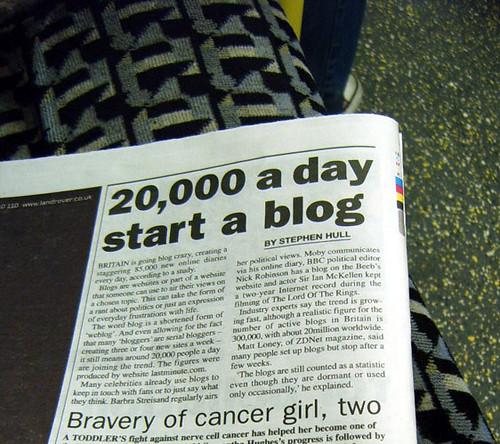
Something tells me this headline was from a fair few years ago…
A few years ago, after I won the European Parliament Prize for Journalism for a post on my politics blog, I told an interviewer that I believed that the arrival of the web heralded a new golden age for journalism (see below, or click to listen).
This – despite all the challenges that the industry still faces – I still believe.
In the last few weeks we’ve seen the launch of FiveThirtyEight, Vox and The Upshot, all trying new things that wouldn’t have been possible pre-internet.
In the last year or so, we’ve seen the rise and rise of Quartz, News Corp buy the excellent Storyful, the Mirror Group launch the interesting – and so far seemingly successful – experiments UsvsTh3m and Ampp3d, and Buzzfeed continue to expand into the realm of the serious (as well as other languages), fuelled by their success in the silly.
And that’s not to mention the increasingly experimental news apps, from Circa to Yahoo News Digest, Reuters’ WiderImage and Zite, all of which are experimenting with the vast, mostly still untapped potential of the splicing of internet and media.
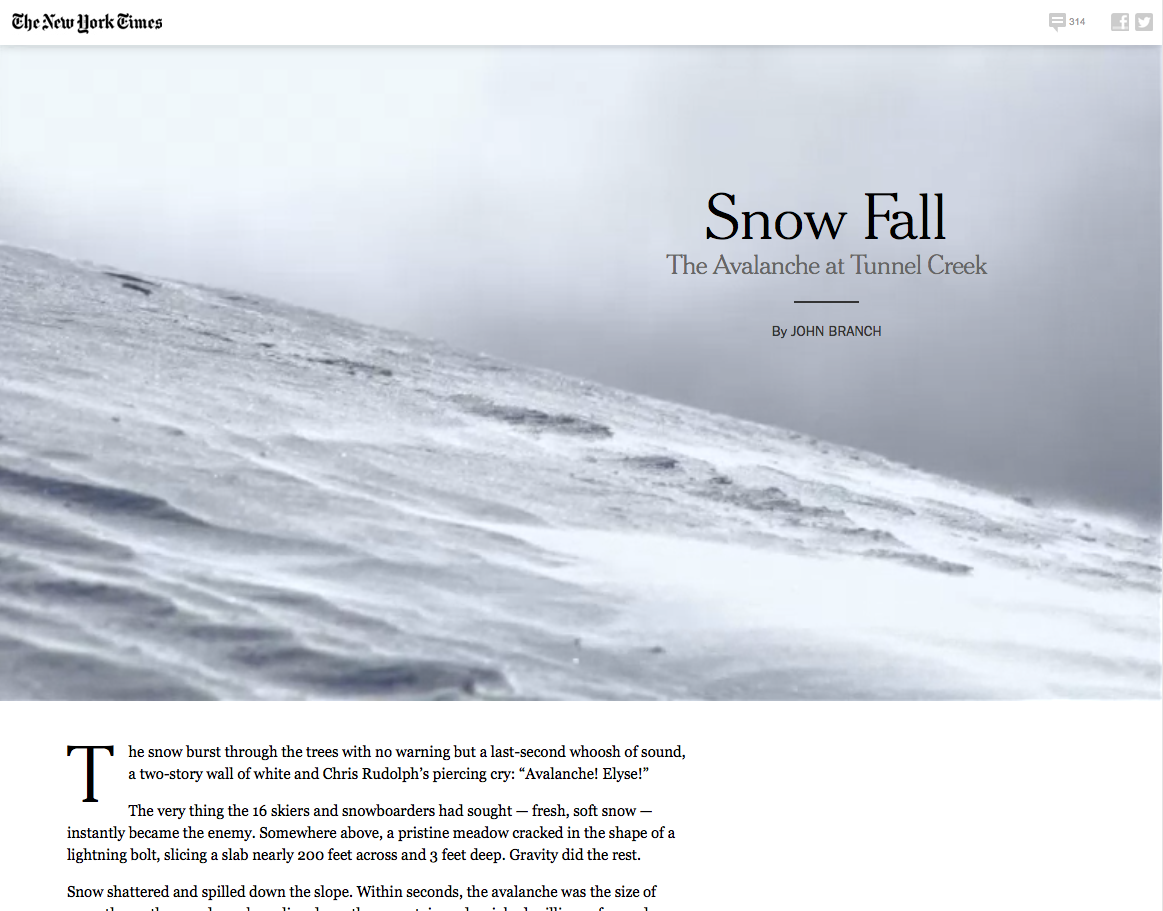
Snowfall – the future, or overblown?
Over the last few years I’ve had the pleasure of attending a number of News:Rewired conferences, hosted by my colleagues at MSN UK and organised by the fine folk at Journalism.co.uk.
At these and other events, be they blogger meetups or the small number of Hacks/Hackers events I’ve managed to attend, I’ve met or listened to too many interesting people with interesting ideas to list.
At the same time, there seems to be more interesting coverage of the world of media now than ever – especially of that intersection of media and technology that is the internet. And with this coverage comes more interesting discussion. (I’ve been deeply envious of all those at the International Journalism Festival in Perugia at the moment, and have been avidly following on Twitter.)
Recently I’ve been enjoying posting the occasional comment on LinkedIn about the media/online world in which I’ve been earning my living for the last decade and a half. But the discussions on LinkedIn can be limited by the forum itself – people are reluctant to speak freely on a platform that’s little more than a glorified CV repository.
Using my existing blog to talk about my fascination with the ongoing evolution of journalism doesn’t seem quite right – that’s got 11 years’ worth of posts about European politics, with only occasional digressions on the media and the web.
And so I’m starting up this blog to give myself more space to work out my own ideas on the future of news (and how to fund it), as well as the web and communication than in any expectation of interesting anyone else. But all contributions and discussions will be most welcome – be they here (once I’ve got comments set up, at least, or elsewhere.
Journalists following the dodo?: Interview with James Clive-Matthews by tuulitoivanen
