This didn’t get only three stars because this isn’t well-written, or that it’s not fun and interesting – but because it’s so inconsistent and hard to follow.
It purports to be the “story of a city and its people”, but can’t decide which people. Mostly it seems to be the story of kings, occasionally writers, very rarely others.
It both assumes a lot of prior knowledge of French history and explains the well-known at length – including things that have little specifically to do with Paris. But then it passes over specifically, uniquely Parisian events like the Revolution and barricades of 1848 in mere paragraphs, ignoring the vast numbers of fascinating people who could have made for great diversions.
Basically, I can’t work out the author’s criteria for what to include and ignore.
This lack of a clear schema means you’re better off with a tourist guide for the linear narrative history, a literary guide for the cultural, and a social history for an insight into the people. This covers parts of all, none of them comprehensively enough to be fully satisfying – but well enough to make me want to find out more. From a more coherent, consistent book.
The New Statesman has a long piece on the ongoing slow death of the advertising industry, with some fun distinctions between the ad industry (creative, visionary) and the ad business (dull, obsessed with data).
Can you guess which part the person who wrote it comes from?
Of course, the simple response to the majority of the article’s debate about whether high-impact artistic visions or hyper-efficient attempts to ensure relevancy are the best way forwards is:
But while there’s much to disagree (and agree) with throughout, it was this particular passage that sparked a realisation about the real challenge for the marketing industry:
“Now that people carry media around with them everywhere, advertisers have less incentive to create memorable brands. Instead, they concentrate on forcing our attention towards the message or offer of the moment. The ad business doesn’t care about the future of its audience, only its present.”
This, within the context of modern ad microtargeting and algorithms (as well as the general proliferation of TV channels, streaming video, and the decline in newspaper readership), is kinda true – with no clear way to ensure a follow-up interaction, the classic old ad model of trying to get a message in front of someone eight times (or whatever) and it’ll stick is no longer as straightforward as it once was. Even if you succeed, it’ll be by using cookies to track someone across multiple sites, firing the same advert at them so relentlessly that it seems desperate – and obvious.
But the obsession with the fast-paced present also shows how many marketing campaigns continue to utterly miss the point of social media.
The clue’s in the name
Social – done properly – *isn’t* simply of the moment, as much as it’s often dismissed as ephemeral.
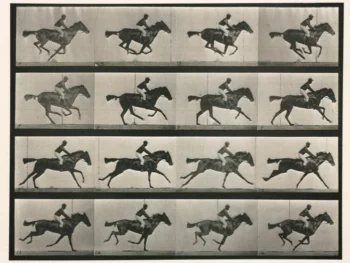
To think of social posts as throw-away one-offs, as much marketing does, is like viewing a single frame of a film that’s designed to be watched at 24 frames per second. It’s like the blind men and the elephant – you may *think* you know what’s going on, and how your audience is responding, but you’re not seeing the whole (motion) picture.
Yes, a single tweet or Facebook post *can* work in isolation. It can have impact. A person with a couple of hundred followers can see something they post go viral and reach hundreds of thousands of likes. An influencer can amplify it to the point the original poster can monetise that single moment, or use it as the starting point to become an influencer in their own right.
But the clue’s in the name – social is *social*. It’s about relationships, not one-off interactions. And the internet is the same – again, the clue’s in the name. It’s a network. It’s interconnected. Nothing online operates in isolation.
This is why an approach to online advertising that thinks only about the advert – in isolation – is always going to be doomed to fail. (And yes, if your social media post or article or video or whatever is put out on a schedule to broadcast to your followers – whether you put paid behind it or not – if you have no plan or resources to follow up and respond to the replies, then all it is is an advert.)
Even if you aggregate all your social data to see trends over time, you may *think* you’re seeing the big picture – but you’re not seeing it from the perspective of your audience. You’re lumping them together as stats, when in reality they’re all individuals – each having a distinct interaction with your brand. The long-term trends hide the fact that your audience is not always the same audience – different people will see different posts at different times, and many won’t see some of what you’re putting out at all. This means they’ll all be getting different impressions of what it is you’re about.
I remember when all this were fields…
When I started playing about in IRC and messageboards in the 90s, it took months to be recognised as a regular. When I started blogging in the early 2000s, it again took months to build a following and reputation.
And that’s months of multiple posts a day. Multiple replies to comments. Discussions. Following commenters back to their own blogs and reading *their* stuff. Getting a sense of how they thought.
This was all pre-Twitter, pre-Facebook – but post-IRC, and after messageboards, MSN Messenger and the like had become passé. We’d encounter each other on other people’s blogs, in their comment sections, and notice we were talking about the same things through trackbacks, RSS aggregators (after 2004 or so), checking now-defunct sites like Technorati, IceRocket and the like to find other people talking about the same thing (because Google was still rubbish for realtime search back then), and occasionally directly emailing.
Looking beneath the surface
The public face of blogging was our individual blogs. The individual posts. But those were just the tip of the proverbial iceberg – the starting points for interactions between blogger and reader that in some cases have lasted years. Some of the people I met virtually through my various blogs have become real-life friends. Some discussions inspired people to take up blogging for themselves, or to pursue different careers. Some of those interactions even led to real-world, paid work (as they did for me – which, in turn, led to my transition from print journalism to digital, and from there to my current role developing multiplatform, multimedia digital marketing strategies).
All these deep, lasting, sometimes life-changing relationships started with a connection around shared interests – just as, today, algorithms try to match adverts to people who may be interested in them. Superficially, to anyone looking from outside, those initial interactions in the comment sections under individual posts would have looked like that was all there was. If you’d looked at the stats on our blogs, the numbers would have looked *tiny*.
But the *real* story was the ongoing conversations and subconscious assimilation of each others’ ideas. The discussions and collaborations that stretched over months, and led to the short-lived rise of group-blogs, real-world meet-ups, grand plans that (in my case at least) never quite came to fruition. It was about the relationships and trust we built up over time.
The *real* impact took *years*, and in some cases was more significant than any of us ever imagined when we first put finger to keyboard.
How humans work
We’re all humans. We latch onto stories. We need big ideas. Emotional connections. Things to inspire and entertain. Things that speak to our gut instincts as well as to our heads. We’ve all read Daniel Kahneman, and know these heuristics are classic marketing creative territory.
And yes – as we’re humans we can also be manipulated if we’re targeted with the right message at the right time. Some of us will be more susceptible to some messaging than others. We will all have slightly different interests, meaning you can’t speak to us all in the same way. So a data-driven approach makes sense to try and finally give some clarity to John Wanamaker’s classic “Half the money I spend on advertising is wasted” conundrum.
But where big idea creative can attract attention, and data-driven targeting can increase relevance, what’s still missing for many brands is the follow-up. The vital thing that comes next.
In some cases this is where CRM comes in – but I can tell you from my blogging and chatroom days, in most cases being overly keen to initiate a conversation is going to have precisely the opposite response from the one you want. No one wants a pop-up window asking if they want help the second they land on a site any more than they want cookie notifications or requests to turn off their adblocker. Overly keen CRM = instant bounce, often with feelings of mild violation and anger. Not great for the start of a relationship. There’s a reason Microsoft killed Clippy…
My point? Let your audience go at their own pace
The reason the brief Golden Age of blogging (from around 2003-2006, by my reckoning) led to so many strong, lasting relationships is that those relationships were able to be built at our own pace.
There was no realtime chat. There was no “unread” notification to put pressure on us to respond unless and until we were ready. We all gradually built up archives of work that our readers and fellow bloggers could all check out at their leisure to get a sense of who we were and what we stood for. We linked to our past work – and each other – where relevant, showing how our thinking was developing over time, and allowing others to follow our trains of thought at their own pace to catch up and join in the conversation.
So when you encountered an unfamiliar blog or blogger – which was frequently – you could dip your toe in, test the water, and go back and check the context before engaging only when you had an idea what you were going to get involved in.
It was a slower-paced, more civilised way of communicating online that the likes of Twitter seem to have permanently destroyed with the constant need for instantaneous responses to everything.
But today’s pressure to living in the moment and make instant decisions is deeply offputting. It’s not how people like to work. It’s not how any successful relationship has ever been built. It goes against all the instincts of the high-pressured world we’re now in, but today’s emphasis on the hard sell and call to action – not just the obvious “BUY NOW!” but also the more subtle “CLICK HERE TO…” and “FIND OUT HOW…” – may give a short-term nudge but not a long-term engagement.
Engagement – true, lasting engagement – comes through recognition, familiarity, and trust. This can only ever be built over time – often a long time. It will never come through a hard sell, and rarely through a single call to action.
In short:
Rather than worry about big ideas vs targeting, what the marketing industry really needs to learn how to do is revive the art of the soft sell and the long tail. That’s the more human way of building relationships that last – but to work it needs a significantly more nuanced understanding of how people will be interacting with you than I’ve seen from pretty much any modern brand marketing campaign.
So remember:
Every interaction with every part of your brand’s marketing campaign may seem like a one-off to you, but it’s part of a series to your audience. It’s all connected – but one bad experience could break the chain.
This means you need a truly integrated combination of high-impact big ideas and detailed data and longer-term storytelling and archives of the earlier bits of the story so people can catch up and targeting to the people who’ll be most interested and a true understanding of how people – and the internet – actually work.
No one said it was easy. But some things take time.
Inventive, but as if by numbers: multiple perspectives over several centuries, in multiple formats – diaries, letters, court transcripts, book extracts, stream of consciousness, snippets of pub conversation, photo captions, film scripts – with only the smallest nods to past sections throughout, meaning an excellent memory is vital to spot the narrative connections.
But the point here isn’t narrative (because there isn’t much of a one, beyond the vague narratives of each section, most of which end in disappointment for the subject) – it’s the nature of history and memory, how different people and eras have different priorities, how there’s always a clash between the desire to maintain tradition and progress (even if that tradition is barely understood, and the benefits of that progress aren’t clear).
This makes it, in many ways, both a deeply melancholy and a deeply pessimistic book. And also means it perfectly captures elements of the attitudes of rural southern England in the late 20th century – and probably still today. In some ways it feels quite Brexity, in fact – or, at least, that it helps explain Brexity attitudes.
A superb piecing together of disparate unreliable information from multiple countries and centuries in an effort to piece together just what medieval Europe knew of the wider world, prior to its rapid expansion after Columbus, Magellan, and Da Gama.
The legends of Prester John, the travels of Marco Polo and John Mandeville, the rediscovery of classical learning, the threat of the Mongols, the desire to reconquer Jerusalem with a new crusade, the closing of the Silk Road by Central Asian wars, the rumours of Atlantic islands, the pursuit of Paradise in Ceylon, the source of African gold, and the various pre-Columbian discoverers of the Americas – all are here, making the medieval world seem much bigger in the process.
Excellent fun stuff that makes Columbus’ voyage both make more sense and less – he had enough evidence there was something over the horizon, but much of that evidence suggested it was much further away, and he still had no real idea how to get there.
Impressively prescient, considering it was published five years ago but is about technology – something that’s been moving madly fast during that timeframe. The Facebook / Cambridge Analytica scandal effectively predicted, many of the debates still going on in business and government today about things like the gig economy, autonomous vehicles and more were anticipated and summarised before they’d really started happening. The impression is that Lanier had seen all this coming decades ago – and he probably did.
As such, lots here to spark thought, lots to be impressed with, and it’s hard to disagree with the central thesis that the informational economics of the internet age are fundamentally broken. But at the same time, the only alternative to the current way of doing things – micropayments for data exhange/generation – still seems insanely impractical, even employing a technology like blockchain (something similar to which Lanier kinda proposes here).
So while Lanier ends on an optimistic note, the book left me more pessimistic than ever about our tech-driven future.
Borderline five star for me, this. Ticks a huge number of the boxes for books I love: Lyrically-written magic realism, unreliably narrated from multiple perspectives, set in the 16th century (flicking between Medici Florence and the court of Akbar the Great), weaving together elements of real history, fiction, fable, philosophy, and inventive ideas.
My issue with it is hard to pinpoint, but throughout I had a niggling dislike of a book whose writing and concept I loved. I think it’s probably to do with how every single female character is an archetype: the whore, the jealous wife, the bitter mother-in-law, the spurned lover, the unattainable object of desire, the witch, the imaginary ideal.
This is, of course, thematically kind of appropriate for the story – which revolves around the romanticised fiction of a mythical woman’s life – but it still grated. The inner workings of the mind of the Mughal emperor are so interestingly explored, yet none of the women in this novel seem to have any layers of complexity to them at all.
Is that just because the women are presented through the eyes of the men in the novel, or because Rushdie lacks the ability to create a convincing female character? It’s the first book of his I’ve read (have been meaning to get around to him for ages), so hard to judge. But I’ll still certainly try more of his stuff after this.
A surprisingly deep book for one written in such a simple, innocent style – and once that slowly presses the emotional buttons in a way you don’t quite notice until it’s too late and you’re fully sucked in. Want to go and give the wife a massive hug right now, basically…
Initially couldn’t see what the fuss was about, but it builds and grows, layer after layer, subtly adding depth and clarity to the allegorical elements and emotional attachment to the characters. The conclusion, though long expected, is done with a skill that has genuinely left me feeling a little shell-shocked – that kind of sadness that comes with a calm acceptance. Fits the book perfectly.
It’s about relationships, memory, trust, forgiveness, anger, revenge, and history. How the past is forgotten, manipulated, subjective, vital – but also how human relationships are the thing that both bind and divide us, and can, with the right attitude, overcome any past.
It gives both cause for hope and for despair. It’s both pessimistic and optimistic. And, ultimately, despite being a fantasy, it’s profoundly realist and meaningful. Worth a read.
One of the few strategy books recommended by Lawrence Freedman in his chunky Strategy: A History, largely for its gleeful destruction of the fatuous nonsense that passes for most business strategy.
There’s a lot of good stuff in here. Useful ideas. Good tips for clarifying thinking and approaching problems in a more strategic way.
But, as with so many business books, it’s very heavy on anecdote and case study, few of which are well told, and all of which could do with succinct, clearly formsttd summaries of the point so you can skip the details if needed. Only one section tries to do this, and it doesn’t do it well.
Nonetheless, where the thinking is clear and clearly presented, it’s got some excellent short sumaries of ways to think and act that can be invaluable to anyone in a leadership position. If you are, it’s definitely worth a read.
An impressive no bullshit overview of strategic thinking (and claims about the merits of such thinking) over the last two centuries. My copy is now littered with copious notes, and I’m sure I’ll be returning to it repeatedly as a reference book from now on. Particularly enjoyed the excellent destruction of pretty much all businesses guru claims about management strategy.
Well worth investing the time to read this for anyone interested in politics or business – though there are big chunks it’s perfectly possible to skip, depending on your primary interest (the lengthy detour into left-wing and radical political theory added little for me, largely because I was already familiar with it).
Had read most of these in isolation before, never cover to cover as a coherent collection. They work better as a collection – themes emerging, parallels, repetitions.
No real standout story for me, bar possibly The House of Asterion and The Writing of the God, though many standout ideas. The core concepts of The Zahir (an object or thing that drives obsession it’s impossible to shake) and The Aleph (a point in time and space from which it’s possible to see all other points in time and space simultaneously) both could have been expanded into much more.
And that’s the thing with Borges – he always leaves you wanting more. May well try this same trick of reading his collections as collections with the rest now…
An immense amount of research packed into a well-written, fascinating book. Has given me untold new appreciation for the late Georgian scientists and explorers – from a period before the word scientist had even been invented, and where art and science were still far more closely intertwined. This isn’t just Banks, Herschel and Davy – Coleridge also plays a significant role, as do Shelley, Woolstonecraft, Wordsworth.
Is it a bit Anglocentric? Possibly – I don’t know enough about the period to tell. But it does amply show how much scientific dialogue there was between England and France in particular, even during the Napoleonic Wars – a kind of friendly rivalry in which England seemed to have come out on top.
Is it a bit London-centric too? Possibly, though the Davy chapters do feature the Westcounty, and there are references to the later proliferation of provincial scientific associations. And in any case, this is about the initial scientific breakthroughs, not their applications asthe Industrial Revolution spread.
I took my time reading this, as it was an ideal tube journey book – each chapter split into shorter sub-chapters, and all enjoyably worth savouring. Tiny print in the paperback also means this packs in far more words than many books of the same pagecount. Could it have been a far faster read? Yes – but I’m glad I took my time, and that I finally got around to it after years of it lying on the shelf unread.
A solid, readable polemic (with occasional excellent passages and a few clunky ones) that neatly demonstrates the complex challenges of Britain’s odd understanding of and responses to racism.
In all, the book made a fair few things clearer, while provoking several moments of “hmmm… That’s a bit strong / doesn’t really help the argument” – but as I’m a white man, most of my objections had either already been anticipated or dismissed as me not getting the point. (A useful rhetorical device for shutting down objections, that – but here, in places, it is probably a valid one.)
Most interesting were probably the chapters on race and feminism / race and class – this is where the core argument about the need to fight all forms of injustice and inequality (to really get rid of the structures that ensure racism/sexism/etc persists) begins to kick in. That’s a good argument, and needs to be made more often. (*waves at the Labour party*)
Only fear now is that even by writing this review (let alone reading the book on the tube earlier) I could be guilty of “performative anti-racism”. I kinda knew that was a thing, and know I’m occasionally guilty of it, but now can’t tell what counts – or whether the “performance” is a negative to be avoided, or just something that doesn’t make sufficient difference in the overall battle. (I’d argue it’s all good marketing…)
The author is one of those irritatingly lucky people who stumbles through life being in the right place at the right time, meeting the right people. Deep envy.
Some small oddnesses and cultural misunderstandings, though – such as a passage describing the interpretation of a painted scene. He reads the image from left to right (making it about the moment before glory) rather than right to left, as Japanese people would read it (making it about the transient nature of life and success, a much more Japanese concept). Small things like that make me wonder whether, despite the author’s long years living in Japan, and his close familiarity with many aspects of its culture and history, he really does understand the place.
But then, as he says, that’s the beauty of Japan – it can’t really be explained in words, it mostly has to be experienced. And, to be fair, he has a good stab of explaining it.
The book itself is an engaging overview of the crisis of cultural identity Japan’s still going through, though mostly from the boom years of the 60s to 80s. Makes a lot of the oddness of modern Japan make a lot more sense than most other books I’ve read on the place, and so well worth a read for anyone interested in trying to understand the place.
Flicked through before, this time read kinda cover to cover over a few days. Skipping bits, for sure, but reading most of it. Main observations:
1) It’s going to date badly – too much speculation about meanings, and too many interpretations that feel very of a particular moment.
2) Despite thinking it’s being critical and analytical, it’s actually kinda teleological, and definitely has an agenda. It’s an agenda I agree with and support, pushing a global, multicultural view of the world, but just because I agree with the agenda doesn’t mean I can’t see that some of the points are stretched very, very thin.
3) It doesn’t function as a linear narrative, but the thematic sections also don’t make much sense to me – largely because they’re also kinda chronological. It would make much more sense to have the first coins followed by the first ledgers and the first bank notes, but instead these objects are all grouped into other sections, to facilitate a more semi-chronological approach. Thematic makes more sense.
4) There’s a huge amount of unjustified historical equivalence, making some things sound more important than they are for world history to ensure a good geographic spread – often accompanied by enthusiastic hyperbole about the significance. But there’s also still a number of significant gaps: nowhere near enough China or Greece in particular.
That’s not to say it’s not a good book. It is. And it informed me abiut a bunch if things I never knew. But history is about selection, and here the selection was limited by the British Museum’s own collections. How would other major global museums have approached this differently? I’d be keen to find out.
I’ve come away convinced that this would have been infinitely better as a 400-page standalone novel with an optional 600-page sister volume of semi-related spin-off short stories as a kind of DVD extras disc, rather than this incoherent mess of disjointed interconnected short stories.
Even though I understand *why* he structured it this way (to fit in with his new, fun, central concept of the nature of nonlinear time), and though he makes it clear enough he doesn’t really care what his audience thinks (this is ART, darling – and if you don’t like it you’re an idiot and can fuck off), I kinda prefer novels to have some kind of coherent narrative to them, as well as a thematic point.
All that said, there are bits of this vast, meandering not-really-a-novel that are five stars. There are some genuinely great bits in it, where Moore is at his very best. The 350-odd pages of straight narrative in the middle, written as a kind of heightened, metaphysical Enid Blyton Magic Faraway Tree for adults, is good fun – the sort of thing fans of Promethea, Top 10, Tom Strong and The League of Extraordinary Gentlemen will love. Even the Joyce pastiche chapter is very well done – albeit an appropriately hard slog that adds little, if anything, to the overall narrative.
But it’s far too self-indulgent. Too smug. At points – especially towards the end as he builds up to the conclusion (which isn’t really a conclusion, because – thematically appropriately – the promised one never comes), he starts breaking the fourth wall via his characters, dropping more and more hints as to his book’s grand design.
Eventually he gives up, and taps on a final “postlude” chapter to smugly, patronisingly, and still vaguely obscurely, explain the entire thing, positioning himself as a weirdo artistic genius who doesn’t really care if you understand it or not.
I did understand it. I did enjoy much of it – including many of the bits I think should have been cut. I just didn’t think it was as clever as he does, and didn’t think it holds together as a narrative whole. Because it doesn’t, pretty much by design.
Glad to have got it over with. Glad to have read it. And now know far more about Northampton than I ever wished to.
As ever with anthologies, some variation in quality of writing (from excellent to competent) – but consistently raw and compelling in emotion and insight for those, like me, lucky enough not to have to live with racism every day.
Horrible to say, but at first as a Brit I kept comparing to something like Ta-Nehesi Coates’ Between the World and Me and the US experience of racism, and being slightly proud of the UK for there are fewer stories of naked aggression or direct violence, or even of fear.
But then that’s the point. The worst racism isn’t necessarily the extremes, the exceptions, the stuff we can all (even our racist relatives) safely disassociate ourselves from and loudly disapprove of – the shit through the letterbox, the defacing of Jewish graves, the random assaults – it’s the daily, mundane slog of unspoken assumptions and unconscious bias. The stuff us privileged white people, even well-meaning ones, barely notice – even when we’ve realised it’s there. Constantly. Inescapably. With no end in sight.
To better appreciate the all-pervasive impact of that kind of everyday racism, this book is essential.
Decent and interesting, as far as it goes – but this is a history of religious myth only, and then only really of ancient Near East and Judeo-Christian religious myth. China is breifly touched on, but no India, no Africa, no Americas, no Asia-Pacific. No national myths, no folklore (bar some Chinese ones), no attempt to define the difference between myths and legends (that I remember).
Why no myths of the likes of King Arthur or Robin Hood? Why no discussion of folk tales, ghosts, genies, goblins, faries, and the like? Why no mythical creatures like the Loch Ness monster, Bigfoot, and the like?
As much as I like Armstrong, the only answer that I can think of is that it doesn’t fit the narrative of the rise of rational thought – because the appeal of these kinds of non-religious myths have endured. If anything, the rise of the urban myth and appeal of TV shows like The X-Files and its successors show we’re still looking for unbelievable things to believe in.
But while Armstrong keeps talking about humans being attracted to myths, her explanation leaves out any real psychological discussion. Instead, it’s all about “spirituality”, a concept she fails to define (that I can recall).
Not her best book, in other words. Too limited in thinking, not just in length. But still interesting enough for a quick read. Sparked a few ideas, at any rate – and that’s all I ask for.
Rather liked this. Told from multiple perspectives (including those of animals, dead people, and abstract concepts), it’s a rare historical murder mystery that didn’t violently irritate me by being an historical novel that’s a murder mystery, one of the most frustrating clichés of the historical fiction genre.
Underlying it all is a melancholy exploration of the Islamic rejection of art, and the Turkish identity crisis that’s continuing to this day, making this a wonderfully contemporary book, even while being set five centuries ago. Reads well too – a solid translation.
Four stars primarily because it’s deliberately written in a way that makes it hard to keep track of some of the characters’ identities, which may well help maintain the murder mystery, but occasionally makes for a confusing reading experience.
“events! if you want those, you’d best stop reading now)”
Extremely readable – finished in one sitting – and a perfect piece of postmodern contemporary anthropology of a particular kind of existence in c.2012-2015 London that felt all kinds of familiar. I can see how some would find it pretentious, but it felt so much like a more accessible, less thesaurus-prone mid-90s Will Self that I couldn’t help but like it lots.
Two passages in particular sum up the book, for me:
“It will find its shape, he’d said; I leave all that to you… What if, rather than *it* finding its shape, the age itself, in all its shape-shifting and multi-channelled incarnations, were to find and mould *it*? What if the age, the era, were to do this from so close up, and with such immediacy and force, thay the *it* would all but vanish, leaving just world-shape, era-mould? I started thinking thoughts like this… Beneath their vagueness, I felt something forming”
And:
“Certainly, the fact it came from me, and the context within which it was presented, would imbue it for him with all kinds of cryptic meaning. And besides, I felt with real conviction that it *was* full of this already: meaning of a genuinely deep and intense nature, whose sense eluded me but whose presence radiated, pouring into everything around it.”
Yes, I can see how some would find it pretentious, pointless. Because it is. But knowingly so. Which is, as far as I can tell, the entire postmodernist point – and one that I greatly enjoyed.
An excellent achievement, original in conception, convincing in execution – a kind of reconstructed autobiography from a dauntingly chaotic array of manuscripts that gives an intriguing new perspective on the much-covered intellectual circles of mid- to late-17th century Oxford and London. It’s a perspective firmly from the sidelines, written by a bit player, a kind of hanger-on.
And that’s why only four stars. It’s fascinating for people interested in the period, and novel-like enough to be worth reading anyway. But Aubrey is so self-deprecating, so timid, so uncertain of himself, so seemingly incapable of atanding up for his own interests, so prone to prevarication, that he can become a depressing, frustrating companion. You feel like shaking him, telling him to sort his shit out and get on with it, to write that damned book at long last.
Yes, I see much of myself in Aubrey, which made this book all kinds of existentialist. I should stop prevaricating myself. Life is short. In three hundred years will they remember me as they do him?
To help shape my thinking, I write essays and shorter notes examining the ideas and narratives that shape media, marketing, technology and culture.
A core focus: The way context and assumptions can radically change how ideas are interpreted. Much of modern business, marketing, and media thinking is built on other people's frameworks, models, theories, and received wisdom. This can help clarify complex problems – but as ideas travel between disciplines and organisations they are often simplified, misapplied or treated as universal truths. I'm digging into these, across the following categories - the first being a catch-all for shorter thoughts:

 3/5 stars



 3/5 stars
 5/5 stars
 4/5 stars
 4/5 stars
 5/5 stars
 4/5 stars
 5/5 stars
 5/5 stars
 5/5 stars
 4/5 stars
 4/5 stars
 4/5 stars
 3/5 stars
 5/5 stars
 3/5 stars
 4/5 stars
 5/5 stars
 4/5 stars