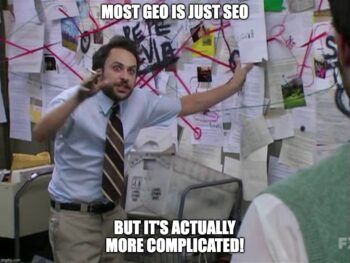
I’m seeing more and more people realise that “AEO” (Answer Engine Optimisation”) is just SEO in new clothes. But are GenAI outputs even something you can optimise for?
These systems don’t just read what you publish and serve up the most relevant parts – they synthesise it, blending multiple sources based on patterns they infer across a wider field of signals:
– everything you publish
– everything others publish about you
– everything they consider adjacent or comparable
They’re also not just looking at what’s being said now. They’re conflating and combining the accumulated traces of how your organisation expresses itself over time – across campaigns, content, product information and everything in between.
Repetition and consistency may help, but they won’t just pick up what you intend. They absorb whatever is most legible – including contradictions, gaps, and overlap with competitors.
If your positioning isn’t distinctive, you’ll get flattened into the category. If your communication isn’t coherent, the model will reconstruct a version of your brand from whatever patterns it can find. And when it comes to facts and details – where accuracy actually matters – these systems are still unreliable enough to pose a real risk.
This is where a focus on structured data starts to look like a promising way forward. That was my first assumption. But it’s becoming increasingly clear that this isn’t going to be enough.
—
The key is to remember that these systems don’t *understand* information. They generate outputs by following probabilistic sequences – patterns shaped by the data they’ve seen.
It’s a sophistiated form of word association. Structure helps, but only where it clarifies those patterns to nudge the model to follow the path you’d prefer.
Over time, what you’re really creating – deliberately or not – is a set of associations the LLM learns to treat as related. What we’d normally think of as a brand “narrative” sits inside that – not as something the model understands directly, but as a pattern of connections it learns to reproduce.
—
This means “AEO” should be considered less about optimising individual outputs, and more about the long-term shape of the signals you generate – across teams, markets and years.
I’ve been doing some work on this recently, trying to make that problem more tangible and diagnosable in practice. Still early, but the direction of travel feels clearer.
The brands that show up well won’t just be the ones optimising for visibility. They’ll be the ones whose overall pattern of behaviour is coherent enough that even a probabilistic system can’t easily misread what they are.
This is pretty much what I’ve been talking about for the last few years, via Joe Burns.
The problem isn’t just that the old model doesn’t work in a more complex environment – it’s that the very terminology precludes understanding and alignment, as everyone has a different idea of what the labels mean.
The key to success has always been systems thinking – but many agencies (and even more so in-house marketing teams) continue work in siloes, with nowhere near as much discussion and collaboration as is needed to come up with truly effective approaches.
As Joe Burns put it in his post on this:
“Coherence has to come from the system, not just one execution. The idea of a ‘Campaign’ only works if you can muster a critical mass of attention to carry people through it.”
Maybe it’s my “content” background speaking – because really strong content strategies need to work at multiple levels, across multiple channels and formats, and for multiple audiences with multiple needs. Without understanding the big picture *and* the details, it’s impossible to deliver effectively content across a campaign – individual assets may be solid, but the whole ends up less than the sum of its parts.
This is why I’ll continue trying to play in those overlap areas – not only do I find the diversity and clash of approaches and ideas stimulating, but I see it as the only way to work out the best way to succeed. You have to try to see the big picture to work out the best individual brush strokes.
I’m vaguely pondering starting up a newsletter/podcast/etc exploring media/marketing received wisdom and groupthink…
The Superbowl, Davos, and ChatGPT’s announcement it’s running ads means media/marketing LinkedIn will be swamped with lukewarm hot takes this week.
This industry herd mentality is increasingly fascinating to me – the need to comment on the same things everyone else is talking about is rarely “thought leadership”, and is very far from the old advertising mantra “When the world zigs, zag”.
I’ve spent a decade in marketing, more than double that in publishing. In all that time I’ve rarely encountered many convincing new ideas – even during major platform shifts. And usually when I have, the evidence for “best practice” has lacked much substance – or blatantly originated in some tech company’s hype (as with the first, second, and third pivots to video, and certainly with the “everything needs to be optimised for Alexa now” fad).
It feels like we’ve now all got so used to running with the latest fad for fear of missing out or – worse! – looking out of touch, we’ve lost all sense of critical thinking, or desire to question industry norms.
But is this something in which enough people would be sufficiently interested to make it worthwhile? And will it cut through the algorithm – another idea we’ve all unthinkingly adopted?
I’ve seen this piece shared a lot, and like it. I’ve long been a fan of Systems Thinking (check my bio, it’s at the heart of my approach to everything).
But I’ve always seen Systems Thinking as more of a mental model or reminder to look beyond the immediately obvious causes and effects that could impact a strategy, rather than an enjoinder to try and literally map out interactions between all the different components.
As this piece notes, if you try to map out every interaction in a complex, shifting, uncertain system, you’ll never succeed. There are too many variables, all changing. Complexity Theory – even Chaos Theory and the Heisenberg Uncertainty Principle – rapidly becomes more helpful. Only these usually aren’t of much *practical* help at all.
It’s like playing chess – you don’t bother mapping out ALL the possible moves, as that would take forever (look up the Shannon number to get a sense of how many there could be – it’s more than the number of atoms in the observable universe…), and is therefore useless.
With experience, good chess players (and good strategists) can rapidly, intuitively home in on the moves most likely to work – both now and several moves down the line.
The problem is that the same moves will rarely work twice – at least not against the same opponent. And in a complex, ever-changing system, you’ll rarely have the opportunity to make the same sequence of moves more than once anyway, as the pieces will be constantly changing position on the board. Which will also be constantly changing size and shape.
“But metaphor isn’t method.”
That’s the key line from the linked piece. Business strategy isn’t chess – because you’re not restricted to making just one move at a time, or moving specific pieces in specific ways.
The challenge is to keep as flexible as possible while still moving forwards, which is why this bit of advice – one line of many I like, especially when combined with the recommendation to design in a modular, adaptive way – is one I pushed (sadly unsuccessfully) in a previous role:
“Instead of placing one big bet, leaders need a mix of pilots, partnerships, and minority stakes, ready to scale or abandon as conditions change.”
The problem is that strategy decks – still at the heart of most businesses and almost every marketing agency – are intrinsically linear, despite trying to address nonlinear, complex systems.
This is why most strategies end up not really being strategies, but plans, or lists of tactics.
And thats why most “strategies” fail.
Don’t focus on the *what* – focus on the *how*. Great advice from my former boss Jane O’Connell, which took me a long time to truly understand. It’s a concept that’s core to this excellent piece – and incredibly hard to explain.
I’m not a stickler for “correct” punctuation, as a rule – except when it comes to apostrophes and the Oxford Comma. This is because punctuation, mostly, is about flow and rhythm, not meaning. Misplaced apostrophes and missing commas in lists can substantially change meaning rather than flow, so their correct placement becomes vital.
This fascinating essay on the evolution of punctuation makes clear that improving flow and clarifying meaning has long been the goal – while also exploring the long history of resistance to punctuation that over-clarifies meaning.
It’s a useful reminder that words are about interpretation as much as intention. Sometimes ambiguity lets greater meaning emerge, building stronger connections with your audience by encouraging them to think more deeply about your words. Sometimes it creates confusion.
The challenge, as ever, is getting the balance right – so focus on the needs of your audience. What will most help them understand your meaning (or meanings)? What will confuse? No one wants to have to try and parse a complex run-on sentence with multiple sub-clauses and dozens of punctuation marks. Even if they do make it through to the end without giving up, your meaning is likely to be lost.
In other words, as ever, when in doubt: Keep it simple.
I’ve been getting increasingly sucked into the systems thinking wormhole in recent months, and this piece brings together a lot of the reasons why in a wonderfully readable bit of weekend lean-back longform food for thought – on the pandemic, society, science, economics, politics, and everything in between.
The concepts of information flux, robustness mechanisms, Sauron’s bias and monkey fights are definitely ones I can see myself obsessing over and trying to work into future strategy decks…
(Also, one of the co-authors of which has the truly awesome job title “Professor of Complexity”, giving me a whole new career aspiration.)
A teaser:
As the mathematician John Allen Paulos remarked about complex systems: ‘Uncertainty is the only certainty there is. And knowing how to live with insecurity is the only security.’ Instead of prioritising outcomes based on the last bad thing that happened – applying laser focus to terrorism or inequality, or putting vast resources into healthcare – we might take inspiration from complex systems in nature and design processes that foster adaptability and robustness for a range of scenarios that could come to pass.
This approach has been called emergent engineering. It’s profoundly different from traditional engineering, which is dominated by forecasting, trying to control the behaviour of a system and designing it to achieve specific outcomes. By contrast, emergent engineering embraces uncertainty as a fact of life that’s potentially constructive.
When applied to society-wide challenges, emergent engineering yields a different kind of problem-solving.
Somehow I’d not already read this, despite loving magic realism a bit more than it probably deserves. It was different to what I was expecting. Far less realism, much more absurdity.
Still, it was mostly very enjoyable – and packed full of fantastic (in both senses) imagery and phrases.
But there’s just so much of this descriptive oddness that halfway through the sheer unrelenting imagination, sidetracks, asides, quirkiness, and deliberately meaningless obsessions becomes somehow repetitive. Pointless. Frustrating. No longer enjoyable.
But then the final chapter wraps it all up with a kind of thematic unity that makes this very repetition – the way the various stories blur into one despite their wild differences – all make sense. After enduring one hundred plus pages of annoyance, that wrap-up means I’ve ended up leaving One Hundred Years Of Solitude with affection – if not the love I was expecting.
A strange book. Well written, entertaining, but largely pointless – and doesn’t deliver on its core promise of explaining *how to use* rhetoric more effectively.
Instead, its basic argument consists of the astonishing revelation that:
language can be used to make a case that’s designed to persuade
people have been doing this for a long time
people used to study the techniques involved and gave them all fancy Greek names
people no longer use the fancy Greek names but still use the techniques.
All of which is illustrated with examples, including deconstructions, showing what techniques were used.
So far, so good – but that’s a *what*, not a *how*. As such, so what?
This book starts out as a plea for the restitution of rhetoric as a field of study – but then fails to follow through with a convincing case to do so because it never manages to demonstrate the practical application of an understanding of rhetorical theory. About halfway through there’s even a line that tells us to ignore the detailed analysis and use of rhetorical terminology via the double dismissal:
“in the end, these distinctions… can safely be left to the theorists.” (p.131-2)
If those distinctions can be ignored, what is the benefit of learning *any* of the terminology of rhetoric that is scattered throughout the book? It seems to be just to make you look clever by spouting archaic Greekisms.
(That question was, of course, a rhetorical device.do I know the *name* of the rhetorical device? No. But I knew how to deploy it. I rest my case.)
Because the problem is that while Leith shows how an understanding of rhetoric can be used to analyse words and see how arguments were constructed, at no point does he coherently illustrate how to use this knowledge in a practical way to construct arguments of your own. Nor does he provide a single example of how anyone has done so – beyond references to great speakers of the past reading lots of past great speeches, which is not the same thing at all.
All of which means that, while this is a perfectly entertaining enough book, I’ve come out of it *less* convinced that there’s any point in trying to memorise what hendiadys or hypallage, pleonasmus or polysyndeton are. All I need to know is that I know how to use them. And this book, despite giving plentiful examples of how these techniques have been used by other people, is no practical use on that front at all.
In short, if you want to learn more about how to write or speak in a more convincing rhetorical style, this may be good to point you to some of the greats of the past so you can go and read their stuff (as long as you’re happy focusing primarily on British and American greats, that us), but that’s about it.
And, most importantly, that’s not what the dust jacket promises.
This didn’t get only three stars because this isn’t well-written, or that it’s not fun and interesting – but because it’s so inconsistent and hard to follow.
It purports to be the “story of a city and its people”, but can’t decide which people. Mostly it seems to be the story of kings, occasionally writers, very rarely others.
It both assumes a lot of prior knowledge of French history and explains the well-known at length – including things that have little specifically to do with Paris. But then it passes over specifically, uniquely Parisian events like the Revolution and barricades of 1848 in mere paragraphs, ignoring the vast numbers of fascinating people who could have made for great diversions.
Basically, I can’t work out the author’s criteria for what to include and ignore.
This lack of a clear schema means you’re better off with a tourist guide for the linear narrative history, a literary guide for the cultural, and a social history for an insight into the people. This covers parts of all, none of them comprehensively enough to be fully satisfying – but well enough to make me want to find out more. From a more coherent, consistent book.
Inventive, but as if by numbers: multiple perspectives over several centuries, in multiple formats – diaries, letters, court transcripts, book extracts, stream of consciousness, snippets of pub conversation, photo captions, film scripts – with only the smallest nods to past sections throughout, meaning an excellent memory is vital to spot the narrative connections.
But the point here isn’t narrative (because there isn’t much of a one, beyond the vague narratives of each section, most of which end in disappointment for the subject) – it’s the nature of history and memory, how different people and eras have different priorities, how there’s always a clash between the desire to maintain tradition and progress (even if that tradition is barely understood, and the benefits of that progress aren’t clear).
This makes it, in many ways, both a deeply melancholy and a deeply pessimistic book. And also means it perfectly captures elements of the attitudes of rural southern England in the late 20th century – and probably still today. In some ways it feels quite Brexity, in fact – or, at least, that it helps explain Brexity attitudes.
To help shape my thinking, I write essays and shorter notes examining the ideas and narratives that shape media, marketing, technology and culture.
A core focus: The way context and assumptions can radically change how ideas are interpreted. Much of modern business, marketing, and media thinking is built on other people's frameworks, models, theories, and received wisdom. This can help clarify complex problems – but as ideas travel between disciplines and organisations they are often simplified, misapplied or treated as universal truths. I'm digging into these, across the following categories - the first being a catch-all for shorter thoughts:

 I’m seeing more and more people realise that “AEO” (Answer Engine Optimisation”) is just SEO in new clothes. But are GenAI outputs even something you can optimise for?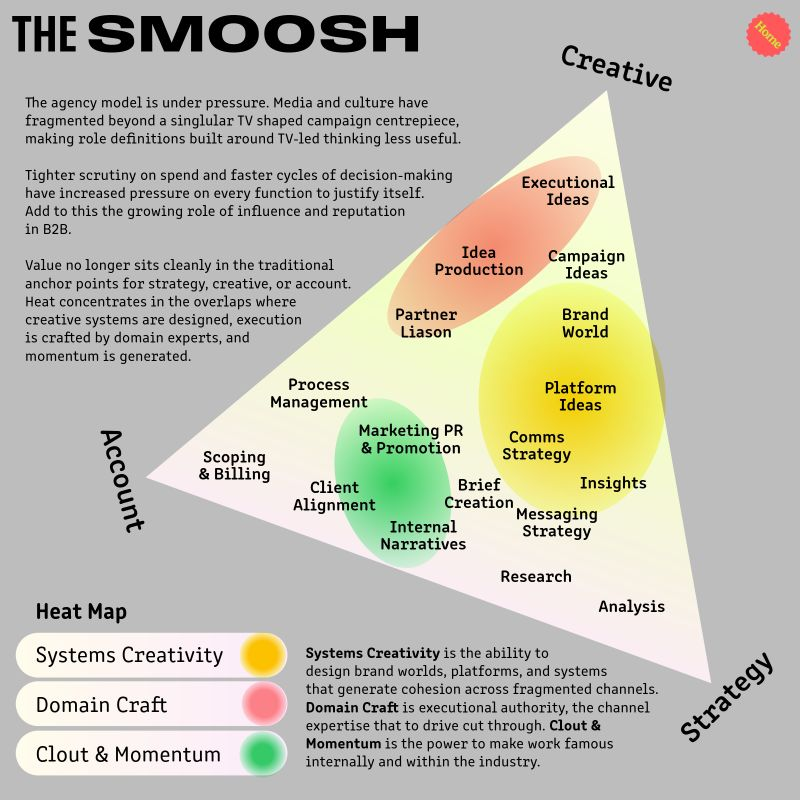
 I’ve seen
  4/5 stars
 3/5 stars
 3/5 stars
 3/5 stars