by JCM | 2 Apr, 2016 | Marginalia
 5/5 stars
A short, readable book, well worth a read for anyone interested in the media – specifically how to tackle the ongoing challenge of funding news, and the role of journalism in democracy.
The solution proposed for the ongoing challenges of monetisation and the maintenance of independence from vested interests is an interesting one. Plausible too – if governments can be persuaded that news is a public good, that is.
And even if you don’t buy in to the news as public good argument that underpins the entire thesis, along the way come a number of interesting – often surprising – nuggets about the media industry across various countries that make this worth a look by themselves. I was particularly intrigued by the finding that an increase in the number of newspapers leads to a decrease in democratic engagement – initially counterintuitive, but makes perfect sense once explained.
by JCM | 17 Jan, 2016 | Narratives & Meanings
 5/5 stars
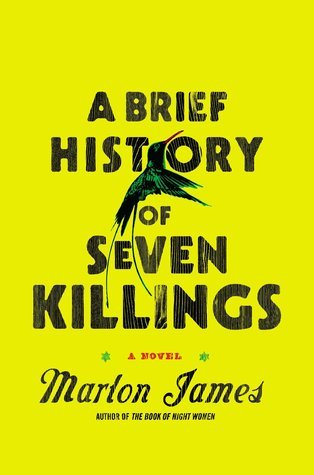
In the acknowledgements, James describes the book as “A novel that would be driven only by voice.” It’s an excellent description. Multiple characters, multiple perspectives, but each with a such a distinctive written style you can tell whose chapter it is even when they’re unnamed.
On starting, I was told it’s like James Ellroy, and it really is. Complex in places, but fairly easy to keep track, even without knowing pretty much anything about Bob Marley. But unlike Ellroy, (or, at leasy, the Ellroy I’ve read, which can get a bit monotonous after a while), the multiple voices and short chapters keep the pace fast, even when very little is happening. And the atmosphere. Excellent stuff.
Not my usual sort of thing, but may well make me look out more novels that aren’t my usual sort of thing.
by JCM | 3 Jan, 2016 | Narratives & Meanings
 4/5 stars
I’m not convinced that Mishima really works in translation, as it’s all about the beauty of the language he uses rather than the narrative. For this book in particular, with the concept of beauty at its heart, this is especially the case, and this translation was at times a little too clunky to work. In places terrible, in fact.
That said, I enjoyed it. The introduction compares it to Dostoyevsky, and that’s a fair one – strong hints of Turgenev as well.
The book sums itself up nicely, though again this would likely work better in the original Japanese (I mean, “adumbrated”? Really, translator?):
“If one examined the beauty of each individual detail… the beauty was never completed in any single detail… for each detail adumbrated the beauty of the succeeding detail. The beauty of the individual detail itself was always filled with uneasiness. It dreamed of perfection, but it knew no completion and was invariably lured on to the next beauty… Such adumbrations were signs of nothingness. Nothingness was the very structure of this beauty”
by JCM | 8 Mar, 2015 | Narratives & Meanings
 4/5 stars
Finally got through the whole thing, and am frankly not much the wiser, and still not sure how to explain what it’s about.
A plot made of innumerable MacGuffins and deliberately incoherent sidetracks, writing that is at once beautiful in its flow and incomprehensible in its meaning, packed with schoolboyishly deliberate attempts to shock through the gamut of sexual taboos (paedophilia, coprophilia, incest, bestiality) and postmodernisms piled so densely on top of postmodernisms that you can’t help feeling that Pynchon was, at least in places, taking the piss. (Hell, the plot centres on magical erections, so…)
Did I enjoy it? For the most part, and in places I loved it. Did I understand it? Well, I think I get the overarching point, which is something.
But as much as I like “difficult” books and have enjoyed every Pynchon I’ve read so far, (including the much-maligned Vineland), there’s something to be said for plots that can be followed. Mason & Dixon is similarly episodic, yet works as a narrative as well as a concept. Against the Day has significant flaws, but its multiple narratives are at least internally coherent and enjoyable to read. V becomes hard to follow in places, like reading while drunk, but always pulls you back.
Gravity’s Rainbow, meanwhile, works as a concept, but I’m not convinced that it does as a novel. It’s simply too sprawling, too vague, too unconcerned with helping the reader to keep up, or in delivering a satisfactory resolution. Which is, of course, part of the point that the book’s trying to get across about the meaning and nature of life, so I guess I shouldn’t complain.
by JCM | 31 Dec, 2014 | Narratives & Meanings
 5/5 stars
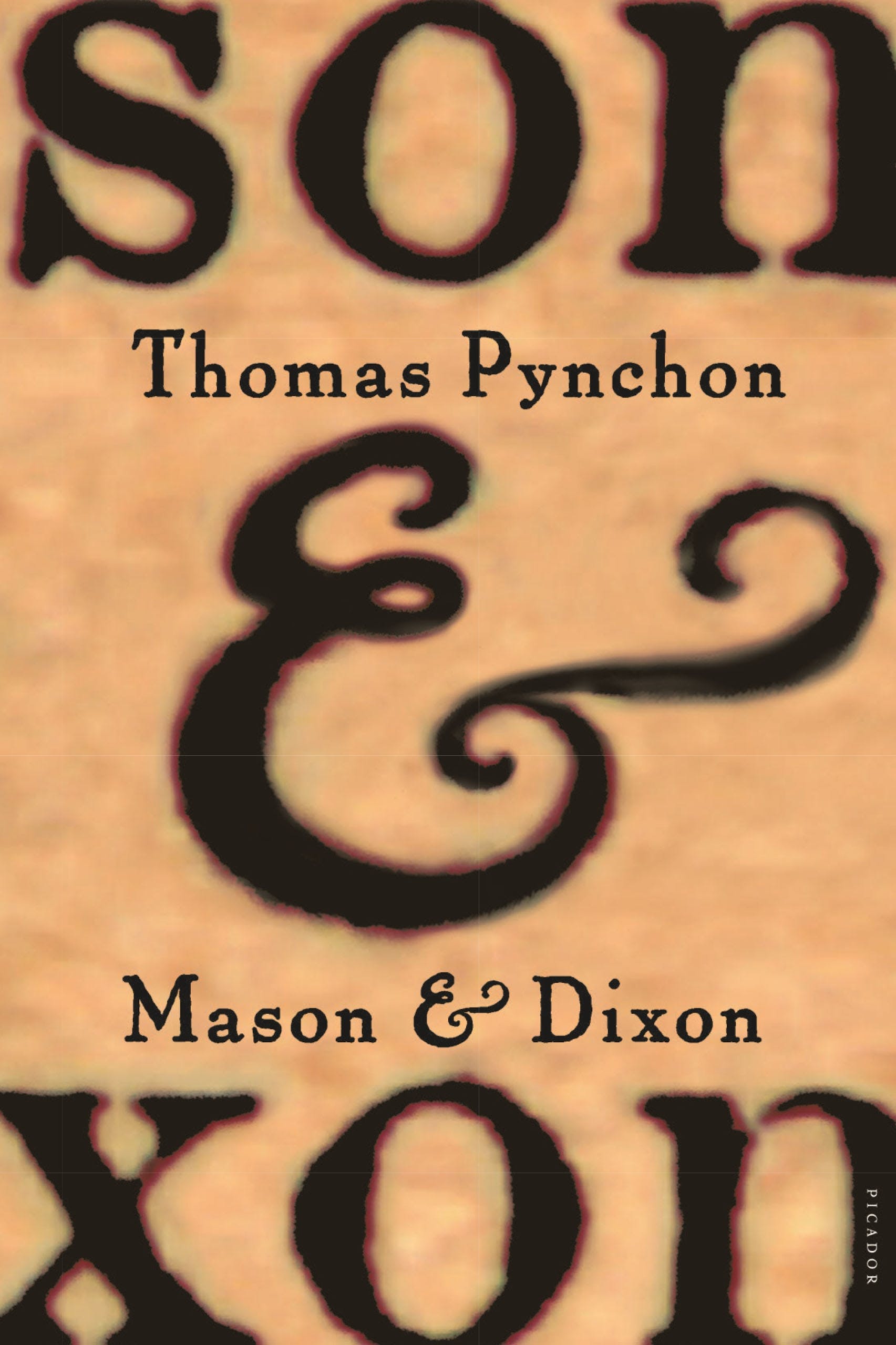
As ever with Pynchon, I loved it even while I struggled to get into it at first. Episodic, confusing, beautifully written, dreamlike, near impossible to follow, and definitely deserving to be re-read – it was only with a passage on page 610(!) that my inability to keep track of what it all meant started to make sense, as Mason speculates to his companion about the purpose and meaning of the titular duo’s lengthy mission into the American wilderness:
“None of this may be about either you or me. Our story may lie rather behind and ahead… never here in the Present, upon the Line, whose true Drama belongs to others… and when ’tis all done I shall only return to Shapperton, no wiser, and someday wake up and not know if any of this’ happen’d,’ or if I merely dream’d it, even this very moment, Dixon, which I know is real…”
Dixon’s response to this may be that of many when approaching this book: “Oh dear…?”
It certainly won’t be to everyone’s taste, but a postmodern 18th century pastiche was never going to be. Hell, if the first sentence hasn’t put you off, you’ve got no excuse not to make it to the end, I say. At which point you’ll want to return to try it again, to try and understand the bits you missed the first time around:
“Snow-Balls have flown their Arcs, starr’d the Sides of Outbuildings, as of Cousins, carried Hats away into the brisk Wind off Delaware,-the Sleds are brought in and their Runners carefully dried and greased, shoes deposited in the back Hall, a stocking’d-foot Descent made upon the great Kitchen, in a purposeful Dither since Morning, punctuated by the ringing Lids of various Boilers and Stewing-Pots, fragrant with Pie-Spices, peel’d Fruits, Suet, heated Sugar,-the Children, having all upon the Fly, among rhythmic slaps of Batter and Spoon, coax’d and stolen what they might, proceed, as upon each afternoon all this snowy Advent, to a comfortable Room at the rear of the House, years since given over to their carefree Assaults.”
Glorious stuff.
by JCM | 28 Sep, 2014 | Narratives & Meanings
 3/5 stars
Interesting, but frustratingly messy in places.
Bookended by the author’s personal experiences hunting for Genghis’ final resting place, and explaining the persecutions the Mongol people have experienced in the last century or so along the way, the majority of the book is a fairly straight narrative of the rise and fall of the Mongol Empire, constantly at pains to point out that they weren’t a bunch of bloodthirsty barbarians.
As someone new to the subject, this was all interesting enough – but a) I was reading this to understand the post-Mongol impact on the world (as promised by the title) , not how they achieved power, and b) there was consistently far more emphasis on the eastern branch of the Empire in China than on the Middle Eastern, Indian or Russian wings.
This seems especially odd considering that:
- the author emphasises how much of the Mongols’ innovations in China were deliberately suppressed after their fall,
- the Indian branch lasted the longest,
- the Middle Eastern angle could have surely been tied in to the instabilities and rivalries in that region that have lasted to the present day, and
- that he starts and ends with personal accounts of Soviet repression of Mongol memory, implying that there remains some deep Russian connection.
None of these things are elaborated on at any length, which is a real shame, as the author is mostly good on his supposedly central thesis of how important the Mongols were on the creation of the modern world (although he is decidedly shaky on specifics in some areas).
I ended up left with the distinct impression that the book the author wanted to write was about the life, culture and history of the Mongol people, but his publisher insisted on something a bit more sellable, so tacked on the modern world pitch. The two parts may well have worked better as separate books.
by JCM | 9 Sep, 2014 | Systems & Technology
Here it is. The new, multiplatform MSN.

Engadget has a solid overview piece.
The content proposition is fairly straightforward – a customisable mix of useful tools and the best content from many of the world’s biggest publishing brands across a bunch of key topic areas or verticals, curated by teams of in-market editors.
The aim on a technical level is actually the most interesting part of it – we’ve been developing a cloud-hosted CMS that enables single-publish across all devices and platforms, for both web and apps, running across 55 markets in 27 languages, with a coherent look and feel no matter your screen size or operating system. That’s properly ambitious.
Most of my input has been procedural (improving multimarket and multiplatform publishing processes) and hidden in the back end (I was part of the CMS superuser group that’s been working on back-end UX and workflow). I’ve not had as much involvement in the front-end design, architecture, or overall content strategy as I’d like, but still – a most definite improvement on one of the web’s longest-running major publishers (20 years old this year, and still doing a good 22 billion pageviews every month).
by JCM | 6 Sep, 2014 | Marginalia
This is exactly why I always try to muscle in on the design process:
“what are the ethics of platform design? …When designers create a… news app, they aren’t just designing software. They are creating a platform that participates in constructing an *idea* of news.”
by JCM | 6 Sep, 2014 | Systems & Technology
The filtered feeds of Facebook (and LinkedIn) are the things I dislike most about them, the unfiltered most recent first approach of Twitter what I love about it, so this possibility that Twitter’s going down the algorithmic-filter route worries me – and not just because of recent concerns voiced over how algorithms can affect net neutrality and news reporting.
I very much hope Twitter at least retains the option of turning on the firehose, though I fully get the need to tame the chaos with some kind of algo or filter to pull in new users. Not everyone can get to grips with lists and Tweetdeck – too confusing for the newcomer.
Now don’t get me wrong: algorithmic filtering has its place. One of my favourite apps is Zite, and I was an early adoptor of StumbleUpon (well over a decade ago) – precisely because of their ability to get to know my interests and serve me up interesting content from sources I’d usually not discover by myself. For Facebook to offer up this kind of service, with its vast databases of its users’ Likes, makes perfect sense (though I’d still prefer a raw feed, or category feeds, so I can split off news about the world from news about my actual friends – a new baby or a wedding is not the same as a terrorist attack).
This is why I love Twitter – it is raw, unfiltered. And at 140 characters a pop, it’s (more or less) manageable. Especially if these old stats are still accurate, suggesting the majority of Twitter users only follow around 50 other accounts. If you end up following a few hundred, you’re already a power user, and likely know order them via lists. If you end up following a few thousand, then frankly you no longer care if you miss a few things.
Could Twitter be improved with a bit of algo? For sure. Why am I only ever shown three related accounts when I follow a new one? Why isn’t MagicRecs built in?
But the fact is we’ve already got this option on Twitter – it’s called the Discover tab. And I never use it, because it somehow manages to feel even more random than the raw feed. The problem isn’t a lack of algorithms, it’s a lack of intelligent algorithms, intelligently integrated.
by JCM | 4 Sep, 2014 | Marginalia
I loved the concept when I first heard about it, and love that it seems to be working. Proof of concept done – now it’s time to take that concept and expand. Preferably globally.
In short, it’s a cunning system that allows you to pay for individual articles from publications, thus avoiding the constant fustration of not being able to read that great piece from the likes of the FT, Times or Economist because it’s hiding behind a paywall.
If this sort of thing takes off, it could be a whole new business-model – making paywalls more viable, while allowing monetisable ways around them.
But there’s also an interesting quote from Blendle’s founder:
“People want to read articles or want to follow specific journalists but aren’t particularly interested in the newspaper that it comes from anymore.”
This is especially true in the age of social, where URL-shorteners are so endemic that half the time you have no idea which site you’ll end up on.
I’ve got used to reading content that’s been de-branded via a hefty RSS addiction. That’s been replaced in recent years with an addiction to aggregation apps like Zite, Flipboard and Feedly, where what matters is the content itself, not the packaging, or where it’s from.
If the content is good enough, it will stand on its own – it won’t need to hide behind the brand. In fact, the brand can sometimes be a disadvantage, because it leads to preconceptions that can skew the reader’s opinion before they’ve even started to read a piece. There are some publications I avoid simply because I assume that they have nothing to offer me, for reasons of politics, prejudices, or whatever – and I know I’m far from being alone in this.
Remove the publication’s branding and present me with their content as is, would my preconceptions be different? Of course. And if I like the content, this could win them a new long-term reader.
