
3/5 stars
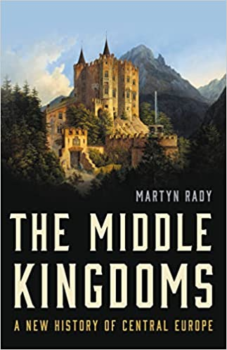
Much like the region it’s covering, this book lacks a certain coherence – and seems to be dominated by the looming presence of Germany.
This makes sense, of course – but if a region is in the middle or central, the obvious question is the middle or centre of what, and what’s surrounding it? Here, Rady seems to focus far more on contrasting central Europe to western Europe than to the east (Russia is the other obvious figure looming over the region’s history, but features far less than Germany), the north, or the south.
For me, the focus on a more or less linear, more or less political history of the region made some sense – and individual chapters were great overviews – but given the fuzziness of the definition of the region and the lack of any long political continuity for most of the countries that exist there today – this makes it even harder to keep track. When there’s no clear narrative, narrative history tends to struggle.
This is because – as Rady makes clear in the final couple of chapters – the concept of central Europe is so relatively recent.
The conclusion mentions something that shows how difficult the task the author set himself was – talking about nations without states, and states without nations, all with borders that have overlapped each other at various times. This is a perceptive and useful summary – but it makes the political history approach feel more than usually useless.
What may have been more helpful would have been a cultural history, or even a linguistic one. If this is a land of overlapping nations, how did these national identities emerge and persist given how frequently the political boundaries have shifted? That’s the book I think I was hoping for, but it’s not this one.
Still worth a read, though.