
4/5 stars
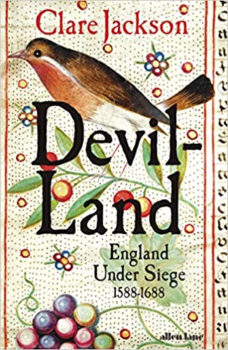
History is all about perspective, and perspectives. This history of England’s most turbulent century – a period I studied to postgrad level – is a welcome attempt to offer alternative views of events via the eyes of non-English observers. As we’re somehow still referring to the central event as the English Civil War – ignoring Scotland, Ireland and Wales – this is very much needed.
The introduction promised a lot, and got me genuinely excited to see how much this focus on foreign perspectives – and foreign policy – would shift my own understanding. But while there were some new things for me here, at its heart this was all rather familiar.
Then again, I’m not really the target audience. As well as having studied the period, I also spent some time plotting out a potential novel that hinged in part on the foreign policy of James VI/I and the (limited) British involvement in the Thirty Years War.
For anyone relatively new to the period, or looking for a refresher overview, this would be really rather good. Standard accounts do tend to focus almost exclusively on England, where here Scotland and Ireland (not so much Wales) do get their due. But more importantly, most accounts tend to obsess about the religious angle, the disputes over tax and revenue, the disputes about the limits to the power of the monarchy, the attempts by parliament to assert itself.
All those are present here too – but so too are explorations of the European horror at the execution of Mary Queen of Scots; the Spanish side of the Spanish Armada and the Spanish Match, as well as worries about the subsequent French marriage; general concern as the civil wars broke out and further horror at England’s execution of a second monarch in sixty-odd years; the Dutch rivalry and wars and invasion.
All this is necessary to a solid understanding of the era – but all too often is skipped over or sidelined. Here, while it’s still not foregrounded as much as I’d hoped – or as much as is promised in the introduction – it’s hard to avoid the fuller understand appreciation that England was not operating in isolation. That other countries existed even then, and that even the foreign relations were far more than just theoretical, largely religious concerns.
All that said, cutting this off with the Glorious Revolution (another bad name that’s stuck) makes zero sense from a non-English perspective (even if the epilogue continues the story through to George I). Logically, the cut off should be more like 1745 (that final Jacobite rising, in the midst of British involvement in the War of Austrian Succession) and the solidification of the Hanoverian dynasty, or even a century later with the death of the Young Pretender / Bonnie Prince Charlie. But I guess by that point Britain was so firmly involved in European and global affairs that the emphasis on non-English opinions about the English would hardly be surprising.
So, a good overview – even if sadly not as radical and overhaul of the period’s traditional narratives as I was hoping.