I’m not normally one for posting random aphorisms of motivational/aspirational self-improvement (far too journalistically cynical), but this – from Francis Bacon’s Essays, written a good 400 years ago – strikes me as an ideal personal manifesto for someone in my line of business:
“Read not to contradict and confute; nor to believe and take for granted; nor to find talk and discourse; but to weigh and consider… Reading maketh a full man; conference a ready man; and writing an exact man.”
Francis Bacon, Essays
At this time of deep confusion, frustration and rising anger, more reading, consideration, deliberation and self-reflection can only be a good thing.
Guess how I’ll be spending the weekend?
In fact, after an additional period of consideration since I first posted this on LinkedIn, this quote may even have inspired me to start blogging more regularly again. Because I always used to use my old blog – the once-popular, occasionally influential EUtopia – as a way to shape my ideas, and it was often therapeutic, and helpful.
By semi-regularly writing about things that caught my eye in the world of politics, I honed my thinking, identified interesting trends, and – for a period – became what would now be deemed an influencer in the relatively niche space of the Brussels Bubble.
Now, the world of politics is too depressing to tackle direct. But instead I’m increasingly interested in how ideas – and ideologies – are shaped. How different people see the world. How opinions are formed. How a sense of identity is shaped by both internal and external forces.
This is, of course, an extension of my old political blog’s founding aim – and even of its strapline (“In search of a European identity”).
But the new approach – if I stick with this – will be broader. More philosophical, sociological, anthropological, psychological, semiological, theoretical and – with luck – also practical. At least when it comes to my marketing day job.
How are opinions and ideas shaped? How are minds influenced? Why do people believe what they believe?
At this time of widespread and outright denial of seemingly undeniable evidence and facts – the politicisation of actuality, if you will – much what we have assumed about the post-Enlightenment rise of rationality and evidence-led decision-making has been shown to have been mistaken.
Postmodernist concepts of meaning and reality have become the norm – ironically adopted and most successfully pushed by the right-wingers who have long argued against most postmodern conceptions of the world. Barthes’ idea of the death of the author has spread to the point that the *intention* behind any given statement is no longer seen as quite as important as the *interpretation* of that statement by any number of diverse audiences, creating outrage and confusion across the political spectrum.
Structuralism is similarly on the rise as a way of interpreting the world around us – most notably in a growing awareness of deep structural inequalities for women and minorities – leading to a renewed surge of Deconstructionism as these systems are analysed and explained in an effort to reshape society.
All this is reshaping the norms of how we see the world. Which means a return to the old texts of my university days seems overdue – and this time with more attention than I spent in the rapid skimming for essays on Barthes, Derrida, Saussure, Lacan and more during the theory part of my MA, now half-forgotten from some 20 years ago.
These ideas are complex – to unpack them requires heavy reliance on some of the most difficult theorists of the 20th century – so require a lot of the reading, weighing and considering that Bacon advocates.
And as I know from my past forays into blogging, to shape my currently half-formed ideas will also require more writing, *for myself* than I’ve done in a decade.
This is a start.
I’ll get much wrong along the way. Some of my ideas will seem naive to those who know more, wrong to those with different opinions, and pretentious to many (inevitable as soon as you start on theory).
But, for now, I’m not entirely sure what my opinions really are – except that I believe I need to read and write more to fully form them. And as this blog section of my old dust-covered personal site still exists – a legacy of my freelancing days that desperately needs a back- and front-end refresh – I may as well use it.
Should you find these musings, you’re welcome to read and comment as you see fit, but – just like in the early days of blogging – I’ll be writing here primarily for myself.
A strange book, hinting at some of Rushdie’s later brilliance, but not anywhere near as clever or profound as it seems to think it is.
This quote, from page 141, just as you start to wonder what the point of it all is, pretty much sums up the book:
“I do not care for stories that are so, so tight. Stories should be like life, slightly frayed at the edges, full of loose ends and lives juxtaposed by accident rather than some grand design. Most of life has no meaning – so it must surely be a distortion of life to tell tales in which every single element is meaningful… How terrible to have to see a meaning or a great import in everything around one, everything one does, everything that happens to one!”
Very readably written (hence the extra star and bothering to finish it), but for a 700-page character study it’s impressive just how shallow all the characters are.
Every single one – from the principles to the supporting cast – has one defining characteristic, and one only. There’s so little complexity or depth they may as well all be described as deeply as the two characters known throughout only as “black Henry Young” and “Asian Henry Young”.
There’s Withdrawn Trauma, our hero – the life of the title – defined purely by his childhood abuse, and still acting like a child decades later. Selfish, closed-minded, suspicious. Worthy of pity, certainly – but it’s hard to see why so many other characters deem him worthy of so much loyalty for so long, in the face of so much predictable nonsense. Normally after spending 700 pages with a character you empathise with them. Not this guy, despite having winced through scene upon scene of abuse and suffering.
There’s the three friends, Compassion (who, at least, briefly shows signs of developing some complexity where Compassion briefly turns to Conflicted), Obvious Unrequited Secret Admirer, and Architect (supposedly one of the core group of four friends at the heart of the story, but with no personality beyond his career).
There’s also Ineffective Father-figure, always wanting to help but never quite knowing how. There’s Doctor, who inexplicably keeps staying on call 24/7 – unpaid too, in America! – for one of the most difficult, selfish patients anyone could ever hope not to encounter. And then there’s Violent Rapist, Manipulative Rapist, Psycho Rapist, and a succession of other anonymous rapists undeserving of description.
And it’s still astonishing, 700 pages later, that a woman was able to write such a long novel without a single substantive female character.
Plus, it’s incredibly predictable. In the final quarter I found myself actively laughing as it unfolded, because everything was so obvious. No surprises at all.
But worst of all, this is a novel that exists to smother the concept of hope for change and redemption. To confirm the worst suspicions of the traumatised and suicidal. To encourage the suicidal to go through with it. It’s repeated message is that things don’t get better – at least, not for long. It’s Keynes’ “In the long run we’re all dead” in brutal, unforgiving, waffling novel form.
It contains nothing positive, says nothing new or substantive, is packed with stereotypes, and, considering the subject matter, is deeply irresponsible.
An odd book, but very readable. Mini biographies of various leading economists of the last couple of hundred years are a mostly useful way to build the central argument: Economic ideas are a product of their time, and of their creators’ circumstances. It’s a fair argument, and one likely borne out by the fact I’m leaving this much more sympathetic to the ideas of Amartya Sen than any other person featured. He’s the only economist covered who’s still alive…
But this book is odd mostly due to its choices for who to include – and who to omit.
It starts by scene-setting with Dickens, then progresses straight to Marx and Engels, rather than going slightly further back to include Smith, Malthus, Ricardo and other earlier economists.
It’s heavily focused on British/American/Austrian thinkers to the exclusion of pretty much any others – and doesn’t include any non-Western economists other than Sen. Hell, it doesn’t even include any French economists.
The main contention other than everything progresses (it’s largely teleological in approach) is that everyone’s a Keynesian – even people you don’t think are Keynesian. Keynes hangs over the entire book, from long before he appears.
There’s a good case for this – I mean, Keynes is Keynes – but considering the general argument is that economics has been getting increasingly sophisticated, it seems odd that it largely (and rapidly) tails off in its interest in the aftermath of WWII (and, perhaps not coincidentally, Keynes’ death).
The most surprising omission, considering there’s a strong undercurrent of concern with human welfare throughout, is any reference to behavioural economics – surely one of the most fundamental shifts in approach to the discipline in the last 50-60 years.
Nor is there any coverage of the birth of game theory – arguably one of the most influential (and abused) concepts of the same period. This last is particularly surprising given the frequent use of the term “zero sum game” in latter chapters – and by the fact that the author’s previous best-known book was a biography of John Nash.
So yes, an odd book as much for its omissions as its inclusions. But engaging, readable, and (mostly) relatable. In that, it does what it set out to do – help you to understand not just *what* ideas economists had, but *why* they had them.
Parts of this were very good, and the writing mostly flows well. Parts were a bit confused – or confusing, or both.
Some characters are fully fleshed out, with clear story arcs that make sense. Most flit in and out with little clear purpose beyond serving as an excuse to explore some aspect of Zambian life.
All this is fine enough, as it goes, as the whole book is effectively a montage of snapshots of loosely intertwined lives designed to give a sense of the country’s own confused identity – but it’s a montage building to something that feels unfinished.
Unless that’s the point – which, in part, I think it is. But if so it’s a bit frustrating for the reader who’s just invested all that time reading the best part of 600 pages, even if it may well be thematically appropriate.
A postmodern, magic realist extended analogy about efforts to recover a pre-colonial sense of identity and belonging? Yes. Very much yes.
Brutal in places, though, as I suppose should be expected from a book that opens with a murder and that revolves around a curse – but that magical element is more subtle for the most part. It’s more a McGuffin than central, and the book more realist than magic realist for the most part.
The true centrality is instead Uganda itself – a country invented by outsiders who couldn’t pronounce its name, torn apart and warily trying to put itself back together while trying to avoid having to look too closely at its past.
So many very well thought-through metaphors, many of which I’m sure I’ve missed in my ignorance – but a superbly constructed and considered book.
One of the better books in the series, and certainly the most adult in terms of content. Contains a number of pretty clear parallels with the real-world events of the last few years, from the refugee crisis to dodgy, divisive politics – as well as almost certainly not child-friendly descriptions of how men leer at young women, and even a brutal attempted rape.
There are some more suspect elements too, from stereotypical portrayals of non-English people and cultures (even the Welsh are all miners, and people from the Middle East all seem to be either downtrodden victims of oppression or oppressors, with little in between) to some familiar characters behaving in ways that seem unlikely based on past behaviour in previous books.
There’s a fair bit of quite simplistic philosophising as well, but of a rather more pretentious kind than the straight-up Atheism 101 of The Amber Spyglass, which again suddenly pulls you back into realising this is still a book for kids / teens.
This shouldn’t be a surprise – of *course* it’s a kids book – but tonally it makes the whole feel inconsistent, as Pullman evidently has aspirations for this to appeal to an older audience – and to really *say* something, especially in the latter parts – but can’t quite break out if the writing for kids style that nudges him into a less complex view of the world.
Still a solid four stars on a re-read, despite getting a bit unsubtle and preachy in places. Still kinda impressed that this got published as a book for kids 20 years ago, considering how soon after the pissy responses to things like The Life of Brian and The Last Temptation of Christ that was.
The strange thing is the logical inconsistency in the anti-religion message.
This is a book that basically says religion is actively bad – but:
1) The final message is that something went wrong when science arrived. It’s science that is the cause of Dust leaving the universe – in the age of religious credulity, which Pullman dislikes so much, Dust was stable and even growing. The only way to reverse the damage caused by the Subtle Knife (a product of the new science in the same way Newton was) is to meticulously fix the damage it’s caused and destroy the knife. The message there? Science is bad, and the universe was healthier in the age of religion.
2) At the same time, “The Authority” (aka God) turns out to be a delicate, senile, but seemingly benevolent being who – despite having been set up as something evil and a usurper – has himself been usurped by a much more malevolent, lust-filled angel (who used to be a man). Every other angel we meet is also benevolent. The implication? Not aspects of religion are literally true (god and angels both really exist, and are “good” despite the protestations that there’s no such thing as good and evil), and it’s only humans who have perverted it – be it ex-human angel usurpers or the fanatics of the Church.
3) The world of the mulefa – with its natural roads, seed pod wheels, and creatures perfectly evolved to use those wheels – is repeatedly hinted at being evidence of something closer to intelligent design than evolution. And “the Creator” is mentioned on a few occasions throughout the seriea in a way that heavily implies this was a literally true being, again supporting the core idea if (Christian) religion of a created universe.
4) The alethiometer allows Lyra to communicate with some kind of (never fully explained) higher power that reveals “truth” and appears to be omniscient, aware of the future as well as the present. This same force – and the witches’ prophecy – firmly underscore the idea that there is such a thing as fate / predestination. Despite suggestions that Lyra may not follow her fate, or that her destiny could be shifted by others, follow it she does. Is there actually free will in Pullman’s universe? It seems unlikely. Everything happens for a reason. The higher power, whatever it is, knows best.
The implication is, therefore, not that atheism is the way forward, as I remembered it, but only that organised religion has perverted the deeper literal truths underlying Christianity. Which makes this a much more conservative trilogy than I remembered it – effectively a fantasy version of Martin Luther.
Impressive in ambition, wildly erratic in execution.
Parts of this overview of Western philosophy and thinking (including psychology, science, and humanity’s understanding of the world in the broadest sense) are excellent – enlightening, clear, engagingly-written.
Others are waffly, repetitive, and lack sufficient context of explanation for newcomers to the ideas being discussed.
Yet others are actively confusing – not because they don’t make sense, but because it’s unclear how they could have been written by the same author.
The Epilogue is a prime case in point. This follows a strong chapter on postmodern thinking – one of the best in the book – that has emphasised the flaws in teleological / progress-driven / narrative interpretations of history and the universe. But the conclusion is explicitly, unashamedly teleological, expounding some grand theory of destined progression of thinking to wind up with a frankly rather patronising, paternalistic suggestion of what’s next.
Apparently the same author has also done a book on how astrology can explain key moments in history. Had I known that when I picked this up, I may not have bothered – and it does explain a lot about that conclusion.
But still, some strong chapters mean I don’t utterly begrudge the time spent with this one. A kinda useful companion to other histories of philosophy – albeit one with some very odd quirks.
The New Statesman has a long piece on the ongoing slow death of the advertising industry, with some fun distinctions between the ad industry (creative, visionary) and the ad business (dull, obsessed with data).
Can you guess which part the person who wrote it comes from?
Of course, the simple response to the majority of the article’s debate about whether high-impact artistic visions or hyper-efficient attempts to ensure relevancy are the best way forwards is:
But while there’s much to disagree (and agree) with throughout, it was this particular passage that sparked a realisation about the real challenge for the marketing industry:
“Now that people carry media around with them everywhere, advertisers have less incentive to create memorable brands. Instead, they concentrate on forcing our attention towards the message or offer of the moment. The ad business doesn’t care about the future of its audience, only its present.”
This, within the context of modern ad microtargeting and algorithms (as well as the general proliferation of TV channels, streaming video, and the decline in newspaper readership), is kinda true – with no clear way to ensure a follow-up interaction, the classic old ad model of trying to get a message in front of someone eight times (or whatever) and it’ll stick is no longer as straightforward as it once was. Even if you succeed, it’ll be by using cookies to track someone across multiple sites, firing the same advert at them so relentlessly that it seems desperate – and obvious.
But the obsession with the fast-paced present also shows how many marketing campaigns continue to utterly miss the point of social media.
The clue’s in the name
Social – done properly – *isn’t* simply of the moment, as much as it’s often dismissed as ephemeral.
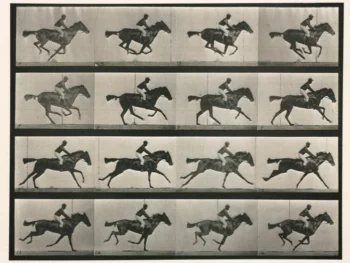
To think of social posts as throw-away one-offs, as much marketing does, is like viewing a single frame of a film that’s designed to be watched at 24 frames per second. It’s like the blind men and the elephant – you may *think* you know what’s going on, and how your audience is responding, but you’re not seeing the whole (motion) picture.
Yes, a single tweet or Facebook post *can* work in isolation. It can have impact. A person with a couple of hundred followers can see something they post go viral and reach hundreds of thousands of likes. An influencer can amplify it to the point the original poster can monetise that single moment, or use it as the starting point to become an influencer in their own right.
But the clue’s in the name – social is *social*. It’s about relationships, not one-off interactions. And the internet is the same – again, the clue’s in the name. It’s a network. It’s interconnected. Nothing online operates in isolation.
This is why an approach to online advertising that thinks only about the advert – in isolation – is always going to be doomed to fail. (And yes, if your social media post or article or video or whatever is put out on a schedule to broadcast to your followers – whether you put paid behind it or not – if you have no plan or resources to follow up and respond to the replies, then all it is is an advert.)
Even if you aggregate all your social data to see trends over time, you may *think* you’re seeing the big picture – but you’re not seeing it from the perspective of your audience. You’re lumping them together as stats, when in reality they’re all individuals – each having a distinct interaction with your brand. The long-term trends hide the fact that your audience is not always the same audience – different people will see different posts at different times, and many won’t see some of what you’re putting out at all. This means they’ll all be getting different impressions of what it is you’re about.
I remember when all this were fields…
When I started playing about in IRC and messageboards in the 90s, it took months to be recognised as a regular. When I started blogging in the early 2000s, it again took months to build a following and reputation.
And that’s months of multiple posts a day. Multiple replies to comments. Discussions. Following commenters back to their own blogs and reading *their* stuff. Getting a sense of how they thought.
This was all pre-Twitter, pre-Facebook – but post-IRC, and after messageboards, MSN Messenger and the like had become passé. We’d encounter each other on other people’s blogs, in their comment sections, and notice we were talking about the same things through trackbacks, RSS aggregators (after 2004 or so), checking now-defunct sites like Technorati, IceRocket and the like to find other people talking about the same thing (because Google was still rubbish for realtime search back then), and occasionally directly emailing.
Looking beneath the surface
The public face of blogging was our individual blogs. The individual posts. But those were just the tip of the proverbial iceberg – the starting points for interactions between blogger and reader that in some cases have lasted years. Some of the people I met virtually through my various blogs have become real-life friends. Some discussions inspired people to take up blogging for themselves, or to pursue different careers. Some of those interactions even led to real-world, paid work (as they did for me – which, in turn, led to my transition from print journalism to digital, and from there to my current role developing multiplatform, multimedia digital marketing strategies).
All these deep, lasting, sometimes life-changing relationships started with a connection around shared interests – just as, today, algorithms try to match adverts to people who may be interested in them. Superficially, to anyone looking from outside, those initial interactions in the comment sections under individual posts would have looked like that was all there was. If you’d looked at the stats on our blogs, the numbers would have looked *tiny*.
But the *real* story was the ongoing conversations and subconscious assimilation of each others’ ideas. The discussions and collaborations that stretched over months, and led to the short-lived rise of group-blogs, real-world meet-ups, grand plans that (in my case at least) never quite came to fruition. It was about the relationships and trust we built up over time.
The *real* impact took *years*, and in some cases was more significant than any of us ever imagined when we first put finger to keyboard.
How humans work
We’re all humans. We latch onto stories. We need big ideas. Emotional connections. Things to inspire and entertain. Things that speak to our gut instincts as well as to our heads. We’ve all read Daniel Kahneman, and know these heuristics are classic marketing creative territory.
And yes – as we’re humans we can also be manipulated if we’re targeted with the right message at the right time. Some of us will be more susceptible to some messaging than others. We will all have slightly different interests, meaning you can’t speak to us all in the same way. So a data-driven approach makes sense to try and finally give some clarity to John Wanamaker’s classic “Half the money I spend on advertising is wasted” conundrum.
But where big idea creative can attract attention, and data-driven targeting can increase relevance, what’s still missing for many brands is the follow-up. The vital thing that comes next.
In some cases this is where CRM comes in – but I can tell you from my blogging and chatroom days, in most cases being overly keen to initiate a conversation is going to have precisely the opposite response from the one you want. No one wants a pop-up window asking if they want help the second they land on a site any more than they want cookie notifications or requests to turn off their adblocker. Overly keen CRM = instant bounce, often with feelings of mild violation and anger. Not great for the start of a relationship. There’s a reason Microsoft killed Clippy…
My point? Let your audience go at their own pace
The reason the brief Golden Age of blogging (from around 2003-2006, by my reckoning) led to so many strong, lasting relationships is that those relationships were able to be built at our own pace.
There was no realtime chat. There was no “unread” notification to put pressure on us to respond unless and until we were ready. We all gradually built up archives of work that our readers and fellow bloggers could all check out at their leisure to get a sense of who we were and what we stood for. We linked to our past work – and each other – where relevant, showing how our thinking was developing over time, and allowing others to follow our trains of thought at their own pace to catch up and join in the conversation.
So when you encountered an unfamiliar blog or blogger – which was frequently – you could dip your toe in, test the water, and go back and check the context before engaging only when you had an idea what you were going to get involved in.
It was a slower-paced, more civilised way of communicating online that the likes of Twitter seem to have permanently destroyed with the constant need for instantaneous responses to everything.
But today’s pressure to living in the moment and make instant decisions is deeply offputting. It’s not how people like to work. It’s not how any successful relationship has ever been built. It goes against all the instincts of the high-pressured world we’re now in, but today’s emphasis on the hard sell and call to action – not just the obvious “BUY NOW!” but also the more subtle “CLICK HERE TO…” and “FIND OUT HOW…” – may give a short-term nudge but not a long-term engagement.
Engagement – true, lasting engagement – comes through recognition, familiarity, and trust. This can only ever be built over time – often a long time. It will never come through a hard sell, and rarely through a single call to action.
In short:
Rather than worry about big ideas vs targeting, what the marketing industry really needs to learn how to do is revive the art of the soft sell and the long tail. That’s the more human way of building relationships that last – but to work it needs a significantly more nuanced understanding of how people will be interacting with you than I’ve seen from pretty much any modern brand marketing campaign.
So remember:
Every interaction with every part of your brand’s marketing campaign may seem like a one-off to you, but it’s part of a series to your audience. It’s all connected – but one bad experience could break the chain.
This means you need a truly integrated combination of high-impact big ideas and detailed data and longer-term storytelling and archives of the earlier bits of the story so people can catch up and targeting to the people who’ll be most interested and a true understanding of how people – and the internet – actually work.
No one said it was easy. But some things take time.
To help shape my thinking, I write essays and shorter notes examining the ideas and narratives that shape media, marketing, technology and culture.
A core focus: The way context and assumptions can radically change how ideas are interpreted. Much of modern business, marketing, and media thinking is built on other people's frameworks, models, theories, and received wisdom. This can help clarify complex problems – but as ideas travel between disciplines and organisations they are often simplified, misapplied or treated as universal truths. I'm digging into these, across the following categories - the first being a catch-all for shorter thoughts:


 2/5 stars
 2/5 stars
 4/5 stars
 3/5 stars
 5/5 stars
 4/5 stars
 4/5 stars
 3/5 stars