“These are nondeterministic, unpredictable systems that are now receiving inputs and context from other such systems… From a security perspective, it’s an absolute nightmare.”
The whole exercise initially struck me as a fun enough probabilistic parlour trick – similar to the entertaining “Infinite conversation” site with bots based on Werner Herzog and Slavoj Žižek from a couple of years back. There’s no true *intelligence* here, just chatbots slotting into established tropes for online forums, including creating their own memes and complaining about privacy and the mods (here, “the humans”).
So far so unsurprising – just as it’s unsurprising that some people who should know better have decided to read meaning and understanding into these interactions. (Hell, some of the stuff robot Werner Herzog came up with could also sound profound – it’s all in the voice…)
But what *is* new is the naiveté of some early adopters who’ve entrusted incredibly sensitive personal information and provided ridiculous amounts of access to AI agents whose programming is not deterministic and which are now able to interact with other agents.
The tech may be impressive – these agents are able to *do* more than I was expecting by this stage – but the potential for compound risk is insane. No sensible organisation would let a system like this anywhere near its operations until it’s possible to put far more robust constraints in place.
And so, just as with gambling, the question with GenAI systems seems increasingly to be all about personal and organisational risk tolerance.
My risk tolerance for this kind of thing is low, because the potential payoff – a bit of enhanced productivity? – is similarly low. If you’re really so time poor that you’re willing to take this gamble, then you need to rethink your priorities.
Much like the region it’s covering, this book lacks a certain coherence – and seems to be dominated by the looming presence of Germany.
This makes sense, of course – but if a region is in the middle or central, the obvious question is the middle or centre of what, and what’s surrounding it? Here, Rady seems to focus far more on contrasting central Europe to western Europe than to the east (Russia is the other obvious figure looming over the region’s history, but features far less than Germany), the north, or the south.
For me, the focus on a more or less linear, more or less political history of the region made some sense – and individual chapters were great overviews – but given the fuzziness of the definition of the region and the lack of any long political continuity for most of the countries that exist there today – this makes it even harder to keep track. When there’s no clear narrative, narrative history tends to struggle.
This is because – as Rady makes clear in the final couple of chapters – the concept of central Europe is so relatively recent.
The conclusion mentions something that shows how difficult the task the author set himself was – talking about nations without states, and states without nations, all with borders that have overlapped each other at various times. This is a perceptive and useful summary – but it makes the political history approach feel more than usually useless.
What may have been more helpful would have been a cultural history, or even a linguistic one. If this is a land of overlapping nations, how did these national identities emerge and persist given how frequently the political boundaries have shifted? That’s the book I think I was hoping for, but it’s not this one.
“While 82% of advertising executives believe Gen Z and millennial consumers feel positively about AI-generated ads, only 45% of these consumers actually feel that way”
But this is hardly a surprise. A couple of years back I referred to GenAI being at every stage of the Gartner hype cycle simultaneously, and that remains true today – it’s just that more people have passed over the peak of inflated expectations.
Meanwhile, the AI companies need to keep on trying to inflate those expectations further to keep the investment money coming in to allow them to build the infrastructure they need to keep delivering.
But we’re at a stage now where high level promises like those you get in an advert or keynote are hitting the law of diminishing returns. These companies are selling to an increasingly sceptical crowd – as a global society, we’re further down the funnel and are looking for more proof points before we buy in.
(This is part of why I’m convinced Elon Musk knew exactly what he was doing with his Grok porn bot – the uproar was great free publicity for Grok’s ability to create photorealistic images and video… PR can be cynical…)
Given this, is an old school Super bowl campaign really going to make any difference? or is this now just another old school brand awareness play, given Google seems to be on the verge of demolishing OpenAI’s previous lead?
Either way, we’re definitely entering a new phase in the AI play – and the emphasis is increasingly going to need to be on proof of impact, not just proof of concept. The narrative needs to shift.
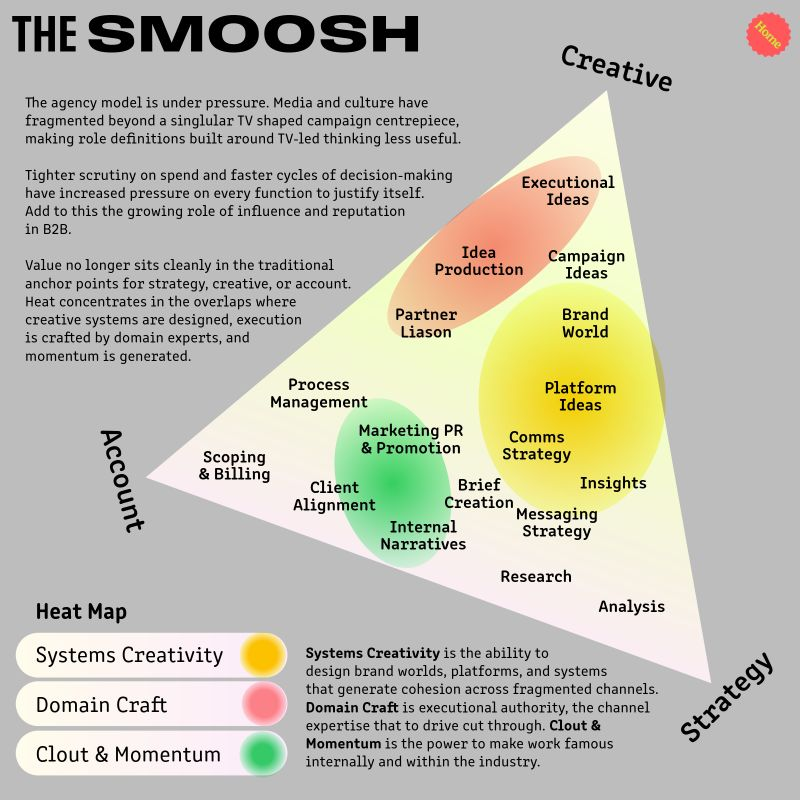
This is pretty much what I’ve been talking about for the last few years, via Joe Burns.
The problem isn’t just that the old model doesn’t work in a more complex environment – it’s that the very terminology precludes understanding and alignment, as everyone has a different idea of what the labels mean.
The key to success has always been systems thinking – but many agencies (and even more so in-house marketing teams) continue work in siloes, with nowhere near as much discussion and collaboration as is needed to come up with truly effective approaches.
As Joe Burns put it in his post on this:
“Coherence has to come from the system, not just one execution. The idea of a ‘Campaign’ only works if you can muster a critical mass of attention to carry people through it.”
Maybe it’s my “content” background speaking – because really strong content strategies need to work at multiple levels, across multiple channels and formats, and for multiple audiences with multiple needs. Without understanding the big picture *and* the details, it’s impossible to deliver effectively content across a campaign – individual assets may be solid, but the whole ends up less than the sum of its parts.
This is why I’ll continue trying to play in those overlap areas – not only do I find the diversity and clash of approaches and ideas stimulating, but I see it as the only way to work out the best way to succeed. You have to try to see the big picture to work out the best individual brush strokes.
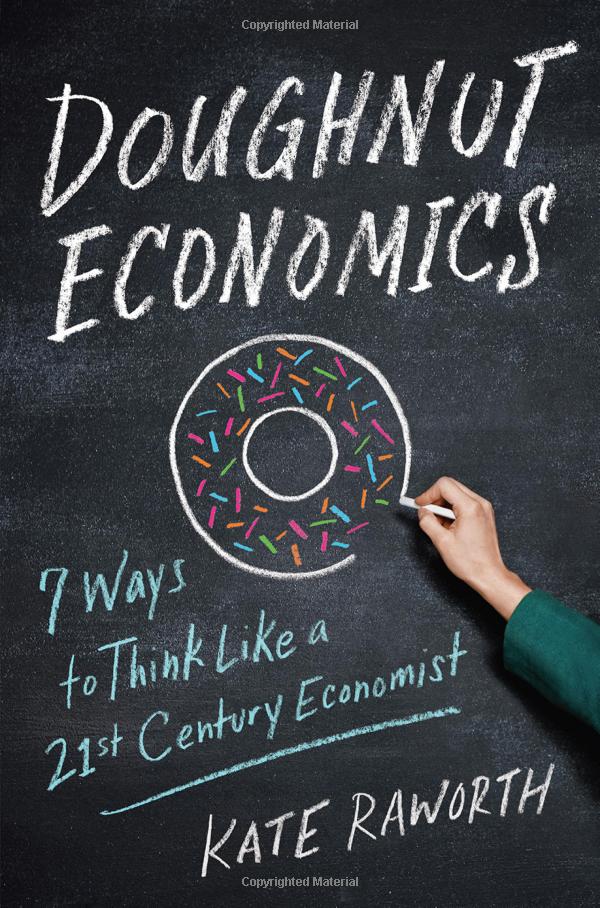
Interesting, thought-provoking and convincing about what needs to be done, while being realistic about how likely it is such vast changes to how the world works will come about. Yet also packed with examples of ways in which such changes are already taking place, giving some room for optimism.
A good polemic, in other words – and made even better by continually citing sources and experts from non-traditional backgrounds – neither ostentatiously nor explicitly, it made me realise how few economics and politics books regularly cite women or people from non-Western countries. Which may well be part of the reason why our economics and politics are so broken.
The only real criticism: The book itself is well enough written in terms of individual sentences and paragraphs, but lacks enough variety of tone and pacing to really keep the attention, and the author has a tendency to both repeat herself and extend metaphors well beyond the point where they have impact.
I’m vaguely pondering starting up a newsletter/podcast/etc exploring media/marketing received wisdom and groupthink…
The Superbowl, Davos, and ChatGPT’s announcement it’s running ads means media/marketing LinkedIn will be swamped with lukewarm hot takes this week.
This industry herd mentality is increasingly fascinating to me – the need to comment on the same things everyone else is talking about is rarely “thought leadership”, and is very far from the old advertising mantra “When the world zigs, zag”.
I’ve spent a decade in marketing, more than double that in publishing. In all that time I’ve rarely encountered many convincing new ideas – even during major platform shifts. And usually when I have, the evidence for “best practice” has lacked much substance – or blatantly originated in some tech company’s hype (as with the first, second, and third pivots to video, and certainly with the “everything needs to be optimised for Alexa now” fad).
It feels like we’ve now all got so used to running with the latest fad for fear of missing out or – worse! – looking out of touch, we’ve lost all sense of critical thinking, or desire to question industry norms.
But is this something in which enough people would be sufficiently interested to make it worthwhile? And will it cut through the algorithm – another idea we’ve all unthinkingly adopted?
This is a strange book. Originally written to accompany a BBC TV series back in 1981, it has since been extensively revised to reflect the (substantial) changes in understanding of this long period – covering over a thousand years, from Boudicca to the Norman Conquest.
That period alone is enough to raise an eyebrow. What the hell does Wood mean by “the Dark Ages”? And why, if he’s in search of them, does he focus purely on England? Equally, why does he choose to explore them by focusing on a series of individuals?
In part, the thinking seems to be that by centering each chapter on a named individual, you can explore the sources to understand how much we can really know in an era of fragmentary record keeping and near constant conflict. This is a nice enough idea – but it’s been done better elsewhere, especially in the last decade or so, as archaeology and history have merged and a glut of good books have come out on the Vikings and Anglo-Saxons in particular.
Equally, given the use of the term “Dark Ages” – usually contrasted to the Greek/Roman Golden Age and the Renaissance – it’s strange the focus here is largely on politics and power rather than culture and learning and civilisation and society.
Not a bad book, certainly, but its episodic nature betrays its roots in television. It’s let down by the fact that there’s really no clear connecting thread, and nor is there a flowing narrative – something seemingly made worse by Woods’ laudable decision to add some new chapters about prominent women in this revised edition, to counter his early 80s patriarchal mindset and work in some more recent scholarship.
Nonetheless, Woods is a good writer, and this is engaging enough – it just feels a bit confused and incomplete.
This. My biggest data lessons from 25 years in digital publishing / marketing to add to the efficiency/effectiveness debate:
1) There’s an important distinction between being data-driven and data-informed; more organisations need to lean towards the latter, because…
2) No numbers mean anything without context – almost everything measurable needs multiple other datapoints, timescales, and points of comparison to have any meaning
3) Most data tracked by marketing departments are vanity metrics with almost zero long-term value for the business as a whole
4) Pick the wrong KPIs (pageviews being the most obvious, revenue growth perhaps the least) you’re more likely to harm the business than help it by focusing on improving the *indicator* rather than the business-wide performance, because…
5) Almost every metric can be gamed or significantly impacted by outliers or picking the wrong points of comparison, but…
6) Not enough people check to see if this is what’s happening, especially if the results are looking good
7) Equally, just because you *think* you can measure something doesn’t mean this is what you’re actually measuring, or that it’s helpful to do so, but…
8) Tables of numbers and nice pretty charts (especially with trend lines) are addictive, while cross-referencing multiple metrics and trying to make sense of it all is difficult – not helped by most of the tools available being deeply unintuitive, so…
9) Most laypeople don’t bother asking about the methodology for fear of looking stupid, and just nod along, so…
10) Keep on questioning the data – who compiled it, how, when, where, why, and what could we be missing? Data interpretation is as much art as science – the more we question what we’re seeing, the more likely it is someone will have one of those sparks of inspiration that help you find something genuinely meaningful
At times I liked this a lot – a neat companion to Neal Stephenson’s Cryptonomicon as a novel about the birth of the computer age. It could equally work as a companion to Sebastian Mallaby’s non-fiction The Power Law, focused on the venture capitalists and somewhat unstable, potentially sociopathic tech bros who have built the modern tech industry into the morally suspect force that it is.
Effectively a montage rather than a narrative, with surprisingly little-known polymath genius John von Neumann and the various hugely influential ideas he had as its centre of gravity, it’s as wide-ranging as he was. This is the guy who co-created Game Theory (an approach many tech types seem to consciously adopt), helped develop not just the atomic bomb, but also the hydrogen bomb and concept of Mutually Assured Destruction – with its wonderfully appropriate acronym.
But he also came up with some initial concepts for artificial intelligence, notably the self-teaching, self-reproducing, self-improving Von Neumann machines that he envisioned spreading through the universe long after his (and humankind’s) death.
It’s this that the book is really building to throughout: Pretty much all modern AI systems are Von Neumann machines – at least, to an extent.
This makes this extremely timely and thought-provoking, despite being about someone who died 70 years ago.
How will these systems continue to evolve? Given von Neumann himself is, throughout, compared to the machines and systems he developed – his utterly alien way of thinking, his apparent disregard for his fellow humans, his neglect of his family, his apparent patronising contempt for people not as smart as he was – the suggestion that these alien intelligences are something to be wary and probably scared of starts coming through stronger and stronger.
This culminates in the final section, a detailed narrative of the significance and a blow by blow account of DeepMind’s 2016 victory over the world’s leading human Go player with their AlphaGo system.
Yet while an impressive achievement, as a whole the book didn’t quite work for me. The different voices talking about their relationships and experiences with von Neumann, done as if being interviewed, eventually all started to sound too similar. The opening and closing sections were thematically clearly linked, but the structure as a whole leaves the reader doing much of the work to connect the dots and get to the point the author’s making. A final coda to wrap it all up would, for me at least, have been appreciated.
Goodreads tells me I finished 74 books in 2025, some 35,000 pages. I almost made it to 75, but just ran out of time… Most were nonfiction, but mostly history, philosophy and science, so not exactly classic LinkedIn fodder.
Here’s a few I’d definitely recommend to better navigate the world of business / work (in no particular order):
1) Alchemy, by Rory Sutherland – a useful corrective to the idea that logic and reason should drive strategy, and a timely reminder (in this age of GenAI probability-driven “thinking”) that it’s often necessary to go lateral to succeed. But Sutherland’s a marketer at heart – of *course* he’d say that…
2) The Art of Explanation, by Ros Atkins – a guide to more effective communication, borrowing from a couple of decades’ experience in journalism; a book many non-journalists could do with reading, and almost the opposite of Sutherland’s approach.
3) Economics, The User’s Guide, by Ha-Joon Chang – as the debate about AI bubbles and the future of the job market drags on, this is one of the very best overviews of the history and post-financial crisis state of economic thinking I’ve come across; thought-provoking and accessible via short, clear chapters. An excellent read.
4) The Corporation in the 21st Century, by John Kay – a slight cheat as I’ve got a couple of dozen pages to go, but this is an excellent companion to the previous one, providing a potted history of how we’ve got to where we are in the world of business organisations and ecosystems, and how it all seems to be changing. Again.
5) The Power Law, by Sebastian Mallaby – a deep dive into the history, mentality and working methods of the venture capitalists that have done so much to influence the tech industry and global economy over the last few decades. It helpfully shows that Elon Musk (among others) has been problematic for years…
—
Of course, all of these were written before the rise of GenAI and the advent of Trump 2, so.who knows how helpful they’ll be in navigating 2026?
Notes and Essays
To help shape my thinking, I write essays and shorter notes examining the ideas and narratives that shape media, marketing, technology and culture.
A core focus: The way context and assumptions can radically change how ideas are interpreted. Much of modern business, marketing, and media thinking is built on other people's frameworks, models, theories, and received wisdom. This can help clarify complex problems – but as ideas travel between disciplines and organisations they are often simplified, misapplied or treated as universal truths. I'm digging into these, across the following categories - the first being a catch-all for shorter thoughts:


 4/5 stars