
Thinking of media channels as cognitive environments – shaped by context, attention and mode of consumption – is a useful perspective shift, from this piece by Faris Yakob, via WARC.
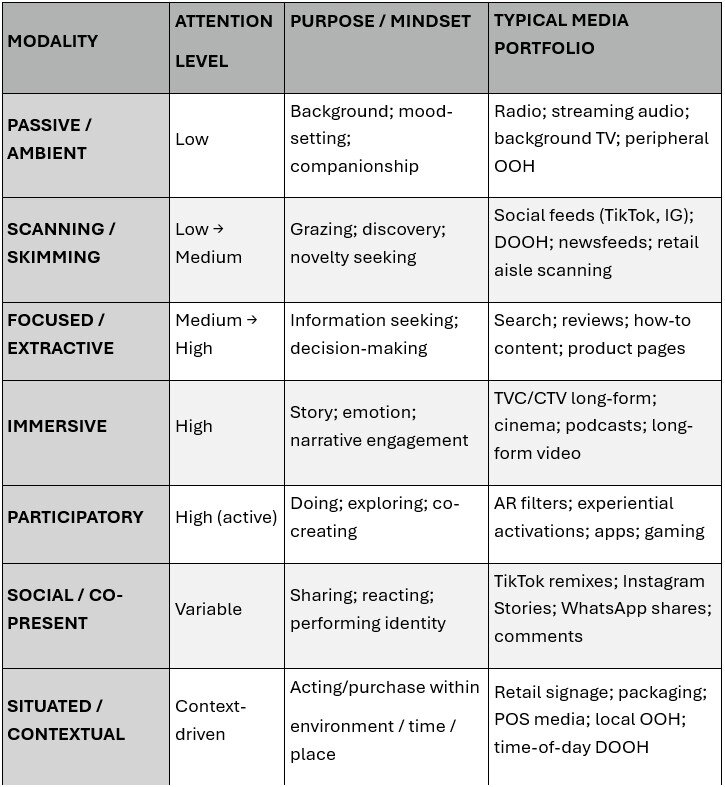
The part that matters most for brand-building is momentum, and that’s the least clearly explained. How do ideas actually build over time across different environments, teams, markets and formats? What creates momentum deliberately and consistently – the long as well as the short of it – connecting one “moment” to the next, beyond loose consistency or a set of distinctive assets?
This need for sustained momentum becomes more obvious in B2B contexts, where “moments” are harder to engineer, cycles are longer, and distinctiveness can be difficult – even risky – to pursue.
In those environments, the question is whether the organisation can produce and sustain a coherent narrative across everything it does, over time.
That isn’t really a media or creative (or modality or moment) problem – it’s structural.
It comes down to how narratives are defined, how topics are prioritised, how content is developed and reused, and how different teams interpret and apply the same underlying ideas over time, not just over campaigns or activations.
In other words, it’s about the architecture of the system that generates the communication, not just the optimisation of what gets put into it.
Without that, modality and moments are useful lenses, but they don’t explain why some brands build momentum while others just generate activity.