by JCM | 27 Nov, 2025 | Narratives & Meanings
If you’re happy with platitudinous banality for your “thought leadership”, GenAI is great!
The trouble is, this isn’t just a GenAI issue.
Many (most?) brands have been spewing out generic nonsense with their content marketing for as long as content marketing has been a thing.
Because what GenAI content is very good at exposing is something that those of us who’ve been working in content marketing for a long time have known since forever: Coming up with genuinely original, compelling insights is *incredibly* hard.
Especially when the raw material most B2B marketers have to work with is the half-remembered received wisdom a distracted senior stakeholder has just tried to recall from their MBA days in response to a question about their business strategy that they’ve probably never even considered before.
And even more especially when these days many of those senior stakeholders are asking their PA to ask ChatGPT to come up with an answer for the question via email rather than speak with anyone.
If you want real insight that’s going to impress real experts, you need to put the work in, and give it some real thought. GenAI can help with this – I have endless conversations with various bots to refine my thinking across dozens of projects. But even that takes time. Often a hell of a lot of time.
Because even in the age of GenAI, it turns out the project management Time / Cost / Quality triangle still applies.
And you still only get to pick two.
{Post sparked by a post about how NotebookLM can now produce entire, quite decent-seeming slide decks, based on a few prompts)
by JCM | 12 Nov, 2025 | Marginalia
 GenAI content is neither good nor bad:
– Bad AI content is bad.
– Good AI content is good.
We were having the same arguments 20 years ago about blog content from actual humans.
The problem is not with how the sausage is made but, as Sturgeon’s Law states, that “Ninety percent of everything is crap”.
(Of course, on Linkedin this quite simple – and surely obvious – statement led to lots of debate about the *ethics* of AI content rather than the quality. That’s a different matter altogether…)
by JCM | 28 Oct, 2025 | Systems & Technology
“45% of the AI responses studied contained at least one significant issue, with 81% having some form of problem”
I’m a big fan of using GenAI to assist in research, ideation, and even sense-checking – asking it to help me with my own critical and lateral thinking. I use these tools multiple times a day, and am constantly encouraging the journalists I work with at Today Digital o use GenAI more to help them boost both their productivity and the impact of their work.
But it’s *vital* to keep fully aware of GenAI’s limitations when using it for anything where facts are important.
No matter how often we remind ourselves that LLMs have no true understanding, no real intelligence, no concept of what a “fact” actually is, the more you use them the easier it is to be taken in by their very, very convincing pastiche of true intelligence.
As this Reuters study shows, despite the apparent progress of the last couple of years, there are still fundamental challenges – which are unlikely to ever be fully overcome using this form of AI. (And which is why LLMs weren’t even classified as AI until very recently…)
The good news? With GenAI’s limitations increasingly becoming more widely appreciated, this could ultimately be a good thing for news orgs – because why go to an unreliable intermediary when you can go direct to the journalistic source?
Journalistic scepticism and fundamental critical thinking skills are becoming more important than ever.
by JCM | 10 Oct, 2025 | Systems & Technology
The rhythms and tone of AI-assisted writing are now pretty much endemic on LinkedIn
And I get why: GenAI copy is generally pretty tight, pretty focused, and flows pretty well. Certainly better than most non-professional writers can manage on their own.
Hell, it sounds annoyingly like my own natural writing style, honed over years of practice…
But people I’ve known for years are starting to no longer sound like themselves.
Their words are too polished, too slick, too much like those an American social media copywriter would use, no matter where they’re from.
None of this post was written with AI.
And despite (because of?) being a professional writer/editor, It took me over half an hour of questioning myself, rewriting, starting again, looking for the right phrase. Doing this on my phone, my thumbs now ache and the little finger on my right hand, which I always use to support the weight while writing, is begging for a break.
With GenAI I could have “written” this in a fraction of the time, and it would have been tighter, easier to follow.
But it wouldn’t have been me – and I still (naively) want my social media interactions to be authentically human to human.
(Of course, the AI version would probably have ended up getting more engagement, because this post – as well as going out on a Sunday morning when no one’s looking, and without an image – is now far too long for most people, or the LinkedIn algorithm, to give it much attention. Hey ho!)
by JCM | 28 Sep, 2025 | Structures & Models
 I’ve seen this piece shared a lot, and like it. I’ve long been a fan of Systems Thinking (check my bio, it’s at the heart of my approach to everything).
But I’ve always seen Systems Thinking as more of a mental model or reminder to look beyond the immediately obvious causes and effects that could impact a strategy, rather than an enjoinder to try and literally map out interactions between all the different components.
As this piece notes, if you try to map out every interaction in a complex, shifting, uncertain system, you’ll never succeed. There are too many variables, all changing. Complexity Theory – even Chaos Theory and the Heisenberg Uncertainty Principle – rapidly becomes more helpful. Only these usually aren’t of much *practical* help at all.
It’s like playing chess – you don’t bother mapping out ALL the possible moves, as that would take forever (look up the Shannon number to get a sense of how many there could be – it’s more than the number of atoms in the observable universe…), and is therefore useless.
With experience, good chess players (and good strategists) can rapidly, intuitively home in on the moves most likely to work – both now and several moves down the line.
The problem is that the same moves will rarely work twice – at least not against the same opponent. And in a complex, ever-changing system, you’ll rarely have the opportunity to make the same sequence of moves more than once anyway, as the pieces will be constantly changing position on the board. Which will also be constantly changing size and shape.
“But metaphor isn’t method.”
That’s the key line from the linked piece. Business strategy isn’t chess – because you’re not restricted to making just one move at a time, or moving specific pieces in specific ways.
The challenge is to keep as flexible as possible while still moving forwards, which is why this bit of advice – one line of many I like, especially when combined with the recommendation to design in a modular, adaptive way – is one I pushed (sadly unsuccessfully) in a previous role:
“Instead of placing one big bet, leaders need a mix of pilots, partnerships, and minority stakes, ready to scale or abandon as conditions change.”
The problem is that strategy decks – still at the heart of most businesses and almost every marketing agency – are intrinsically linear, despite trying to address nonlinear, complex systems.
This is why most strategies end up not really being strategies, but plans, or lists of tactics.
And thats why most “strategies” fail.
Don’t focus on the *what* – focus on the *how*. Great advice from my former boss Jane O’Connell, which took me a long time to truly understand. It’s a concept that’s core to this excellent piece – and incredibly hard to explain.
Have a read – and a think.
by JCM | 30 Aug, 2025 | Narratives & Meanings
This:
The question of what AI does to publishing has much more to do with why people are reading than how you wrote. Do they care who you are? About your voice or your story? Or are they looking for a database output?
Benedict Evans, on LinkedIn
Context is (usually) more important to the success of content than the content itself. And that context depends on the reader/viewer/listener.
It’s the classic journalistic questioning model, but about the audience, not the story:
- Who are they?
- What are they looking for?
- Why are they looking for it?
- Where are they looking for it?
- When do they need it by?
- How else could they get the same results?
- Which options will best meet their needs?
Every one of these questions impacts that individual’s perceptions of what type of content will be most valuable to them, and therefore their choice of preferred format / platform for that specific moment in time. Sometimes they’ll want a snappy overview, other times a deep dive, yet other times to hear direct from or talk with an expert.
GenAI enables format flexibility, and chatbot interfaces encourage audience interaction through follow-up Q&As that can help make answers increasingly specific and relevant. This means it will have some pretty wide applications – but it still won’t be appropriate to every context / audience need state.
The real question is which audience needs can publishers – and human content creators – meet better than GenAI?
It’s easy to criticise “AI slop” – but the internet has been awash with utterly bland, characterless human-created slop for years. If GenAI forces those of us in the media to try a bit harder, then it’s all for the good.
by JCM | 24 Jul, 2025 | Systems & Technology
The Tragedy of the Commons is coming for the internet:
Google’s AI Is Destroying Search, the Internet, and Your Brain
404 Media, 23 July 2025
The GenAI equivalent of Googlebombing (remember that?) was one of my first concerns when pondering the likely impact of GenAI search, way back when ChatGPT 3.5 came out and the prospect started looking real.
This kind of thing is, sadly, inevitable. And while Google’s got very solid experience of getting around attempts to manipulate its algorithms, it doesn’t have a great track record of releasing AI products that can distinguish facts from confabulations (remember both the Bard and the Gemini launches?).
The other inevitability is that this is also going to lead to more scammy marketing techniques. We’re going to be inundated with yet more of those snake oil salespeople popping up to promise brands results in GenAI, just as they used to in the early days of SEO – fuelled by similar tactics of vast networks of websites all interlinking to each other to create the impression of authority.
Only now, rather than using underpaid humans in content farms, they’ll be using GenAI to spit out infinite copy and infinite webpages, poisoning the GenAI well for everyone in pursuit of short-term profits.
by JCM | 21 Aug, 2024 | Systems & Technology
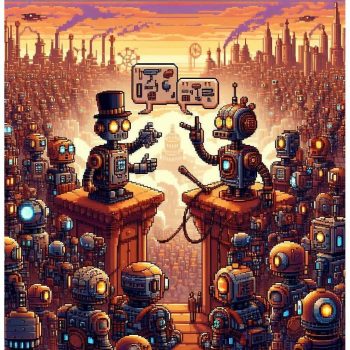 The default writing style of GenAI is becoming ever more prevalent on LinkedIn, both in posts and comments.
This GenAI standard copy has a rhythm that, because it’s becoming so common, is becoming increasingly noticeable.
Sometimes it’s really very obvious we’ve got bots talking to bots – especially on those AI-generated posts where LinkedIn tries to algorithmically flatter us by pretending we’re one of a select few experts invited to respond to a question.
—
Top tip: If you’re using LinkedIn to build a personal / professional brand, you really need a personality – a style or tone (and preferably ideas) of your own. If you sound the same as everyone else, you fade into the background noise.
So while it may be tempting to hit the “Rewrite with AI” button, or just paste a question into your Chatbot of choice, my advice: Don’t.
Or, at least, don’t without giving it some thought.
—
There are lots of good reasons to use AI to help with your writing – it’s an annoyingly good editor when used carefully, and can be a superb help for people working in their second language, or with neurodiverse needs. It can be helpful to spot ways to tighten arguments, and in suggesting additional points. But like any tool, it needs a bit of practice and skill to use well.
But seeing that this platform is about showing off professional skills, don’t use the default – that’s like turning up to a client presentation with a PowerPoint with no formatting.
Put a bit of effort in, and maybe you’ll get read and responded to by people, not just bots. And isn’t that the point of *social* media?
by JCM | 16 Aug, 2024 | Marginalia
 This from John Hegarty resonated. Unpopular opinion, but awards – especially in B2B marketing – are the ad industry equivalent of social media vanity metrics. They may get you marginally more reach (usually long after the campaign’s over), but rarely with your real target audiences.
What’s worse, the positive signals award wins send out can create feedback loops of groupthink about tactics that can actively harm your ability to deliver.
I know it’s tough to demonstrate marketing effectiveness, but award wins rarely prove much beyond that marketing people like something. So unless you’re selling to marketers, they don’t really have much value.
This means awards make perfect sense for agencies (and individuals) to enter – but for their clients? The point of marketing is to improve brand perception and make sales with your buyers, not getting a round of applause from other marketers.
Which is why, often, I find the less glamorous side of marketing is where the real businesses impact can be found.
by JCM | 15 Aug, 2024 | Systems & Technology
There’s some fascinating stuff in this SEO long read, based on impressive research and analysis. Just bear in mind that, as leaked Google documents put it, “If you think you understand how [search algorithms] work, trust us: you don’t. We’re not sure that we do either.”
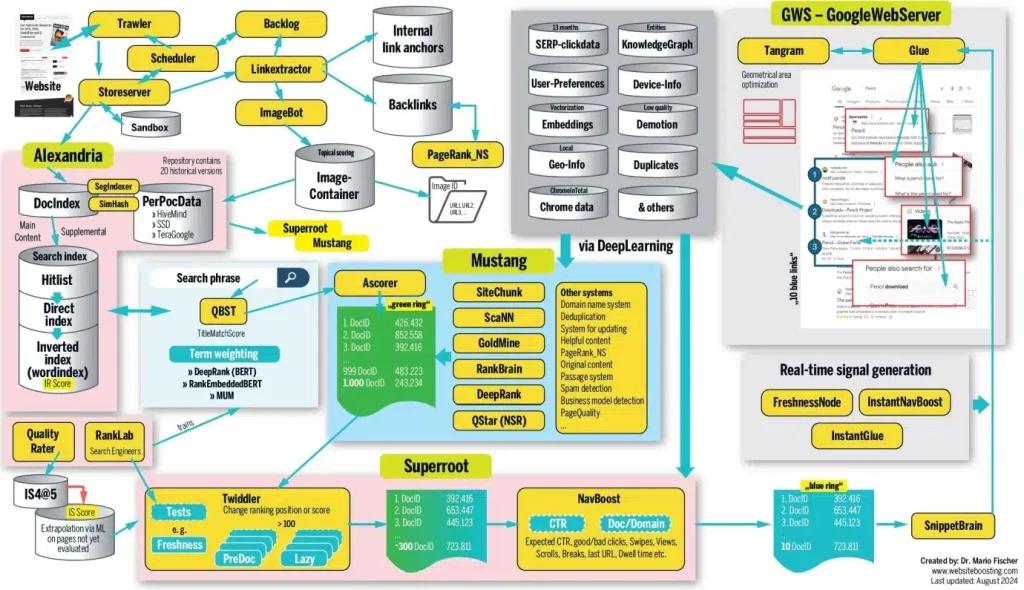 To save you time, the main lesson is that “achieving a high ranking isn’t solely about having a great document or implementing the right SEO measures with high-quality content”. Search results shift in near realtime based on thousands of utterly opaque, interconnected assessments of obscure demand and user intent signals, so there’s only so much website managers can do.
For me, this all confirms a few core content principles:
- Context is king, not content. You can have an amazing page full of astounding insight, but if it doesn’t clearly meet the needs of the user at that moment in time, it will go unviewed.
- Page structure is at least as important as substance – if (human and bot) audiences can’t quickly tell that your page is interesting and relevant, they’ll bounce.
- But don’t worry – the key to success is rarely going to be a single webpage. More important is the authority of the domain and brand.
- This means the impact of content is at least as much about cumulative brand building as it is immediate engagement. Think of the long tail, not just the short spike – and focus your content strategy on building this long-term growth over the short-term quick hit.
- Given so much about how this works is unknown, and so many factors are outside your control, it’s best not to over-think it. Follow all the advice SEO experts offer, and you’ll end up with something so over-engineered it’ll lose its coherence and flow. This will increase bounce rates.
So how to succeed?
Go back to basics: Focus on ensuring your content fulfills a clear audience need (ideally currently unmet by other sources), using language audiences are looking for, presented in ways audiences are likely to engage with, and with clear links to and from other relevant content to help both humans and bots understand its relevance within the broader context.
In other words, SEO may be complex when you dig into the details – but it’s really just a combination of common sense, long-term authority building, and a good bit of luck.
It’s still worth reading the whole thing, though.
